AI in Finance Explained
Introduction to Artificial Intelligence
What is Artificial Intelligence?
Artificial intelligence, or AI, is about creating computer systems that can perform tasks that normally require human intelligence. This includes things like learning from experience, solving problems, understanding language, and recognizing objects in images.
Think of it this way: AI gives a computer the ability to interpret data, learn from it, and use those lessons to achieve specific goals through flexible adaptation.
At its core, AI isn't one single technology. It's a broad field of computer science with many different branches and approaches. The ultimate goal is to build machines that can think and act intelligently, whether that means recommending a movie, driving a car, or helping doctors diagnose diseases.
A Brief History
The idea of intelligent machines has been around for centuries, but the modern field of AI officially began in the summer of 1956. A group of pioneering researchers gathered for a workshop at Dartmouth College to explore the possibility of creating machines that could think. It was here that the term "artificial intelligence" was coined.
AI as a scientific discipline can trace its roots back to the Dartmouth Summer Research Project on Artificial Intelligence, held at Dartmouth College in 1956.
The years that followed were filled with excitement and major breakthroughs, but progress wasn't always a straight line. The field experienced several "AI winters"—periods of reduced funding and interest when the hype outpaced the reality of what the technology could do. Despite these setbacks, dedicated researchers kept pushing forward, laying the groundwork for the AI boom we're experiencing today.

Types of AI Systems
AI systems can be built in several ways. The earliest approaches were quite simple, while modern systems are incredibly complex and can learn on their own.
Rule-Based Systems These are the most basic form of AI. They operate on a set of handcrafted, "if-then" rules created by human programmers. For example, an early chess program might have a rule like, "If the opponent's king is in check, then find a move to get it out of check." These systems are predictable and transparent but are limited by the rules humans write for them. They can't handle situations they weren't explicitly programmed for.
Machine Learning Instead of being explicitly programmed, machine learning (ML) systems learn directly from data. You feed an algorithm a huge amount of data, and it learns to recognize patterns and make predictions. For example, to build a spam filter, you'd show it thousands of emails labeled as "spam" or "not spam." The system learns the patterns associated with spam and can then classify new, unseen emails. Machine learning is a subfield of AI.
Deep Learning Deep learning is a specialized type of machine learning that uses structures inspired by the human brain, called artificial neural networks. These networks have many layers, allowing them to learn very complex patterns from vast amounts of data. Deep learning is the technology behind many of today's most impressive AI applications, including voice assistants and image recognition software. It's a subset of machine learning.
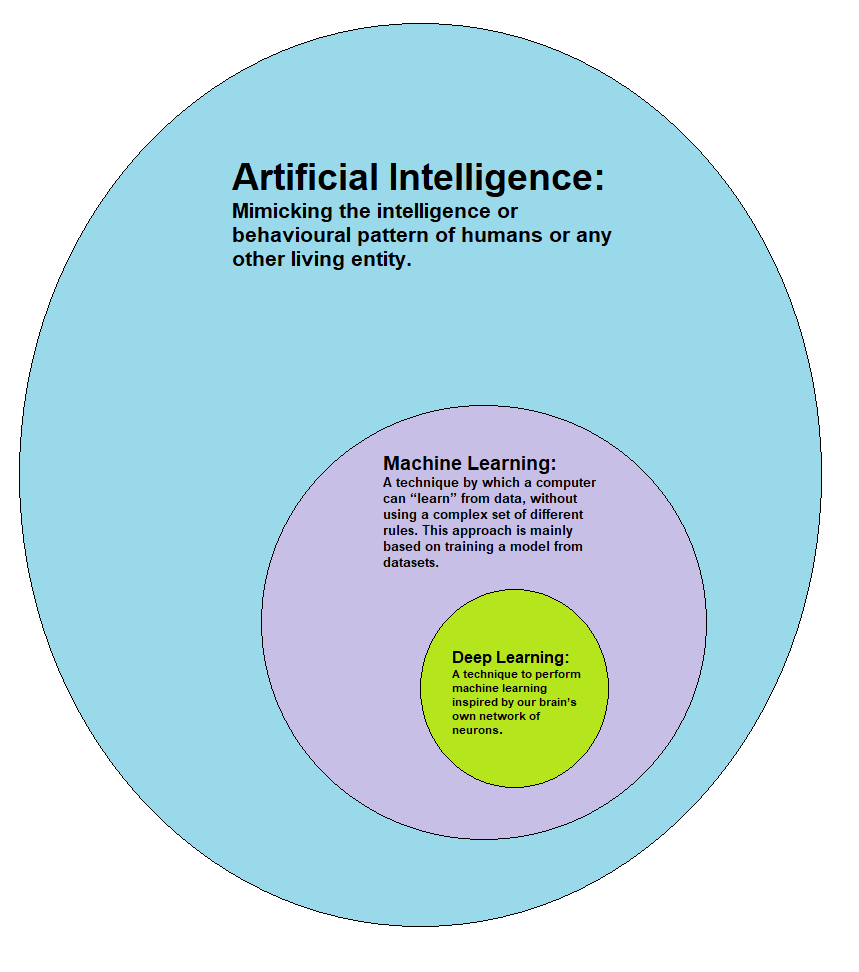
Regardless of the type, all AI systems rely on a few key components: data to learn from, algorithms (the rules or processes the system uses), and the computing power to process it all.
Now, let's test your understanding of these foundational concepts.
What is the primary goal of artificial intelligence?
The term "artificial intelligence" was first coined at a workshop held at which institution in 1956?