AI Engineering for Software Developers
Introduction to AI Engineering
What Is AI Engineering?
Artificial intelligence is no longer just a concept from science fiction; it's a powerful tool being built into the software we use every day. But how does an idea for an AI feature become a real, working product? That's where AI engineering comes in.
AI engineering is the discipline of building and maintaining AI systems. It's less about theoretical research and more about practical application. Think of it as the bridge between the complex world of data science and the structured world of software development. An AI engineer takes a trained machine learning model and builds a robust, scalable system around it so that it can be used by millions of people.
AI engineering serves to create, build, and launch artificial intelligence solutions that resolve practical issues.
This field blends several areas of expertise. It's not enough to know just software development or just data science. An AI engineer needs to be comfortable with both, while also understanding the unique challenges of deploying and managing machine learning models in a live environment, a practice often called MLOps (Machine Learning Operations).
The AI Project Lifecycle
Building an AI system follows a different path than traditional software. While a standard application is built on explicit rules coded by developers, an AI application learns its rules from data. This makes the development process more experimental and iterative.
The lifecycle of an enterprise AI model is a continuous loop, not a straight line from start to finish. It involves constantly collecting data, training models, deploying them, and monitoring their performance to see how they can be improved.
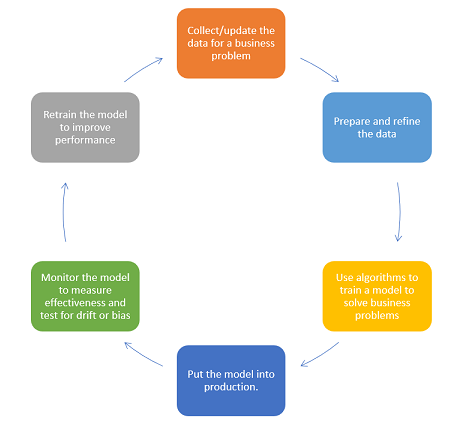
This cycle usually includes these key phases:
- Business Understanding: First, you must define the problem you want to solve and how AI can help. What is the goal?
- Data Collection & Preparation: Next, you gather and clean the data needed to train the model. This is often the most time-consuming part.
- Modeling: Here, you select, train, and test different machine learning models to find the one that best solves the problem.
- Deployment: The chosen model is integrated into a software application and released to users.
- Monitoring & Maintenance: After deployment, the model's performance is tracked. Over time, it may need to be retrained with new data to remain accurate.
Data Is the Foundation
There's a saying in machine learning: "garbage in, garbage out." An AI model is only as good as the data it's trained on. Data engineering is the practice of making sure that data is clean, reliable, and in the right format for a model to learn from.
This involves several steps. Data must be collected from various sources, such as databases or user activity logs. Then, it needs to be cleaned to remove errors, duplicates, and inconsistencies. Finally, it's transformed into a structured format, a process which can involve creating new features—specific, measurable properties of the data—that help the model make better predictions.
High-quality, relevant data is the single most important ingredient for a successful AI project. Without it, even the most advanced model will fail.
A huge part of an AI engineer's job is building and maintaining data pipelines, which are automated systems that perform these collection, cleaning, and transformation steps. A solid data pipeline ensures the model always has fresh, high-quality data for training and making predictions.
Choosing, Testing, and Deploying Models
Once you have good data, you need to select the right model. There isn't a single best model for every problem. The choice depends on the type of data you have and what you're trying to predict. Is it a number, a category, or something else? The engineer's job is to experiment with different models and evaluate their performance.
Evaluation isn't just about accuracy. You also have to consider other factors. How fast does the model make a prediction? How much computing power does it need? A model that's 99% accurate but takes ten seconds to give an answer might be useless for a real-time application.
After a model is selected, it must be deployed, which means making it available to end-users. There are several ways to do this:
- Batch Predictions: The model runs on a schedule (e.g., once a day) to process large amounts of data at once.
- Real-Time Inference: The model is hosted on a server and responds to requests instantly, one by one.
- Edge Deployment: The model runs directly on a user's device, like a smartphone, which is faster and better for privacy.
Building AI Responsibly
With great power comes great responsibility. AI systems can have a huge impact on people's lives, so it's critical to build them ethically. AI engineers must consider the potential for their systems to cause harm, even unintentionally.
Key ethical considerations include fairness, accountability, and transparency. A responsible AI system should make decisions that are unbiased, have clear owners, and are easy for users to understand.
One of the biggest challenges is bias. If a model is trained on biased data, it will learn and amplify those biases. For example, an AI hiring tool trained on historical data from a male-dominated industry might unfairly penalize female candidates. A core part of AI engineering is actively looking for and mitigating these kinds of biases.
Transparency is also crucial. Users should know when they are interacting with an AI and have some insight into how it makes decisions. This builds trust and allows people to contest unfair or incorrect outcomes.
It's time for a quick check-in on what you've learned.
What is the primary role of AI engineering?
In the lifecycle of an AI model, which phase is often the most time-consuming?
AI engineering is a rapidly growing field that combines skills from multiple disciplines to create real-world value. By focusing on robust data pipelines, thoughtful model management, and a strong ethical framework, AI engineers are building the next generation of intelligent software.