AI and Coding Essentials
Introduction to Artificial Intelligence
What Is Artificial Intelligence?
Artificial Intelligence, or AI, is the science of making machines that can think or act intelligently. The core goal is to create systems that can perform tasks that typically require human intelligence, such as learning from experience, solving problems, understanding language, and recognizing objects.
Think of it this way: intelligence is the ability to achieve goals. AI gives machines that ability.
This doesn't mean creating conscious robots like you see in movies. Most AI today is designed for specific tasks. For example, an AI might be excellent at recommending your next song on a music app, but it can't have a conversation about the weather. This is often called 'Narrow AI'. The quest for a more general, human-like intelligence continues, but the tools we have today are already transforming the world.
A Brief History
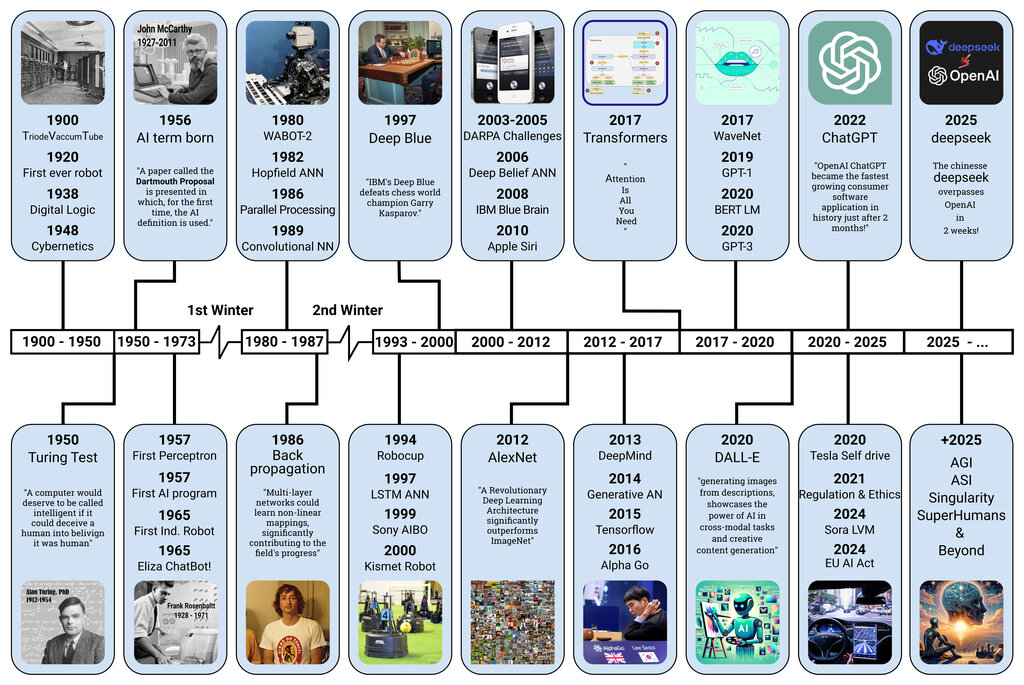
While the idea of artificial beings has existed for centuries in myths and stories, the scientific field of AI is much younger. It officially began in the summer of 1956 at a workshop at Dartmouth College, where the term 'artificial intelligence' was first coined. Early researchers were incredibly optimistic, believing that a machine as intelligent as a human being was just a few decades away.
Progress was slower than expected. The field went through several 'AI winters', periods when funding and interest dried up because the technology couldn't live up to the hype. But in recent decades, two key things changed: the availability of massive amounts of data and the development of powerful computers. These advancements fueled a resurgence, leading to the AI boom we see today.
The AI Family
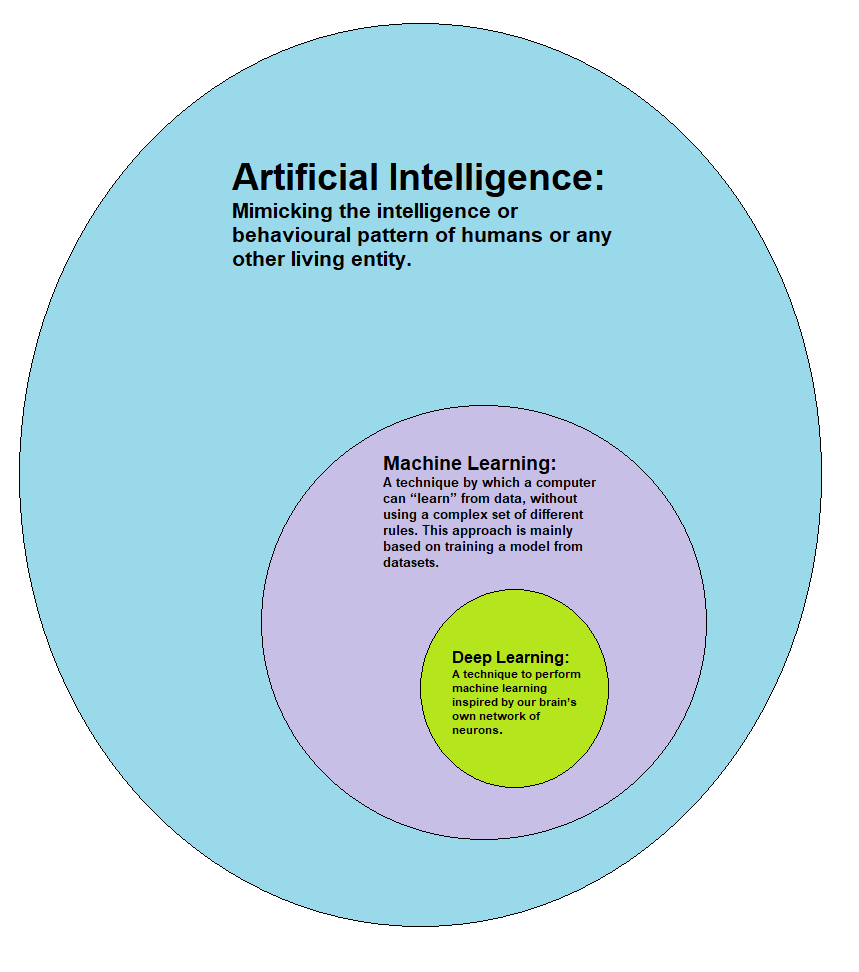
The term AI is often used as a catch-all, but it's actually a broad field with several important subfields. The most common ones you'll hear about are Machine Learning and Deep Learning. It's helpful to think of them as Russian nesting dolls: AI is the largest doll, Machine Learning is a smaller doll inside it, and Deep Learning is an even smaller one inside that.
Machine Learning
noun
The science of getting computers to act without being explicitly programmed. Instead of writing step-by-step instructions, developers 'train' a model by feeding it large amounts of data. The model learns patterns from the data and can then make predictions or decisions.
Deep Learning is a specialized type of machine learning. It uses complex structures called neural networks, which are inspired by the human brain. These networks have many layers that allow them to learn very complex patterns from data. Deep learning is the engine behind many of today's most impressive AI feats, like realistic image generation and advanced voice assistants.
Two other key subfields are Natural Language Processing (NLP) and Computer Vision.
Natural Language Processing (NLP) focuses on the interaction between computers and human language. Its goal is to enable machines to read, understand, and generate language. Think of translation apps, chatbots, and voice assistants like Siri or Alexa.
Computer Vision deals with enabling machines to 'see' and interpret the visual world. This includes tasks like identifying objects in photos and videos, which is crucial for things like facial recognition on your phone and self-driving cars.
Ethical Considerations
As AI becomes more powerful and widespread, it's crucial to think about its impact on society. Building AI responsibly involves navigating several complex ethical challenges.
| Ethical Issue | Description |
|---|---|
| Bias | AI models are trained on data. If that data reflects existing societal biases, the AI will learn and potentially amplify them. For example, a hiring tool trained on past hiring data from a male-dominated industry might unfairly favor male applicants. |
| Privacy | Many AI systems require vast amounts of personal data to function. This raises serious questions about how that data is collected, stored, and used, and how to protect individuals' privacy. |
| Accountability | When an AI system makes a critical mistake, who is responsible? Is it the developer who wrote the code, the company that deployed it, or the user who operated it? Establishing clear lines of accountability is a major challenge. |
| Transparency | Many advanced AI models, especially in deep learning, are 'black boxes'. This means even their creators don't fully understand how they arrive at a specific decision. A lack of transparency can make it hard to trust AI in high-stakes fields like medicine or finance. |
Addressing these issues is a key focus for researchers, policymakers, and developers. The goal is to create AI that is not only powerful but also fair, safe, and beneficial for everyone.
Ready to check your understanding?
What is the primary goal of Artificial Intelligence (AI)?
An AI that excels at recommending songs but cannot have a conversation about the weather is an example of 'Narrow AI'.
This foundation gives you the context to understand how different AI tools work and why they matter.