Agentic AI Explained
Introduction to Agentic AI
Beyond Answering Questions
Most of us think of AI as a tool that responds. We ask a question, and it gives an answer. We give it a prompt, and it generates an image. This is a powerful, but reactive, relationship. The AI waits for our instructions before it does anything.
Agentic AI flips this script. It's a type of artificial intelligence designed to be proactive. Instead of just responding to a command, it can understand a larger goal, break it down into smaller steps, and take action on its own to achieve it. It has agency—the capacity to act independently and make its own choices.
Agentic AI refers to systems that act to achieve goals with minimal human direction.
Imagine you have a simple calculator. It's a perfect tool for a specific task, but it only does exactly what you tell it. You have to input every single number and operation. Now, imagine you have a human personal assistant. You can give them a high-level goal, like "Book a weekend trip to Chicago for next month," and they handle all the details: finding flights, booking a hotel, and maybe even reserving a table at a restaurant. The assistant plans and acts autonomously.
Traditional AI is like the calculator. Agentic AI is like the assistant.
From Following Rules to Making Plans
Traditional AI models are specialists. An image recognition model is fantastic at identifying cats in photos, but it can't write an email. A language model can summarize a document, but it can't book a flight. These systems are trained on massive datasets to excel at a single, well-defined task. They follow a set of learned patterns and rules, executing their function when prompted.
Agentic AI works differently. It's designed to operate in dynamic environments where the steps to success aren't always clear. It can set its own sub-goals, interact with different tools and systems (like a web browser or a calendar app), and adjust its plan based on new information. This ability to reason, plan, and adapt is what sets it apart.
| Feature | Traditional AI | Agentic AI |
|---|---|---|
| Operation | Reactive (Responds to prompts) | Proactive (Takes initiative) |
| Autonomy | Low (Requires human input) | High (Operates independently) |
| Task Scope | Narrow, specific tasks | Complex, multi-step goals |
| Behavior | Follows learned patterns | Plans, reasons, and adapts |
This shift didn't happen overnight. It's the result of decades of progress.
The Path to Autonomy
Early AI was based on hard-coded rules. Think of a chess program from the 1980s. It couldn't learn; it just followed the rules programmed by humans. The next big leap was machine learning, where systems could learn patterns from data without being explicitly programmed for every scenario. This gave us things like spam filters and recommendation engines.
Deep learning, a subset of machine learning, took this even further by using complex neural networks to recognize intricate patterns, powering today's advanced language models and image generators. These models became incredibly capable at their specific tasks.
Agentic AI is the next logical step. It combines the power of these advanced models with the ability to plan and act. Instead of just being a powerful brain for pattern recognition, the AI can now use that brain to interact with the world and pursue goals. It builds on everything that came before, moving from calculation to learning, and now, to action.
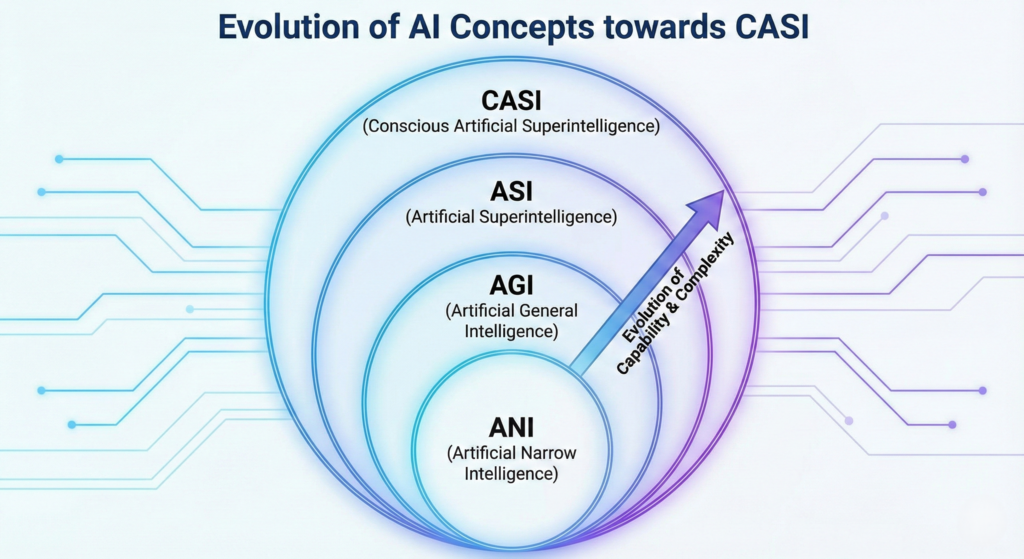
This evolution from rule-based systems to proactive agents opens up a new world of possibilities for how we can use technology to solve complex problems.