Agent-Based Financial Modeling
Introduction to Agent-Based Modeling
What Is Agent-Based Modeling?
Imagine trying to understand a traffic jam by only looking at city-wide traffic data. You'd see averages and general flows, but you'd miss the crucial details: the one driver who braked suddenly, the chain reaction that followed, and how individual decisions created a massive slowdown. Traditional modeling often takes this top-down view, focusing on the big picture with broad equations.
Agent-based modeling (ABM) flips the script. It's a bottom-up approach that simulates a system by focusing on its individual components, called "agents." An agent is an autonomous entity with its own set of rules and behaviors. It could be a driver on a highway, a bird in a flock, a consumer in a market, or a cell in an organism.
Agent-based modeling is a simulation technique that focuses on the behavior of individual agents and their interactions with each other and with their environment.
Instead of writing one giant equation for the entire system, you give each agent a few simple instructions. For example, a driver agent might follow rules like: "Maintain a safe following distance," "Don't exceed the speed limit by more than 10%," and "Change lanes if the car ahead is too slow."
These agents then interact with each other and their environment. The simulation runs, and we observe what happens at the system level. The goal isn't to predict the exact action of any single agent, but to see the large-scale patterns that emerge from all their individual interactions.
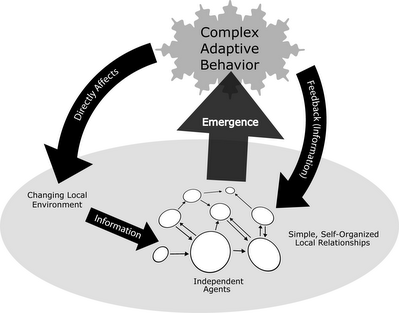
Simple Rules, Complex Results
The most powerful concept in ABM is emergence. This is when complex, system-wide behavior arises from the simple, local rules followed by individual agents, without any central coordination. The system's behavior is more than the sum of its parts.
Think of a flock of starlings. No single bird acts as a leader, and no one has a blueprint for the flock's mesmerizing aerial dance. Each bird follows a few basic rules: stay close to your neighbors, avoid collisions, and fly in the same general direction. From these simple individual behaviors, the intricate and coordinated movement of the flock emerges.
This phenomenon is everywhere. Ant colonies build complex nests, traders create market bubbles, and people form neighborhoods, all based on individual decisions and interactions. Emergence is often counterintuitive and difficult to predict with traditional methods, which is why ABM is so valuable.
A Different Way to Model
Traditional modeling often uses equations to describe a system's behavior from the top down. For example, an economist might use a set of differential equations to model an entire economy's inflation rate or GDP growth. This approach is powerful for systems that are stable and where the components are relatively uniform.
However, these models can struggle when a system is complex, dynamic, and full of diverse individuals whose interactions are key. They often rely on assumptions of "average" behavior, which can miss the mark when just a few unusual actors can change the entire system's trajectory.
| Feature | Traditional Modeling | Agent-Based Modeling |
|---|---|---|
| Approach | Top-down (macro) | Bottom-up (micro) |
| Focus | System-level equations | Individual agent rules |
| Unit of Analysis | The whole system | The autonomous agent |
| Behavior | Assumes rational, average behavior | Allows for diverse, adaptive behavior |
| Best For | Stable, predictable systems | Complex, dynamic systems |
ABM excels where traditional models falter. It's designed to explore systems where the interactions are the most important part of the story. This makes it a flexible tool used across many different fields.
Where ABM Is Used
The power of ABM lies in its versatility. Ecologists use it to model the spread of forest fires or the predator-prey dynamics in an ecosystem. Each tree or animal is an agent with its own rules for survival and reproduction.
Sociologists and urban planners model the growth of cities and the formation of social networks. Agents representing people decide where to live or who to connect with based on factors like income, proximity, or social preferences. These models can help us understand segregation patterns or the spread of information (or misinformation) through a population.
In economics, ABM can simulate financial markets where trader agents have different strategies and levels of risk tolerance. This helps explain phenomena like market crashes that are hard to predict with traditional equilibrium models. It's also used to study supply chains, consumer behavior, and the effects of economic policies.
In all these cases, ABM provides a virtual laboratory to test ideas and ask "what if" questions in a complex world.
What is the fundamental approach of Agent-Based Modeling (ABM)?
In the context of ABM, the phenomenon where complex, system-wide patterns arise from the simple, local interactions of individual agents is known as ______.
By starting with the individual, agent-based modeling provides unique insights into the behavior of the whole.