Aeronautics and the Mechanics of Flight
Aerodynamics and Fluid Dynamics
The Rules of Flow
Air might seem weightless and invisible, but it's a fluid that follows strict physical laws. To understand how an airplane flies, we first need to understand how air moves. The most fundamental rule is the conservation of mass. Simply put, you can't create or destroy air out of nothing.
This principle is captured by the continuity equation. It's a way of saying that for any given volume of space, the rate at which mass enters must equal the rate at which it leaves, plus any change in the mass stored inside. For airflow around a wing, we can often assume the density is constant, which simplifies things.
Think of a river. Where the channel narrows, the water speeds up. The same thing happens to air. As it flows over the curved top surface of a wing, it's forced into a slightly more constricted path than the air flowing under the flatter bottom surface. According to the continuity equation, this means the air on top must accelerate.
Momentum and Pressure
Knowing that mass is conserved is only half the story. We also need to account for the forces acting on the air. This is where the principle of conservation of momentum comes in, which is essentially Newton's second law () applied to fluids.
The governing equations for this are a set of notoriously complex differential equations called the Navier-Stokes equations . In essence, they describe how the velocity of a fluid changes in response to different forces. These forces include pressure gradients (air moving from high to low pressure), viscosity (the internal friction of the air), and external forces like gravity.
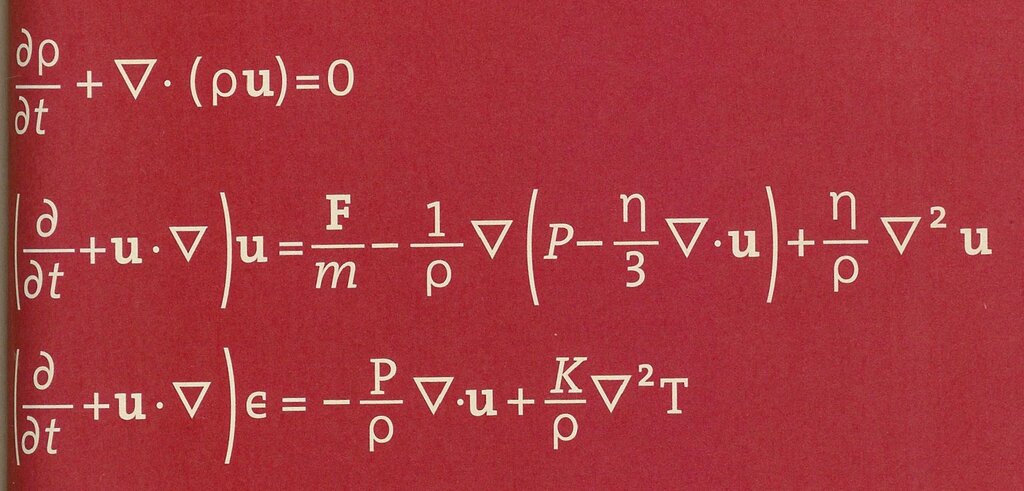
Solving these equations for something as complex as an airplane requires massive computational power. But the core idea is simple: forces change the momentum of the air. A wing is a carefully shaped object designed to apply forces to the air, pushing it downward. By Newton's third law, the air pushes the wing upward with an equal and opposite force. This upward push is lift.
This also connects to Bernoulli's principle. Because the air accelerates over the top of the wing, its pressure drops. The slower-moving air below the wing has a higher pressure. This pressure difference creates a net upward force on the wing.
Circulation and the Real World
While Bernoulli's principle and Newton's laws both provide correct explanations for lift, a more complete model involves a concept called circulation. Imagine the airflow around a wing as a combination of a straight, uniform flow and a swirling, vortex-like flow that circulates around the airfoil. The strength of this circulation determines the amount of lift generated.
But what causes this circulation to start? When an airfoil first starts moving through the air, the flow tries to wrap around the sharp trailing edge from the bottom to the top. This creates an unstable, high-velocity situation that the air can't maintain. To resolve this, nature enforces the Kutta condition .
The Kutta condition states that a body with a sharp trailing edge moving through a fluid will create about itself a circulation of sufficient strength to hold the rear stagnation point at the trailing edge.
In simpler terms, the air must flow smoothly off the sharp trailing edge of the wing. To make this happen, a small vortex, called the starting vortex, is shed from the trailing edge. By conservation of angular momentum, this induces an equal and opposite circulation around the airfoil itself. This circulation is what makes the velocity higher on top and lower on the bottom, generating lift.
The Stickiness of Air
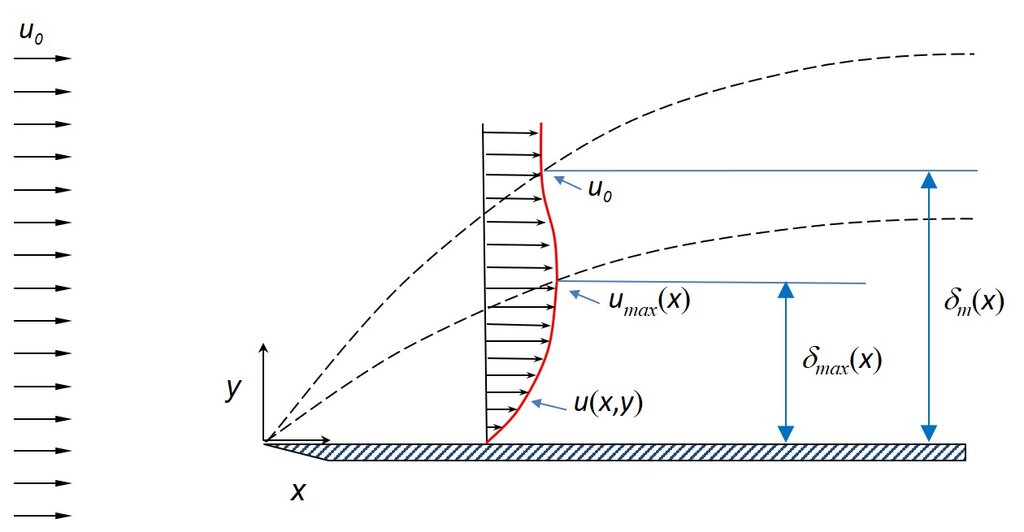
So far, we've mostly treated air as an ideal fluid. But in reality, air has viscosity, a measure of its internal friction or "stickiness." This viscosity is crucial because it creates a thin layer of slow-moving air right next to the wing's surface, known as the [{
The behavior of this boundary layer is one of the most important factors in aerodynamics. Its characteristics are determined by the [{
At low Reynolds numbers, the flow is smooth and orderly, called laminar flow. As the Reynolds number increases (due to higher speed, larger size, or lower viscosity), the boundary layer can become chaotic and turbulent. A turbulent boundary layer has more energy and is less likely to separate from the airfoil surface, which can help prevent a stall. However, it also creates more friction drag.
Aircraft designers must carefully manage the boundary layer and the transition from laminar to turbulent flow to balance lift generation against drag, ensuring efficient flight across a wide range of atmospheric conditions and speeds.
Time to test your knowledge of these core aerodynamic principles.
According to the continuity equation, what happens to the air flowing over the curved top surface of a wing compared to the air flowing underneath?
What is the primary role of the Kutta condition in generating lift?