Advancing Through the Skies
Advanced Flight Dynamics
Beyond Straight and Level
In steady, unaccelerated flight, lift equals weight and thrust equals drag. But flying is rarely that simple. The real art of piloting lies in managing the interplay of these forces when the aircraft is accelerating, decelerating, climbing, descending, or turning. Every maneuver is a dynamic conversation between the pilot, the controls, and the air.
Let's start with a simple turn. To change direction, an aircraft must bank. By banking, the pilot redirects a portion of the wing's total lift from a purely vertical direction to a horizontal one. This horizontal component of lift is what pulls the aircraft into the turn. But this action comes with a cost: with less lift directed vertically, the aircraft will want to descend. To maintain altitude, the pilot must increase the total lift by increasing the angle of attack.
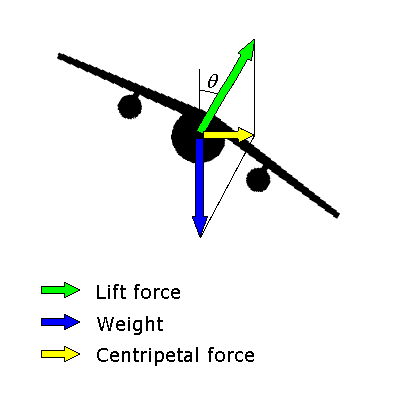
This demand for more lift has a tangible effect. The aircraft's structure, and the pilot inside it, experience an increased force. This is known as the load factor, or G-loading. It's a multiple of the normal force of gravity. In a 45-degree banked turn, you and your aircraft feel 1.4 times heavier. At 60 degrees, the load factor is 2 Gs – you feel twice your normal weight.
Stalls Under Pressure
An aircraft's wing stalls when it exceeds its critical angle of attack, not because its airspeed is too low. While we learn stall speeds for straight-and-level flight, these are minimums. The actual stall speed changes with the load factor. Because you need to generate more lift in a turn to counteract weight, you're operating closer to the critical angle of attack for any given airspeed. This is why a steep turn can lead to an at an airspeed well above the normal stall speed.
The relationship is precise. Stall speed increases with the square root of the load factor. If your aircraft experiences a 2G load factor, your stall speed increases by about 41%. If you somehow managed a 4G turn, your stall speed would double.
Increased load factor directly increases the speed at which the wing will stall.
Balance and the Power Curve
An aircraft's stability is largely determined by the position of its center of gravity (CG) relative to its center of lift. A forward CG makes the aircraft more stable but less maneuverable. It wants to fly straight and requires more control input to change its pitch. An aft CG reduces stability, making the aircraft more responsive but potentially twitchy and difficult to control. In extreme cases, an aft CG can make stall recovery impossible.
This balance between stability and control extends to how we manage energy. An aircraft's drag is composed of two types: parasite drag, which increases with speed, and induced drag, which is a byproduct of lift and decreases as speed increases. When you plot these against each other, you get a total drag curve, often called the 'power curve'.
On the right side of this curve, in the 'region of normal command,' things are intuitive: to fly faster, you add more power; to fly slower, you reduce power. But on the left side, the region of reversed command, things get strange. Here, induced drag is dominant. To fly slower, you must increase power to overcome the rapidly rising drag. This is the regime of flight for final approach and short-field landings. The pilot uses pitch to control airspeed and power to control the descent rate. It's a fundamental skill for precision landings.
Understanding Your Limits
Every aircraft has an operating envelope defined by its V-speeds. Beyond the basics, several key speeds relate directly to structural limits and advanced dynamics:
-
Va (Design Maneuvering Speed): This is the speed at which full, abrupt control inputs can be made without overstressing the airframe. Flying at or below Va ensures that the aircraft will stall before exceeding its structural load limits. It's not a fixed number; it decreases as weight decreases.
-
Vno (Maximum Structural Cruising Speed): This is the top of the 'green arc' on the airspeed indicator. It's the maximum speed for normal operations in smooth air. Flight above Vno should only be conducted with caution and in calm conditions.
-
Vne (Never Exceed Speed): The 'red line.' Flying at or beyond this speed risks structural failure due to aerodynamic forces like flutter, where control surfaces can begin to oscillate uncontrollably.
Ready to test your understanding of these advanced concepts?
What is the primary reason a pilot must increase the angle of attack during a constant-altitude, banked turn?
An accelerated stall occurs at an airspeed significantly higher than the normal, straight-and-level stall speed. Why is this?
Mastering these interactions between forces, balance, and speed is what separates a novice from an experienced pilot. It's about thinking ahead of the aircraft and understanding not just what it is doing, but what it will do next.