Advancing Bharatnatyam Techniques
Advanced Jathi Patterns
The Pulse of Three Speeds
You've mastered the building blocks of Bharatanatyam, the adavus. Now, we weave them into intricate tapestries of rhythm called Jathis. Think of Jathis as the mathematical soul of Nritta, where pure dance meets complex patterns. The first challenge in elevating your Jathis is mastering Trikala, the execution of a single rhythmic pattern in three distinct speeds.
Trikala
noun
The execution of a rhythmic phrase (Jathi) in three speeds: Vilambita (slow), Madhya (medium), and Druta (fast), without altering the underlying beat count.
Moving from Vilambita Kala to Druta Kala is more than just getting faster. It’s a test of precision and stamina. In the slow speed, every movement is deliberate and clear. As you transition to Madhya and then Druta, the challenge is to maintain that same clarity and posture. Your Araimandi must remain stable, your arm extensions sharp, and your footwork precise, even as the tempo triples.
Mastering Trikala feels like holding a conversation with time itself. First you speak slowly and deliberately, then at a normal pace, and finally in a rapid, energetic burst, all while conveying the same core idea.
Shifting Rhythmic Gears
Beyond speed, a dancer must command different rhythmic cycles, or Gatis. You are likely most comfortable in Chatusra Gati, the familiar 4-beat cycle. Now, we introduce a new flavour: , a graceful and slightly more complex 7-beat cycle. The ability to switch between these Gatis seamlessly is a hallmark of an advanced dancer.
The foundational sollukattu, or rhythmic syllables, for Misra Gati is Ta Ki Ta Dha Ri Ki Na. This seven-count pattern feels very different from the steady four-count of Ta Ka Dhi Mi. Practicing Jathis in Misra Gati will challenge your internal clock and push you to find a new kind of rhythmic stability.
| Gati Name | Sollukattu (Example) | Beat Count |
|---|---|---|
| Chatusra | Ta Ka Dhi Mi | 4 |
| Misra | Ta Ki Ta Dha Ri Ki Na | 7 |
As you practice, focus on the transition. A common exercise is to perform a Jathi in Chatusra Gati for two cycles, and then immediately switch to Misra Gati for one cycle, all without breaking the flow or losing your posture. This builds the mental and physical agility needed for complex performance pieces.
The Sound of Precision
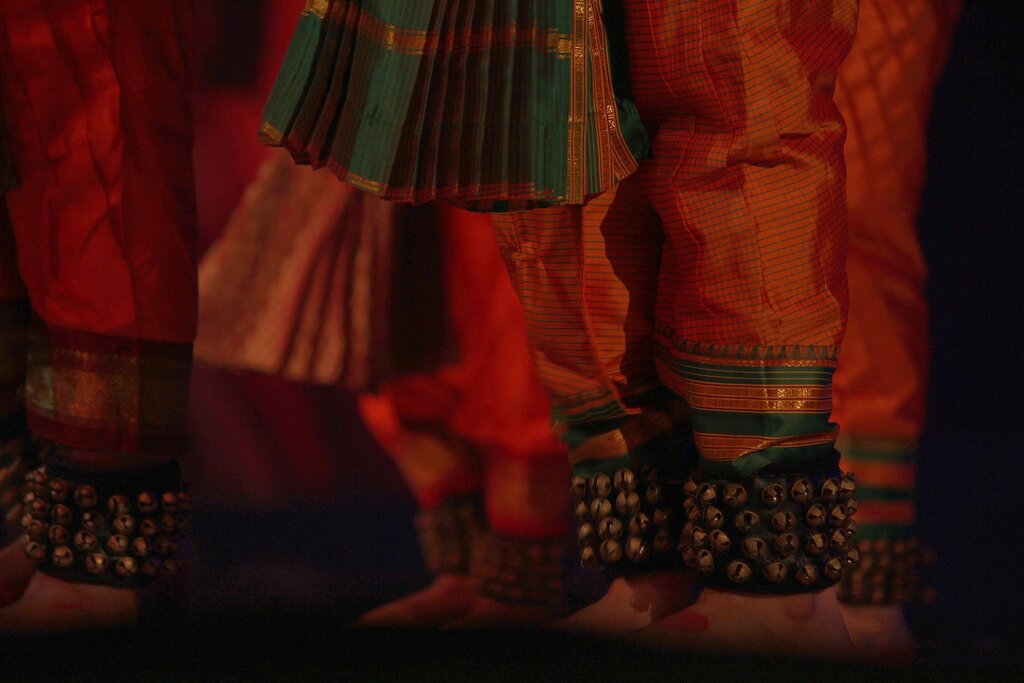
In advanced Nritta, your feet are not just moving—they are instruments. The sound they produce is as important as the movements themselves. This is especially true for Mettu Adavus, which focus on the heel. The goal is to create a sharp, resonant sound with each heel contact, a clear 'mett-mett' that cuts through the music. This requires precise weight transfer and ankle control.
A soft, muffled 'Mettu' suggests a lack of control or energy. A sharp, clear 'Mettu' signals confidence and mastery.
This principle extends to your full footwork, or 'Tattu'. Each stamp should be a full, flat contact with the floor, producing a deep, authoritative sound. As you execute Jathis at high speeds, fight the tendency for these sounds to become sloppy or rushed. Every single beat, whether a Tattu or a Mettu, must be distinct and intentional. This is the difference between simply dancing the steps and truly commanding the rhythm.
Let's check your understanding of these advanced concepts.
What is the primary challenge when performing a Jathi in Trikala?
A rhythmic cycle with a 7-beat pattern, often using the sollukattu 'Ta Ki Ta Dha Ri Ki Na', is known as ________.
By integrating these elements—Trikala precision, Gati transitions, and sonic clarity—your Nritta will evolve from a sequence of steps into a powerful and captivating rhythmic performance.