Advanced Textile Science and Material Engineering
Polymer Chemical Structures
From Thread to Molecule
Every fiber, whether it's from a cotton plant or a chemical plant, is built from long-chain molecules called polymers. Think of a polymer as a train and each individual car as a smaller molecule, or monomer The process of linking these monomers together is called polymerization. The final length of that train, or the number of monomer units in the polymer chain, is known as the degree of polymerization (DP).
A higher DP generally means a longer polymer chain, which results in a stronger and more durable fiber. It's like having a longer rope – it can withstand more force before breaking.
For example, the cellulose in cotton has a very high DP, often in the thousands. This contributes to cotton's renowned strength. In contrast, rayon, a regenerated cellulosic fiber, has its DP intentionally reduced during manufacturing, which is one reason it's typically weaker than cotton, especially when wet.
An Orderly Arrangement
It's not just the length of the polymer chains that matters, but also how they're arranged next to each other. Within a single fiber, these chains can exist in two different states: crystalline and amorphous.
Imagine a box filled with uncooked spaghetti. The strands are mostly parallel and tightly packed. This is like a crystalline region. The polymer chains are highly ordered and lie close together, allowing strong intermolecular forces to form between them. These regions give a fiber its strength, stiffness, and stability.
Now, imagine that same spaghetti after it's been cooked and dumped in a colander. The strands are a tangled, disordered mess. This is like an amorphous region. The polymer chains are randomly arranged with more space between them. These regions provide flexibility, elasticity, and accessibility for things like water and dye molecules.
Most fibers are semi-crystalline, meaning they have a mix of both regions. The ratio of crystalline to amorphous areas is a crucial factor that determines a fiber's properties. A highly crystalline fiber like Kevlar is incredibly strong, while a highly amorphous one like rubber is very elastic.
Natural vs. Synthetic Structures
Let's see how these concepts apply to real-world fibers.
Cellulose and Hydrogen Bonds Cotton is almost pure cellulose, a polymer made of glucose monomers. The cellulose molecule is covered in hydroxyl (-OH) groups. These groups are polar, meaning they have a slight electrical charge. The slightly positive hydrogen of one group is strongly attracted to the slightly negative oxygen of a group on a neighboring chain. This attraction is called a hydrogen bond
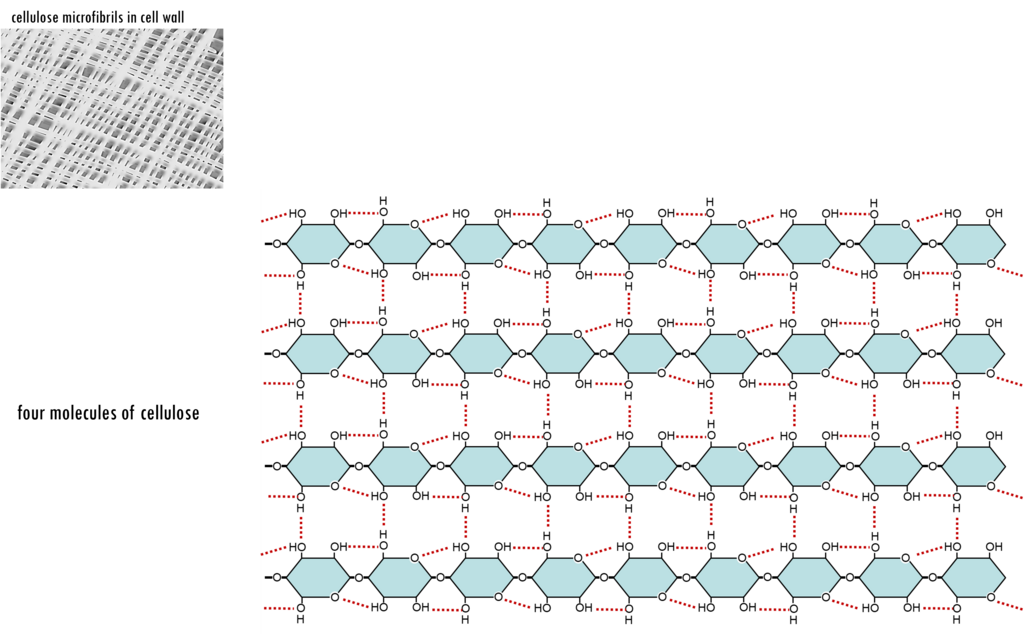
Individually, hydrogen bonds are weak, but in cellulose, there are thousands of them holding the polymer chains tightly together in its crystalline regions. This network of bonds is what gives cotton its strength. These same hydroxyl groups also love to bond with water molecules, which is why cotton is so absorbent and feels comfortable to wear in the heat.
Synthetic Chains and Heat Now consider synthetic polymers like polyester or polyamide (nylon). Their chemical structures are very different. They are formed through step-growth polymerization and lack the abundance of hydroxyl groups found in cellulose. This makes them hydrophobic, or water-repelling. Instead of absorbing moisture, they wick it away from the skin, which is why they are popular for activewear.
Synthetic polymers also have a critical property called the (). This is the temperature at which the amorphous regions of the polymer transition from a hard, rigid, "glassy" state to a soft, flexible, "rubbery" state. Below its , a polymer is brittle. Above it, it's pliable.
This is incredibly important in textile processing. For instance, heat-setting polyester fabric above its allows the manufacturer to lock in a permanent shape, like pleats, or to stabilize the fabric against shrinkage. It's also why you need to be careful with your iron settings – ironing a synthetic fabric above its can cause irreversible changes to its structure.
Understanding these molecular structures explains why we choose certain fibers for specific jobs. We pick cotton for bath towels because of its absorbent hydrogen bonds, and we choose polyester for a running shirt because its hydrophobic chains keep us dry.
Time to check your understanding of these core concepts.
The long-chain molecules that form the basis of all fibres are called ________.
Why is rayon generally weaker than cotton?
By understanding the chemistry of fibers, from the degree of polymerization to the arrangement of their chains, we gain a much deeper appreciation for why fabrics behave the way they do.