Advanced Quantum Mechanics and Field Theory
Quantum Field Theory
From Particles to Fields
In quantum mechanics, we often talk about particles like electrons as if they are tiny, distinct points. Quantum Field Theory (QFT) asks us to zoom out. Instead of point-like particles, imagine the universe is filled with a collection of invisible, overlapping fields. There's an electron field, a photon field, and a field for every other fundamental particle.
So, what is a particle? In QFT, a particle is just a localized vibration or excitation in its corresponding field. An electron is a ripple in the electron field. A photon is a ripple in the electromagnetic field. This process of treating fields as the fundamental objects and deriving particles from them is called field quantization.
Think of a quiet pond. The water is like a field at rest. If you tap the water, you create a ripple. That ripple is like a particle—it's a localized disturbance that can travel and carry energy.
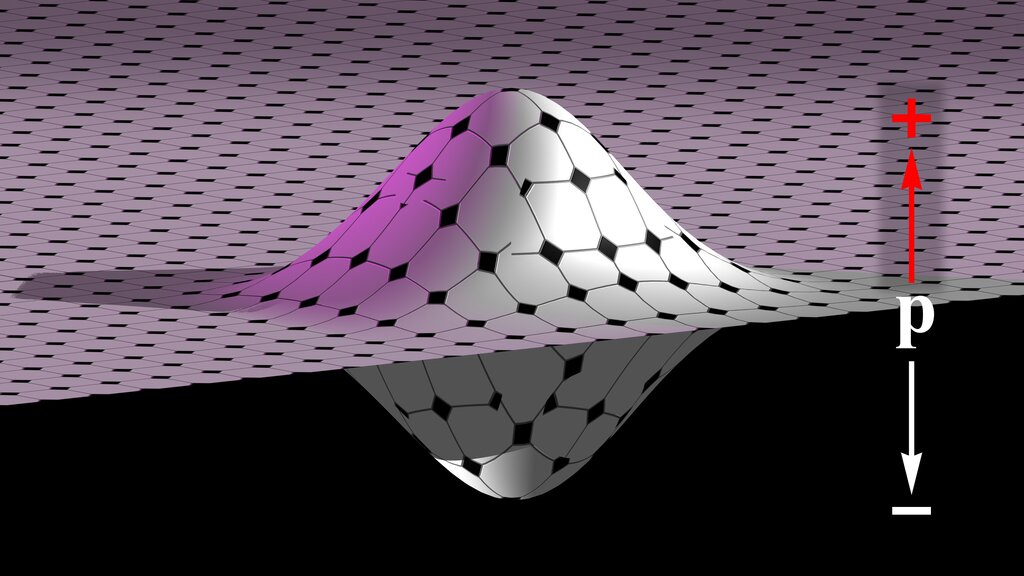
Quantization means these ripples can't have just any amount of energy. They come in discrete packets, or quanta. A ripple with one packet of energy is one particle. A ripple with two packets is two particles. This is how QFT explains the existence of particles while treating fields as the fundamental reality.
The Language of Interactions
If particles are just ripples in fields, how do they interact? When a ripple in the electron field meets a ripple in the positron field, they can annihilate each other and create ripples in the photon field. Describing these interactions mathematically is incredibly complex. The equations are long and difficult to solve directly.
Physicist Richard Feynman developed a brilliant visual shortcut: Feynman diagrams. These simple drawings are more than just pictures; they are a graphical representation of the complicated math used to calculate the probability of a particle interaction.
Let's break down the diagram above, which shows two electrons scattering off each other.
- Straight lines represent matter particles like electrons.
- Wavy lines represent force-carrying particles (bosons), in this case, a virtual photon (γ), which carries the electromagnetic force.
- Vertices are points where lines meet. This is where an interaction happens—a particle is emitted or absorbed.
The diagram shows two electrons approaching, exchanging a photon, and then flying apart. Each line and vertex in the diagram corresponds to a specific term in a very long equation.
Approximating Reality
Even with Feynman diagrams, calculating the exact outcome of an interaction is often impossible. The full calculation would involve an infinite number of possible diagrams, representing increasingly complex virtual particle exchanges.
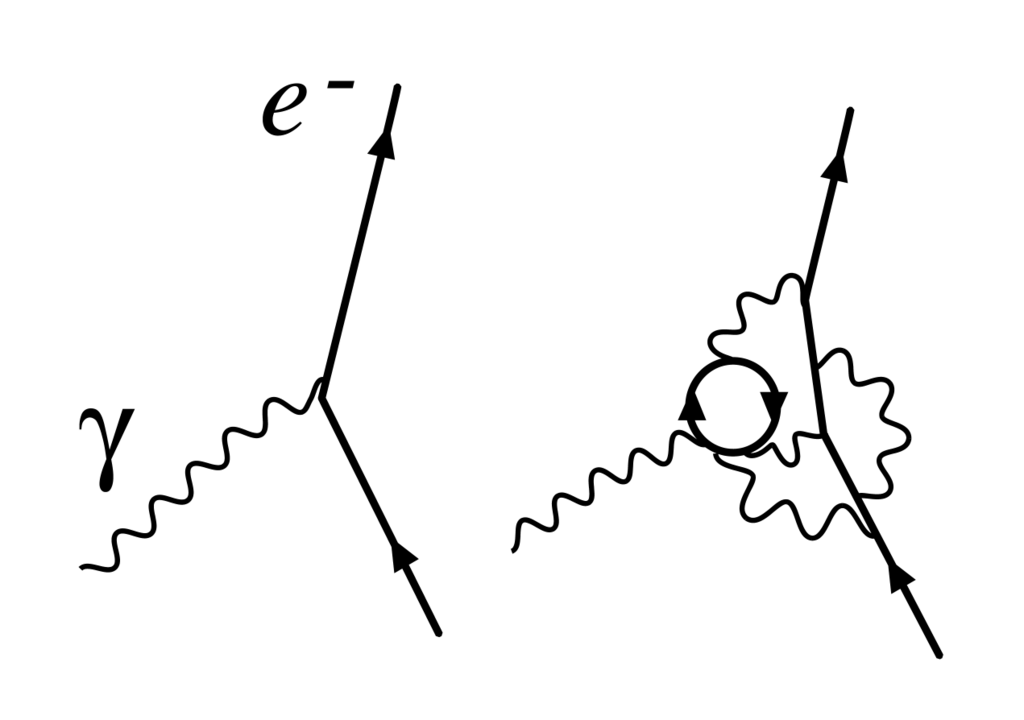
This is where perturbation theory comes in. It's a method for finding an approximate solution to a problem by starting with the exact solution of a simpler, related problem. In QFT, the simplest interaction is represented by the simplest Feynman diagram. More complex diagrams, involving more vertices and virtual particles, represent smaller "perturbations" or corrections to the initial calculation.
Luckily, for many forces like electromagnetism, the interactions get weaker with each additional vertex. This means that the simplest diagrams contribute the most to the final answer, and we can get a very accurate prediction by calculating just the first few diagrams in the series. By adding up the contributions from a few diagrams, we can approximate the true answer with incredible precision.
What is the fundamental premise of Quantum Field Theory (QFT)?
According to QFT, a single photon is best described as:
Quantum Field Theory combines special relativity and quantum mechanics to provide our most fundamental description of the universe. It's the foundation of the Standard Model of particle physics and a crucial tool in condensed matter physics.