Advanced Projectile Motion for JEE
Vector Trajectory Analysis
Motion in Two Dimensions
When an object is launched into the air, its path is governed by a few key factors: its initial speed, the angle it's launched at, and the constant downward pull of gravity. We can describe this entire journey using vectors, which elegantly handle both magnitude and direction.
Let's define our coordinate system. The horizontal direction is represented by the unit vector , and the vertical direction by . An object is launched with an initial velocity at an angle to the horizontal. We can break this initial velocity into its components.
The only force acting on the projectile (ignoring air resistance) is gravity. It acts straight down. So, the acceleration vector is constant and points in the negative direction.
There is one key element to projectile motion---and it is this: You can treat the horizontal motion (x-direction) and the vertical motion (y-direction) as two separate one-dimensional kinematics problem.
With the initial velocity and constant acceleration defined, we can find the velocity and position of the projectile at any time by integrating the acceleration. Recall the kinematic relationship .
Integrating the velocity vector gives us the position vector , assuming the projectile starts from the origin . The general relationship is .
The Equation of the Trajectory
The position vector gives us the x and y coordinates in terms of time, which is known as a parametric representation. To find the shape of the path itself, we need to eliminate the time variable, , and express directly as a function of . This gives us the equation of the trajectory.
From the horizontal position equation, we can solve for : . Now, we substitute this expression for into the vertical position equation.
Simplifying this gives the classic parabolic trajectory equation.
Curvature of the Path
The path of a projectile isn't a perfect circle; its curvature changes. It's sharpest at the peak and flattens out elsewhere. We can quantify this curvature at any point by finding the at that point. This is the radius of a circle that would perfectly match the curve at that specific spot.
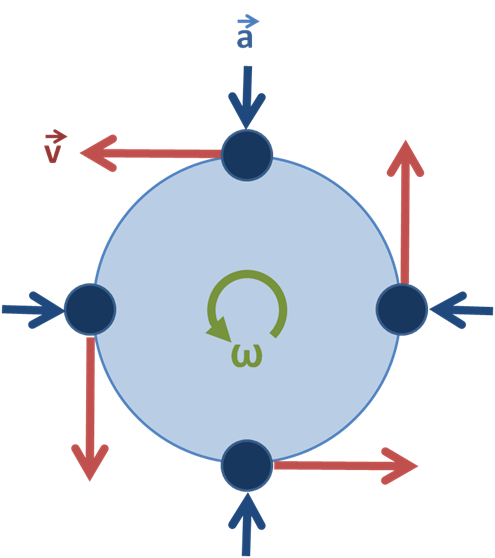
To find it, we use the concept of centripetal acceleration, which is always directed towards the center of the curve. The component of gravitational acceleration that is perpendicular to the velocity vector provides this centripetal acceleration.
Let the velocity vector make an angle with the horizontal at some point. The gravitational acceleration vector points straight down. The component of perpendicular to is . This component acts as the centripetal acceleration, .
We know that centripetal acceleration is related to the speed and the radius of curvature by the formula . By setting our two expressions for equal, we can solve for .
At the very peak of the trajectory, the vertical velocity is zero. This means and . The speed is just the horizontal component, . The radius of curvature is at its minimum here: .
Let's check your understanding of these vector concepts.
An object is launched with an initial speed at an angle to the horizontal. What is the initial velocity vector, ?
Ignoring air resistance, what is the acceleration vector for a projectile at any point during its flight? (where is the magnitude of gravitational acceleration)
By breaking motion into independent horizontal and vertical components, vectors provide a powerful framework for analyzing projectile motion and understanding the elegant parabolic paths objects take under gravity.