Advanced Polymath Computer Science Engineering
Advanced Problem-Solving Techniques
Breaking Down Complexity
Many tough problems in computer science seem like impossible walls. You can't just run at them head-on. Instead, you need smarter strategies. The best engineers have a toolkit of advanced techniques for dismantling these walls, brick by brick. These aren't just about writing code; they're about fundamentally changing how you see and approach a problem.
Divide and Conquer
One of the most powerful strategies is to break a large, complex problem into smaller, more manageable sub-problems. This is the core idea of divide-and-conquer. It follows three simple steps:
- Divide: Break the main problem into several smaller, independent sub-problems of the same type.
- Conquer: Solve the sub-problems. If the sub-problems are still too big, you apply the divide-and-conquer strategy to them recursively until they become simple enough to solve directly.
- Combine: Merge the solutions of the sub-problems to form the solution for the original problem.
Mergesort is a classic example. To sort a large list, you first divide it in half. Then you divide those halves in half, and so on, until you have lists with only one element. A list of one is already sorted. Then, you conquer and combine by merging these small, sorted lists back together in the correct order until you have your final, fully sorted list.
This technique is incredibly efficient for certain classes of problems and is used everywhere from data processing to computer graphics.
Working with Constraints
Not all problems can be neatly divided. Some are messy webs of interdependent rules and limitations. Think about creating a university course schedule. You can't just schedule classes randomly. You have rules:
- A specific class must be in a room large enough for all its students.
- A professor can't teach two different classes at the same time.
- No two classes can be in the same room at the same time.
This is a Constraint Satisfaction Problem (CSP). A CSP is defined by a set of variables, a domain of possible values for each variable, and a set of constraints that the solution must satisfy.
| Component | Description | Scheduling Example |
|---|---|---|
| Variables | The items you need to make decisions about. | Each class section (e.g., CS101-01). |
| Domains | The set of possible values for each variable. | All available time slots and classrooms. |
| Constraints | The rules that limit which values variables can take. | A professor can't be in two places at once. |
Solving CSPs often involves a systematic search. A common technique is backtracking. You assign a value to a variable, then move to the next. If you hit a point where no valid value can be assigned to a variable without violating a constraint, you “backtrack” to the previous variable and try a different value. You explore a tree of possibilities, pruning branches that violate constraints until you find a path that works.
CSPs are used to solve complex real-world logistics, from airline scheduling and factory production planning to resource allocation in computer networks.
Lateral Computing
Sometimes, the best solution isn't found by breaking a problem down or meticulously searching through possibilities. It's found by reframing the problem entirely. This is the essence of lateral computing, which applies the principles of lateral thinking to technical challenges. Instead of digging the same hole deeper (vertical thinking), you start digging in a new place.
Consider the classic nine dots puzzle: connect nine dots arranged in a 3x3 square using four straight lines without lifting your pen. Most people fail because they implicitly assume the lines must stay within the bounds of the square. The solution requires drawing lines that extend beyond the dots.
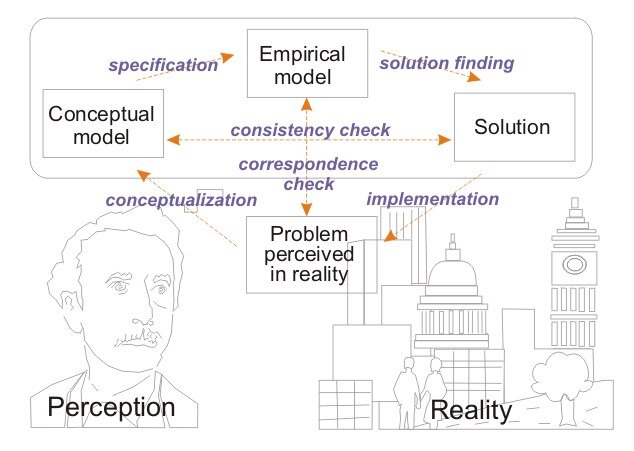
In computing, this means questioning your assumptions. Do you really need to sort the entire dataset, or just find the top ten items? Is there a way to approximate a solution that's “good enough” instead of finding the perfect one? Can you transform the problem into an entirely different domain where it's easier to solve?
Lateral computing doesn't have a fixed algorithm. It's a mindset that encourages creative, non-obvious approaches. It's about seeing the problem from a new angle and finding an elegant shortcut that others missed. This is often where true innovation in software engineering comes from.
Now let's test your understanding of these advanced problem-solving methods.
Which of the following correctly lists the three core steps of the divide-and-conquer strategy in the correct order?
The Mergesort algorithm is an example of Constraint Satisfaction.
Mastering these techniques—divide-and-conquer, constraint satisfaction, and lateral computing—provides a framework for solving not just today's problems, but the unknown, complex challenges of the future.