Advanced LLM Application Development
Introduction to RAG
Giving Models an Open Book
Large language models (LLMs) are powerful, but they have a fundamental limitation. Their knowledge is frozen in time, limited to the data they were trained on. This means they can't tell you about last night's game, and their information on evolving topics can quickly become outdated. It's like taking an exam with only your memory to rely on, a closed-book test.
What if we could give the model an open book? That's the core idea behind Retrieval-Augmented Generation, or RAG.
RAG
noun
An AI framework that enhances a large language model by connecting it to an external knowledge source. It retrieves relevant, up-to-date information first, then uses that information to generate a more accurate and context-aware answer.
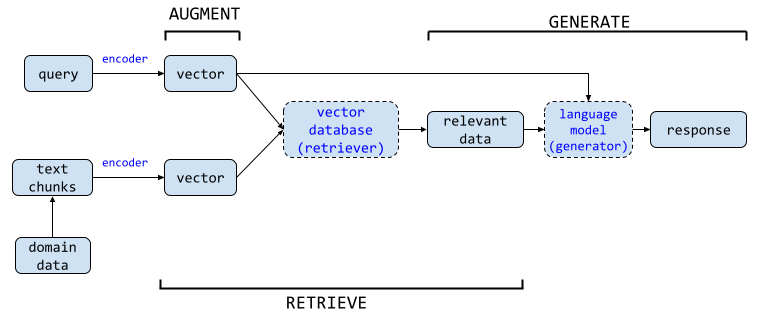
Instead of just relying on its internal, pre-trained knowledge, a RAG system first searches a reliable data source—like a company's internal wiki, a medical database, or the live internet—for information relevant to your question. It then provides this retrieved information to the LLM as context, along with your original prompt. The LLM uses this fresh, specific context to generate its answer.
Retrieval-Augmented Generation (RAG) is an AI framework that connects a language model to an external knowledge repository, allowing the model to fetch and include relevant information when generating an answer.
This simple two-step process of retrieving and then generating changes everything. It makes the model's responses more trustworthy, accurate, and relevant.
Why RAG is a Game Changer
Comparing a standard LLM to one enhanced with RAG highlights a few key advantages.
| Feature | Standard LLM | RAG-Enabled LLM |
|---|---|---|
| Knowledge Source | Static, internal training data | Dynamic, external data sources |
| Up-to-Dateness | Knowledge ends at training date | Can provide real-time information |
| Factual Accuracy | Prone to "hallucinations" | Grounded in retrieved facts |
| Transparency | Operates as a "black box" | Can cite its sources |
| Domain Specificity | General knowledge | Easily adapted to specialized topics |
The most significant benefit is the reduction of hallucinations, where a model generates incorrect or nonsensical information. By grounding the LLM in specific, verifiable documents, RAG ensures the answers are based on facts, not just statistical patterns. This also provides transparency. A RAG system can often show you the exact source material it used, allowing you to verify the information for yourself.
A standard LLM is like a knowledgeable expert who is locked in a library. A RAG system gives that expert a phone to call anyone and a key to leave the library.
RAG in the Real World
The applications for this technology are vast and practical. Imagine a customer support chatbot for an electronics company. Without RAG, it could only answer questions based on old training data. With RAG, it can connect to the company's latest technical manuals and support articles to provide accurate, step-by-step instructions for a product released just yesterday.
In finance, an analyst could use a RAG system to ask complex questions about market trends, pulling real-time data from financial reports and news feeds. In healthcare, a doctor could query a system that retrieves information from the latest medical journals to help diagnose a rare condition. In all these cases, RAG provides answers that are not just generated, but are informed by current, reliable data.
What is the primary limitation of standard Large Language Models (LLMs) that Retrieval-Augmented Generation (RAG) is designed to solve?
In the "open-book test" analogy for RAG, what does the "book" represent?