Advanced Gravitation Physics
Newton's Law of Universal Gravitation
The Universal Pull
Isaac Newton proposed a revolutionary idea: the force that makes an apple fall from a tree is the very same force that keeps the Moon circling the Earth. Before him, the heavens and the Earth were thought to follow different rules. Newton united them with a single principle.
Newton theorized the same force that caused an apple to fall from a tree was also the force that kept the moon in place.
This principle is called the law of universal gravitation. It states that every particle of matter in the universe attracts every other particle. This pull isn't random; its strength depends on two key factors: how much stuff is in the objects and how far apart they are.
Mass and Distance
First, let's consider mass. Mass is a measure of how much matter an object contains. Newton realized that the force of gravity is directly proportional to the masses of the two objects involved. If you double the mass of one object, the gravitational force between them doubles. If you double the mass of both objects, the force quadruples. More mass means a stronger pull.
Next is distance. Gravity gets weaker as objects move apart. This isn't a simple linear relationship, though. The force decreases with the square of the distance between the centers of the two objects. This is known as an inverse square law. If you double the distance between two objects, the gravitational force between them drops to one-fourth of its original strength. If you triple the distance, the force becomes one-ninth as strong.
The Equation of Gravity
By combining these two relationships—direct proportionality to the product of the masses and inverse proportionality to the square of the distance—we get Newton's famous equation.
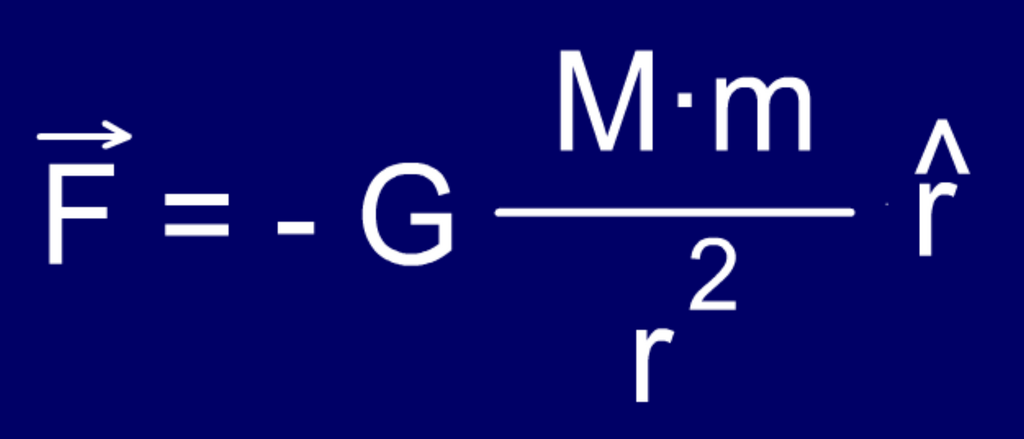
Mathematically, it looks like this:
This elegant formula was a monumental achievement. For the first time, it allowed scientists to calculate the gravitational forces between Earth and the Moon, the Sun and the planets, and any two objects in the universe. It explained why planets move in predictable orbits and provided a mathematical foundation for celestial mechanics.
The Universal Constant
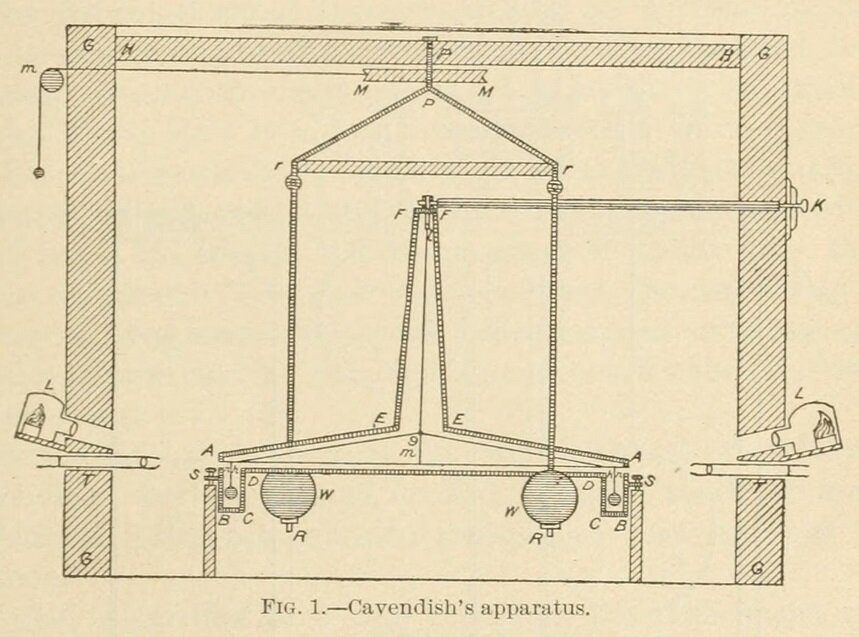
The 'G' in the equation is the universal gravitational constant. It's a fundamental constant of nature, meaning it's the same everywhere in the universe. Newton knew a constant had to exist to make his equation work, but he couldn't measure its value. It took over a century until Henry Cavendish managed to measure it in a brilliant experiment in 1798.
The currently accepted value for G is approximately:
Think about it: nearly every object around you has mass, yet you don't feel them pulling you in. You can overcome the entire Earth's gravitational pull on a paperclip just by picking it up with a small magnet. The force is only significant when you're dealing with objects that have immense mass, like planets and stars.
Newton's law was the final word on gravity for over 200 years. It successfully explained almost all motions observed in the solar system and remains a cornerstone of physics and engineering. Now, let's test your understanding of this universal pull.
What was Isaac Newton's revolutionary insight regarding the force of gravity?
If the distance between two objects is doubled, and the mass of one of the objects is also doubled, what happens to the gravitational force between them?
Understanding this law is the first step in comprehending the grand mechanics of our cosmos.