Acoustic Guitar Fundamentals
Guitar Basics
Know Your Instrument
Before you can play a single note, it helps to know your way around the guitar. Think of it like learning the names of kitchen tools before you start cooking. An acoustic guitar has three main sections: the headstock, the neck, and the body. Let's break them down.
The body is the largest part of the guitar. It's hollow and acts as a resonating chamber, amplifying the sound of the vibrating strings. The hole in the middle is the soundhole, which helps project that sound outwards.
The bridge is mounted on the body and holds the saddle, a small strip of hard material (like bone or plastic) that the strings pass over. The bridge pins hold the strings in place.
The long piece of wood connecting the body to the headstock is the neck. The front surface of the neck is the fretboard, which is where you'll press the strings down. The metal strips embedded in the fretboard are called frets. They divide the neck into specific pitches.
At the top of the neck is the headstock. It holds the tuning pegs (or tuners), which you turn to tighten or loosen the strings, changing their pitch. The nut is a small grooved strip between the fretboard and the headstock that guides the strings.
Holding the Guitar
How you hold your guitar affects your comfort and your ability to play cleanly. Bad posture can lead to strain and make playing feel awkward. The goal is to be relaxed and stable.
Sit on the edge of a chair without arms, keeping your back straight. If you're right-handed, rest the curved part of the guitar's body, called the waist, on your right thigh. The guitar should be angled slightly upward, so the headstock is about level with your shoulder. Your right arm should rest comfortably over the top of the body, allowing your hand to fall naturally over the soundhole. Your left hand will support the neck, with your thumb resting gently on the back.
Proper posture and holding the guitar correctly are essential for beginners to play comfortably and avoid strain.
Avoid slouching or hugging the guitar too tightly. It should feel balanced on your leg without much effort from your arms. This position gives both hands the freedom they need to move.

Getting in Tune
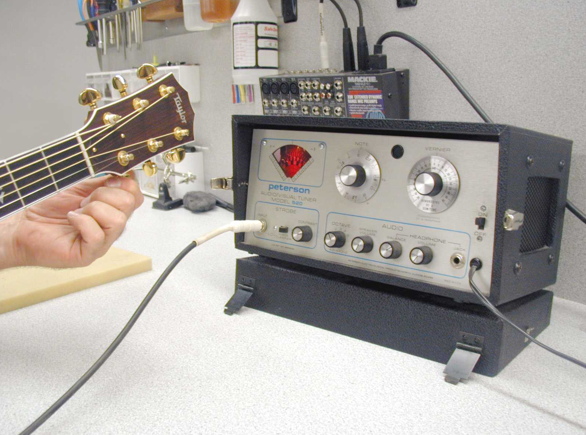
A guitar that's out of tune will never sound right, no matter how well you play it. Tuning is the process of adjusting the strings to the correct pitches. For beginners, the best way to do this is with an electronic tuner. You can use a clip-on tuner that attaches to the headstock, a pedal, or even a smartphone app. These tools listen to the pitch of each string and tell you whether it's too high (sharp) or too low (flat).
As a beginner, one of the most essential things to learn is how to tune your guitar.
Standard tuning is the most common setup for a six-string guitar. The strings are tuned from thickest to thinnest (or lowest pitch to highest pitch).
| String # | Note | Mnemonic Device |
|---|---|---|
| 6 (thickest) | E | Eddie |
| 5 | A | Ate |
| 4 | D | Dynamite |
| 3 | G | Good |
| 2 | B | Bye |
| 1 (thinnest) | E | Eddie |
To tune, pluck a string and watch the tuner. If the note is flat (too low), slowly turn the corresponding tuning peg to tighten the string until the tuner indicates it's correct. If the note is sharp (too high), loosen the string. Make small adjustments. It's a good habit to tune your guitar every time you pick it up.
What is the primary function of the large, hollow body of an acoustic guitar?
The metal strips embedded in the fretboard are called ____.
With a tuned guitar and a comfortable posture, you're ready to start making music.