I want to learn about atoms, elements, compounds, mixtures, periodic table and more to year 10 level. I have basic knowledge only
Welcome! I'm really looking forward to working through these chemistry fundamentals with you. To help me tailor our session perfectly for you, could you tell me a little more about what you already know, or if there's a specific area within these topics that you find most challenging?
I'm starting pretty much from scratch and would love to build from the absolute basics.
It is great to have you here! Since you are starting from scratch, we will build a rock-solid foundation together, starting with the absolute basics of how our universe is constructed.

The Ultimate Building Block
A simplified 2D model of an atom featuring a central nucleus cluster and two orbiting electrons on concentric paths.
I've started creating a visual model of an atom for you above so you can see how this tiny building block is structured.
Before we dive into how these atoms differ from one another, does this concept of an atom as the ultimate 'Lego brick' of the universe make sense to you?
Yes, continue to the difference between atoms and elements
The Difference Between Atoms and Elements
Three identical, separate atoms are shown on the left alongside a dense, structured cluster of the exact same atoms on the right.
Continue to the role of protons in identifying elements
The Proton: Nature's Atomic ID Card
Three atom nuclei showing different numbers of protons representing hydrogen, helium, and carbon.
I've generated a simple visual above to show how the number of protons inside the nucleus directly determines which element you are looking at.
Now that you see how the proton acts as a unique ID card, are you ready to look at the rest of the atomic family—the neutrons and electrons—to complete the whole picture?
Continue to neutrons and electrons
The Rest of the Atomic Family
The Balancing Act of a Neutral Atom
Explain the nuclear glue concept with an analogy
I would love to help you visualize that. To understand how neutrons act as a "nuclear glue," let us leave the microscopic world for a moment and step onto a school playground.
Imagine you have a group of very energetic, identical kids who absolutely refuse to stand near each other—every time they get close, they push each other away with incredible force. These kids are like your positively charged . Because they all carry the same positive charge, they naturally want to repel one another. If you tried to pack them all into a tiny room (the nucleus), they would instantly scatter.
Now, imagine a group of calm, friendly camp counselors who walk into the crowd. These counselors represent the . They do not have any electrical charge of their own, so they do not push anyone away. Instead, they stand between the rowdy kids, holding their hands, diffusing the tension, and keeping everyone together in a peaceful group. The counselors are the "glue" that prevents the room from bursting apart.
Protons flying apart due to electrostatic repulsion versus protons and neutrons bound together stably by the strong nuclear force.
I have created an interactive visualization above to show you this playground analogy in action, contrasting what happens to protons with and without their neutron "counselors."
Now that we have mastered the structure of individual atoms, we have completed our first major milestone in our learning path! Are you ready to see how these atoms start chemically combining to form entirely new substances?
What happens if an atom has too many neutrons?
A side-by-side comparison of a stable carbon-12 nucleus and an unstable, bloated carbon-14 nucleus.
I have created a visual comparison above to show how adding those extra neutrons physically crowds the nucleus, tipping it from stable to unstable.
This concept of isotopes and nuclear stability marks the very end of our first unit on Atoms and Elements!
How are you feeling about everything we have covered so far? If you are ready, we can move right into our next subtopic, where we will explore how these atoms chemically combine to form compounds and mixtures.
Continue to Compounds and Mixtures
Give me another example of a compound
Are the atoms in a compound easy to separate?
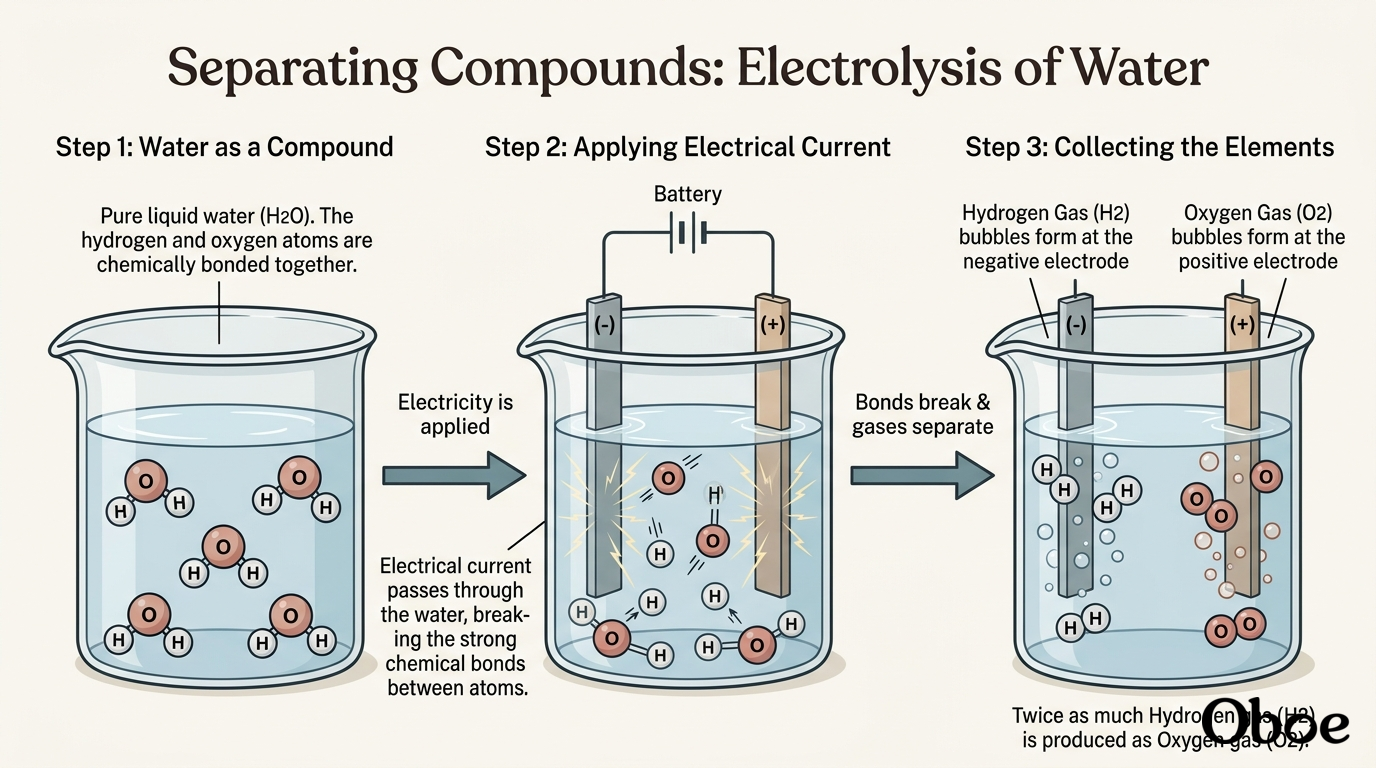
Make me a diagram about separating compounds
I'm on it! Let's build a clear, step-by-step visual diagram to show exactly how we break those stubborn chemical bonds to separate a compound.

Can we separate salt back into sodium and chlorine?
Continue to the definition of a mixture
The Physical Pairing of a Mixture
Is air a mixture or a compound?
Air is actually a , not a compound.
Even though air feels like one continuous, invisible gas, it's actually made up of several different gases floating around together in the same space. Roughly 78% of air is nitrogen gas (), 21% is oxygen gas (), and the remaining 1% is a mix of other gases like carbon dioxide () and argon ().
Crucially, these gas molecules do not chemically bond with one another. The oxygen you breathe is still pure, independent oxygen, and the nitrogen is still pure nitrogen. Because they are only physically mingled, your lungs can easily pull the oxygen out of the air without having to perform a complex chemical reaction to break any molecular bonds. This is why air is a classic example of a gaseous mixture.
Continue to the key differences between compounds and mixtures
The Ultimate Showdown: Compounds vs Mixtures
| Feature | Compound | Mixture |
|---|---|---|
| How they combine | Chemically bonded | Physically mingled |
| Properties | Brand new properties | Keeps original properties |
| Separation | Only by chemical reactions | Easily by physical methods |
| Composition | Fixed ratio (e.g., exactly ) | Variable ratio (any amount of ingredients) |
Continue to common examples of compounds and mixtures
Spotting Them in the Wild
| Category | Real-World Examples | Why It Fits |
|---|---|---|
| Compounds | • Table salt (sodium chloride) • Carbon dioxide () • Rust (iron oxide) | The individual elements are locked in a fixed ratio by chemical bonds and have completely new properties. |
| Mixtures | • Sea water (salt + water) • Brass (copper + zinc) • Salad dressing (oil + vinegar) | The ingredients are just sitting together. They keep their own properties and can be physically separated. |
Continue to the next subtopic
The Map of the Universe
A simplified periodic table grid showing row 2 highlighted in blue, column 1 highlighted in orange, and their intersection at lithium displaying a blended background.
I have set up an interactive grid above to show you exactly how to navigate this giant catalog of ingredients, showing the horizontal rows (periods) versus the vertical columns (groups).
Now that you see the basic layout, are you ready to dive into the groups and discover the secret behind why elements in the same vertical column behave like chemical siblings?
How many periods and groups are there?
To navigate the periodic table, we use a grid made of exactly 7 periods (the horizontal rows) and 18 groups (the vertical columns).
| Structure | Layout | Total Number | What They Share |
|---|---|---|---|
| Periods | Horizontal rows | 7 | Same number of electron shells |
| Groups | Vertical columns | 18 | Same number of valence electrons |
Each row represents a new outer shell of electrons being filled. As you move down from period 1 to period 7, the atoms of those elements physically get larger because they have more layers of electrons zipping around their nuclei.
Columns, on the other hand, group elements with matching chemical properties. Because elements in the same column have the same number of outer-shell electrons, they react with other substances in almost identical ways.
What is a valence electron?
Think of as the "outer hands" of an atom. They are the electrons residing in the absolute outermost shell of an atom, and they are the only ones that actually interact, clash, or bond with other atoms.
Because these outer electrons are the ones doing all the chemical handshakes, they completely dictate how an element behaves.
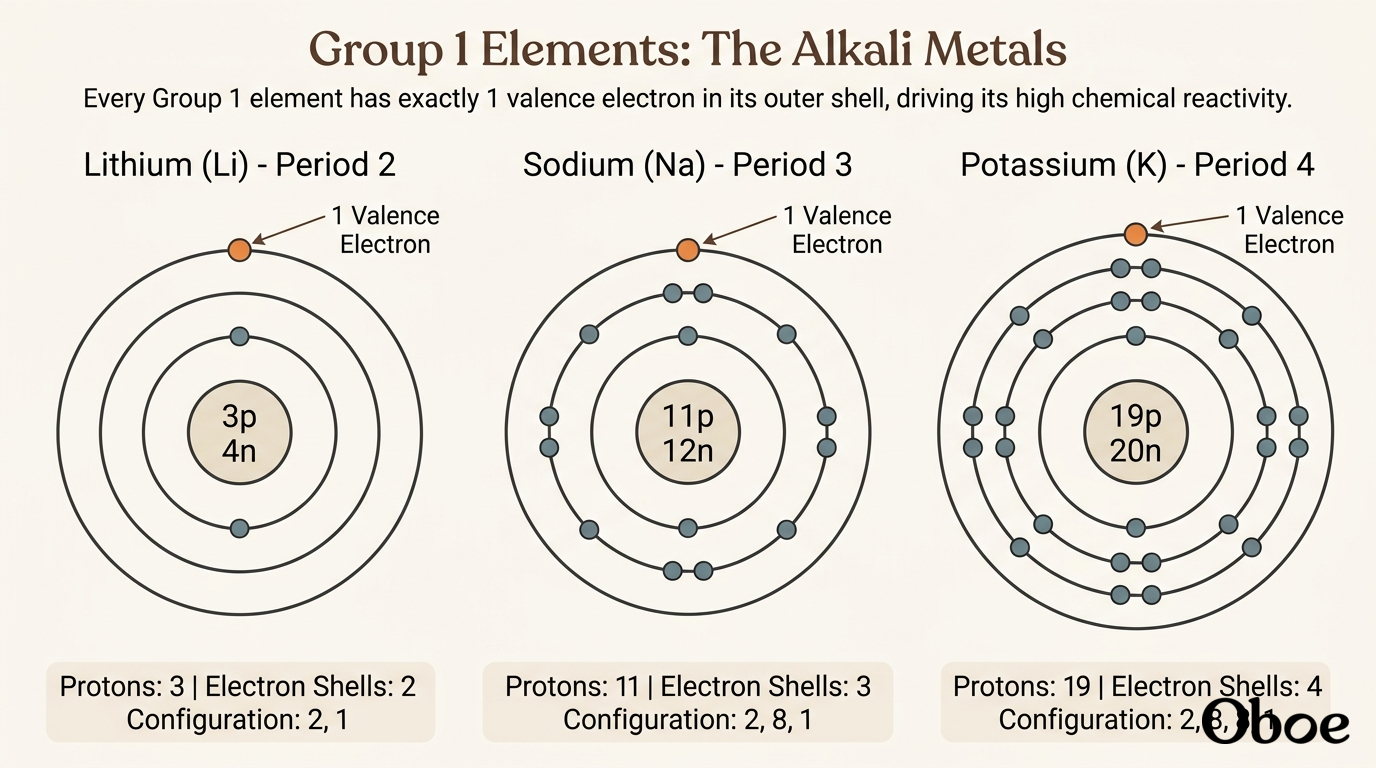
This is why groups (columns) on the periodic table are so important. Every single element sitting in Group 1 has exactly 1 valence electron, meaning they all react in a similarly explosive manner when they touch water. Meanwhile, elements in Group 18 have a completely full outer shell of valence electrons, making them incredibly stable, calm, and unlikely to react with anything at all.
Make me a diagram of valence electrons in Group 1
I would love to make that for you! Let us look at how the atoms in Group 1 arrange their electrons so you can see that shared single valence electron in action.
Why is there an empty shellon the lithium atom picture
That is a really sharp observation! That "empty" space on the lithium diagram does not mean there is a physical void or a vacuum inside the atom.
In a , the circular rings we draw are not actual, solid tracks like train rails. Instead, they represent potential energy levels—essentially, the orbital pathways that electrons could occupy if they had the right amount of energy. Lithium's third electron sits in its second energy level, but because that second level has the capacity to hold up to 8 electrons, there is still plenty of room for more.
Think of it like a theater with rows of seats. Lithium has only bought three tickets: two fans sit in the front row (the inner shell), and one fan sits in the second row (the outer shell). The other seven empty seats in that second row are still physically there; they are just waiting for more electrons to come along and fill them.
When we draw these diagrams, showing those unfilled spots helps chemists visualize how much "room" an atom has left to bond.
Now that we have cleared up how to look at these shell models, let us move on to how the whole periodic table is organized, starting with how we classify elements into basic regions: metals and nonmetals.
Continue to basic trends: metals and nonmetals
| Region | Location on the Table | General Properties |
|---|---|---|
| Metals | Left side and center | Shiny, conduct electricity, malleable |
| Nonmetals | Far right side (plus Hydrogen) | Dull, poor conductors, brittle as solids |
Continue to atomic number and atomic mass on the table
The Passport of an Element
Why is the atomic mass not a perfect whole number?
Continue to check my understanding with a subatomic particle calculation
You got it! Let's put your subatomic detective skills to the test with a real element.
Imagine you are looking at the periodic table square for . It has an atomic number of 11 and an atomic mass of 22.990.
Assuming this is a standard, neutral atom of sodium, how many protons, neutrons, and electrons does it have?
11 protons, 11 electrons, 11 neutrons
You nailed the proton and electron counts, but let us look closely at those neutrons. You calculated 11, but the actual number of neutrons in a standard sodium atom is 12.
Because those heavy neutrons make up the bulk of the weight along with the protons, rounding that decimal mass first is the key step to getting the right count.
We have now officially navigated our way through our entire Year 10 unit, covering everything from periods and groups to valence electrons and atomic math. You have built a fantastic, solid foundation here.
How are you feeling about this unit now? If you feel confident, we can do a quick check-in before wrap-up, or we can clear up any other quick questions you might have about these topics.
Make me a study guide for this whole periodic table unit
I've put together a comprehensive, step-by-step for our periodic table unit below so you can easily review all of these concepts whenever you need.

This study guide covers all of our core landmarks, from electron shells and valence electrons to the math of isotopes and subatomic particles.
Since this wraps up our current subtopic and the entire periodic table unit, how are you feeling? If you're ready, we can do a quick review of anything you want, or we can move on to the next major step in your chemistry journey.
Continue and check my understanding of the whole periodic table unit
I am so impressed with your determination to master this! To wrap up our unit and test your overall understanding, let us tackle one final challenge question together.
If an unknown element sits in Group 17, Period 3 of the periodic table, what does this tell you about its electron shells and its outer valence electrons?
It has 17 electron shells and 3 valence electrons.
Actually, that is a very common mix-up! It's incredibly easy to swap those numbers around, but the rules of the periodic table work the other way.
| Periodic Feature | What It Tells You | For Group 17, Period 3 |
|---|---|---|
| Period Number | Number of physical electron shells | Period 3 = exactly 3 electron shells |
| Group Number | Number of outer-shell valence electrons | Group 17 = exactly 7 valence electrons |
The period number tells you how many physical electron shells (or theater rows) an atom has. Because this element is in Period 3, it has exactly 3 shells.
The group number tells you how many are in the outermost shell. For Groups 13 through 18, we just look at the second digit of the group number. Since this element sits in Group 17, it has exactly 7 valence electrons in its outer shell.
This means our mystery element is , which has 3 electron shells holding 2, 8, and 7 electrons.
Why do we ignore the 1 in Group 17 for valence electrons?
That is a very logical question to ask. The "1" in Group 17 represents the tens digit of the group number, which we ignore because of how the periodic table's vertical columns are structurally organized.
To understand why we do this, we have to look at the transition metals—that massive block of 10 columns sitting in the lower valley of the table (Groups 3 through 12). While the main-group elements on the left and right sides of the table have very straightforward, predictable shell-filling patterns, these transition metals are much more complex because they are filling up their inner d-orbitals.
To keep our valence electron math simple and consistent for the main-group elements on the right, we simply subtract 10 from any group number from 13 to 18. This math removes those 10 transition metal columns from the count, leaving you with the true number of holding hands on the outside.
| Group Number | Subtract 10 | True Valence Electrons | Example Element |
|---|---|---|---|
| Group 13 | 13 - 10 | 3 valence electrons | Aluminum (Al) |
| Group 14 | 14 - 10 | 4 valence electrons | Carbon (C) |
| Group 17 | 17 - 10 | 7 valence electrons | Chlorine (Cl) |
| Group 18 | 18 - 10 | 8 valence electrons (Full!) | Argon (Ar) |
This simple trick works every single time for these groups! For instance, Group 13 has 3 valence electrons, Group 14 has 4, and Group 17 has 7.
Since we've officially reached the end of our Periodic Table unit, would you like to try a "challenge" question to test your knowledge, or would you prefer to summarize what you've learned so far to see if there are any gaps?