
Oboe
No history yet

Why we cannot look at sun eclipse

It is a spectacular sight, but watching an eclipse without the right safety gear can literally cook the light-sensitive cells in your eyes.

Before we dive into exactly how the eye focuses that intense sunlight, I'd love to know a bit more about you so I can tailor our conversation. What brings you to learn about eclipse eye safety today, and do you have any physics or biology background you'd like us to build on?

I'm just curious, and I don't have much of a science background.

It is completely natural to be curious about an eclipse, but understanding how our eyes interact with light is the first step in seeing why looking at one is so risky.

How Your Eye Focuses Light

To understand why the sun is so dangerous during an eclipse, we have to look at how the eye is built. Think of your eye as a tiny, highly efficient camera. When light enters your eye, it first passes through the , which is the clear outer protective layer. Then, it goes through the sitting right behind your pupil. Together, these two parts act like a powerful magnifying glass. Their main job is to bend and focus all that incoming light onto a tiny, highly sensitive spot at the back of your eye called the .

Light rays from a candle flame refract through the curved cornea and lens of a human eye to converge at a focal point on the retina.

I've started generating a visualization above to help you picture exactly how the cornea and lens bend incoming light rays to a single, highly concentrated point at the back of the eyeball.

Make a diagram showing this focusing mechanism

I've generated a diagram below that shows this focusing process in action, tracking light rays as they enter the eye.
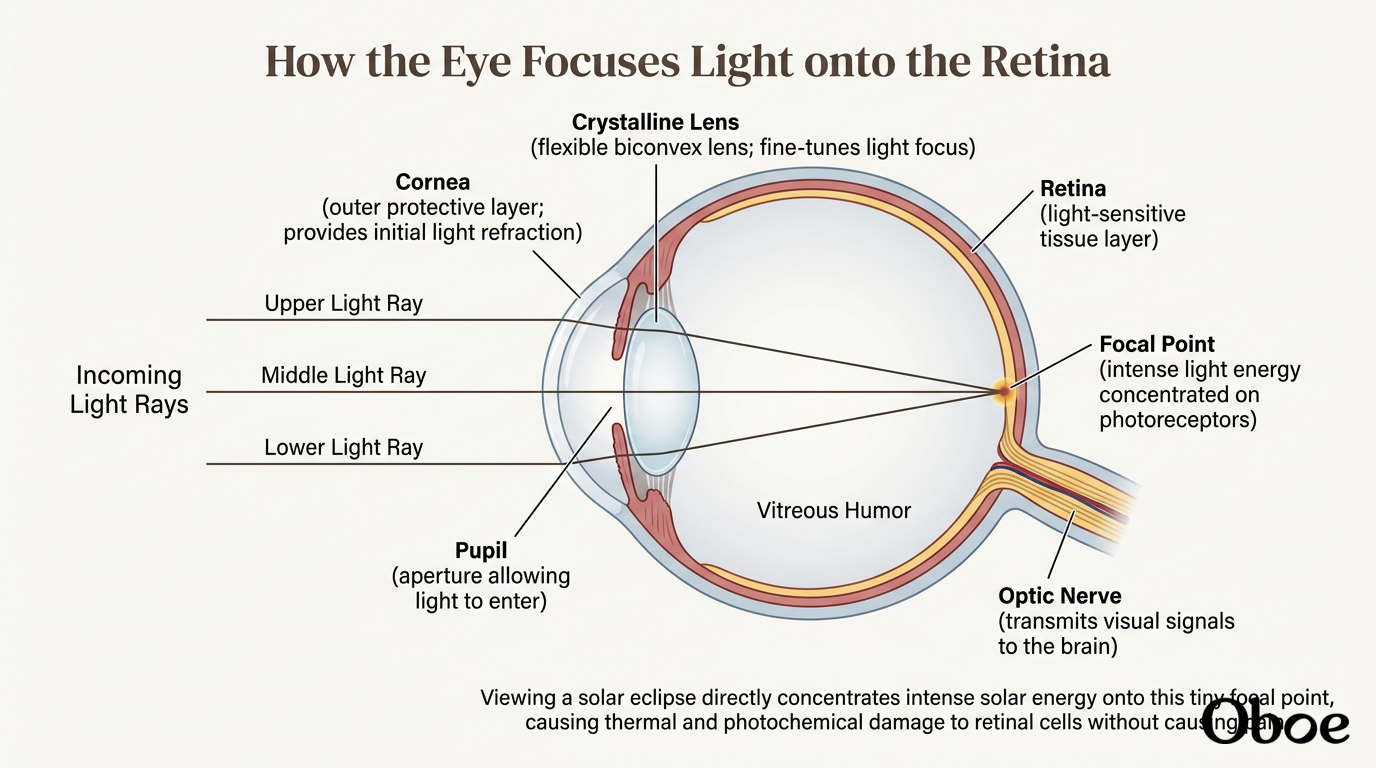
How the Eye Focuses Light onto the RetinaDiagram
Now that you can visualize how light gets bent and focused, let's look at why this optical mechanism turns the sun's rays into a hazard. Under normal conditions, you never stare directly at the sun because it is simply too painful. Your brain's natural response is to squint, look away, or blink. But during a solar eclipse, because the moon covers a large portion of the sun, the overall environment gets darker. This dimming tricks your brain into thinking it is safe to look. Your pupil dilates (opens wider) to let in more light. However, even when 99% of the sun is blocked, the remaining sliver of exposed solar disk is still intense. The cornea and lens continue to do their job perfectly—they take those highly energetic rays and concentrate them onto the , a tiny depression in the center of your retina that gives you sharp, detailed vision. By focusing that light onto such a microscopic area, your eye acts exactly like a magnifying glass focusing sunlight to burn a piece of paper. This concentrates the visible and ultraviolet (UV) light, driving the temperature of those delicate cells up and flooding them with radiation.