Oboe
No history yet

Build me a podcast-style course, two hosts discussing the topic in depth, on the following: how a Medicaid/PACE compliance leader should understand Medicaid managed care, MCO contracting, and enterprise Fraud Waste and Abuse (FWA) program ownership, in order to credibly interview for a VP, Compliance & Medicaid Programs role at a PE-backed home care platform.

Cover these specifically:

How Medi-Cal managed care plans and MCOs are structured and contracted, and how MCO contract compliance differs from CMS/DHCS PACE capitated program compliance, since I come from a PACE background (42 CFR Title 42, DHCS Title 22) and need to understand where the two overlap and where they genuinely diverge. What CalAIM and Community Supports are, in plain terms, and how they connect to managed care plans and home and community-based service providers. What it actually means to build and own an enterprise Fraud, Waste & Abuse program, as distinct from handling individual FWA cases: standing monitoring systems, a defined investigation process, reporting cadence, and how that scales across a ~20-person compliance organization with a Director layer underneath a VP. How compliance functions at PE-backed healthcare platforms tend to operate differently than at a single nonprofit PACE program, particularly around Board/executive reporting expectations and being positioned as a growth-enabler rather than a blocker. Close with a short recap section that translates each concept back to a PACE compliance leader's existing vocabulary, so I can bridge my own experience to this terrain in an interview without overclaiming.

Keep it dense with real regulatory and operational detail, not surface-level definitions. I already know compliance fundamentals; I need the Medicaid managed care and enterprise FWA layer I haven't worked in directly.

Welcome! I have structured a dedicated five-stage learning path specifically designed to help you transition your deep expertise in PACE compliance over to the complex, high-velocity landscape of PE-backed Medicaid managed care and enterprise Fraud, Waste, and Abuse (FWA) program ownership.

Your path
CalAIM Framework and Community Supports Contracting
Enterprise FWA Program Design and Operations
PE Platform Compliance Leadership and Growth Alignment
Vocabulary Bridge and Interview Translation Strategy
We will begin with our first subtopic: analyzing the mechanical and regulatory intersections between (the PACE tri-party agreement) and (Medicaid Managed Care regulations), highlighting where your PACE background directly translates and where you need to adapt to downstream managed care organization (MCO) structures.
From PACE to Platform: A VP-Level Masterclass in Medicaid Managed Care, MCO Contracting, and Enterprise FWAPodcast
I have initiated the generation of our podcast lesson. While the audio is preparing, let us review how these structural elements dictate your positioning as a candidate. In PACE, you owned the entire risk pool and delivery system under a single roof. In the PE-backed home care platform model, you will navigate a fragmented web of MCO contracts where compliance is managed through rigorous delegation oversight and downstream monitoring.

Explain how delegation oversight works under an MCO contract compared to PACE.

In a PACE program, compliance operates under a unified umbrella. Because you manage a fully integrated insurer-provider model under , you possess direct operational control over your clinics, staffing, and clinical protocols. Under a Medicaid managed care organization (MCO) contract, governance transitions into a governed by .
This means that as a VP of Compliance at a PE-backed home care platform, your organization acts as a downstream subcontractor or (DRE). The MCO delegates specific functions to you, and you must prove compliance through their rigorous oversight mechanisms. The table below outlines how this operational dynamic differs fundamentally from PACE governance:
Compliance DimensionPACE Program (Direct Control)MCO Subcontractor / DRE (Delegated Oversight)
Governance & AuthorityTri-party agreement (CMS, State, PACE)Downstream bilateral MCO network contracts
Credentialing & StaffingDirect IDT hiring and internal credentialingDelegated credentialing verified by MCO audits
Utilization ManagementIDT clinical consensus on care planPrior authorization submissions & MCO reviews
Audit InfrastructureDirect CMS and state agency program auditsPre-delegation audits & annual plan reviews
To maintain your status under an MCO contract, your compliance team will manage intensive to prove your systems can handle the work, followed by ongoing credentialing checks, utilization reviews, and annual sub-delegate evaluations. When gaps are identified, you will be expected to rapidly deploy contractually mandated Corrective Action Plans (CAPs) to prevent contract termination. Ready to see how this translates to your everyday operations?

Explain how a home care platform manages multiple differing MCO audit standards simultaneously.

Managing a multi-plan compliance architecture across 20+ differing MCO contracts simultaneously requires transitioning from the direct operational control you exercised in PACE to a structured paired with localized operational checklists. Instead of attempting to standard-by-standard reconcile every contract, a PE-backed home care platform maps all requirements to a single (UCF). This framework establishes a 'highest common denominator' baseline while maintaining plan-specific annexes for outlier requirements.
Operationally, your compliance division must build a structured, repeating three-tier architecture to ingest, execute, and audit these varying requirements without creating administrative bottlenecks. The table below outlines how this multi-plan compliance workflow operates at scale, bridging the gap between plan variations in , utilization management, and audit preparedness:
Functional LayerStandardizing the Core (The UCF)Customizing the Edge (The Annexes)Monitoring & Escalation
Credentialing & OnboardingUniform primary-source verification guidelines matching NCQA standards.Plan-specific background check parameters or state-mandated Medicaid enrollment forms.Monthly automated roster reconciliation with each MCO's active provider network registry.
Prior Authorization (UM)Centralized intake and clinical documentation upload template.Plan-specific authorization portals, turn-around-time limits, and appeal-filing windows.Daily EHR dashboard tracking pending authorizations against expiration dates to prevent unbillable visits.
Audit PreparednessStandardized electronic audit folder structure containing core corporate documents.Specific sampling sizes, file format preferences, and secure data transfer protocols.Mock pre-delegation audits run by your Director layer 90 days before scheduled MCO reviews.
To scale this across a multi-site enterprise, your Director layer will oversee the execution of 'plan-specific playbook profiles'. For instance, while 80% of your credentialing and electronic visit verification (EVV) rules remain standard, your team uses specialized automated alerts in your electronic health record (EHR) system to flag local exceptions—such as a specific plan requiring a unique or a 48-hour prior authorization turnaround instead of the typical 72-hour window. This keeps operations running at high velocity while insulating the frontline clinical staff from administrative complexity.

How do we build the compliance dashboard to track these 20+ plan audits in real time?

Building a real-time audit dashboard to monitor 20+ plan audits simultaneously requires moving away from static spreadsheets and transitioning to a dynamic, risk-stratified tracking matrix. This system must translate diverse MCO requirements into clear, actionable compliance signals. Below, we lay out the operational architecture for a real-time compliance dashboard designed for a high-velocity, private equity-backed home care platform:

Dashboard WidgetCore Metrics TrackedAlert Triggers (Action thresholds)Reporting Output
Pre-Delegation ReadinessAudit folder completeness, NCQA credentialing alignment, mock audit scorecards.Score falls below 95% on mock evaluations.Weekly summary sent to the Director layer.
Credentialing PipelineFile completion speed, primary-source verification hits, pending roster updates.Practitioner file outstanding > 10 days post-hire.Real-time EHR alert and RCM warning banner.
Authorization & UMPortal submission lag, denial trends, authorization renewal windows.Authorization expiring in < 14 days with active scheduled shifts.Daily operational billing reconciliation queues.
FWA & Program IntegrityEVV mismatch rates, outlier visit lengths, billing modifier exceptions.Single provider EVV mismatch > 5% in a weekly cycle.Automated alert directly to the Special Investigations Unit (SIU).
To ensure this dashboard functions as an active management tool rather than a passive log, your compliance team must integrate these metrics directly into your EHR and billing systems. This setup enables your regional managers and Directors to intercept issues before they trigger an official MCO audit. Our expert hosts discuss how to implement this real-time system and how to present it to your Board. Let's listen in on the latest episode of our compliance podcast series:
The Control Dashboard: Building Real-Time Compliance Architecture Across 20+ MCO Plan AuditsPodcast
I have initiated the generation of our podcast lesson. While the audio is preparing, let us analyze how this dashboard functions as an executive asset. In your VP interview, presenting a unified dashboard framework shows that you know how to manage risk across multiple health plans without slowing down growth. It proves that you can run a compliance program that scales efficiently.

Generate a study guide for MCO audit readiness.

To support your transition from a PACE program to a private equity-backed home care platform, this study guide acts as your strategic . It compares the direct regulatory control of PACE with the highly delegated, multi-payer environment of Medicaid Managed Care Organizations (MCOs), equipping you with the operational frameworks and vocabulary needed to excel in your VP interview.
Medicaid MCO ComplianceStudy Guide
I have initiated the generation of your MCO audit readiness study guide. While it compiles, note how shifting from PACE's direct-provider model to a changes how you prove program integrity. Instead of relying on internal administrative consensus, you must demonstrate compliance using systematic metrics that align with and the latest federal oversight trends.

How do NCQA credentialing requirements differ from traditional PACE HR checks?

Shifting from a PACE environment to a private equity-backed home care platform requires a total paradigm shift in how you verify your workforce. In a single-site PACE program, credentialing is typically treated as a routine HR onboarding function integrated with your interdisciplinary team (IDT) setup under . However, under delegated MCO contracts governed by , credentialing is a high-stakes, contractually delegated compliance function that must strictly align with national quality benchmarks.
Verification ElementPACE Program (Traditional HR Check)PE Home Care Platform (Delegated NCQA Credentialing)
Core Governing StandardCMS & State Joint PACE ReviewsNational Committee for Quality Assurance (NCQA)
Primary Source Verification (PSV)Completed at hire via state registriesContinuous automated checks (OIG, SAM, licensure boards)
Verification CycleAnnual or bi-annual internal updatesStrict 180-day cycle limits with rolling updates
Approval AuthorityHR Director & IDT Clinical LeadFormal Credentialing Committee with peer-review structure
Audit ConsequencesNon-compliance cited in state program auditImmediate freeze on new MCO referrals and billing privileges
To succeed in a VP role, you must show that you know how to build a formal, peer-reviewed and manage so that your credentialing files are perpetually audit-ready. The key is establishing a system that actively verifies every single clinical file against primary sources (like the OIG Exclusion Database and state licensing boards) rather than relying on a static annual file check. This level of operational rigor is what protects your platform's revenue streams during intensive MCO pre-delegation audits.

Generate a visual diagram of the NCQA delegated credentialing workflow.
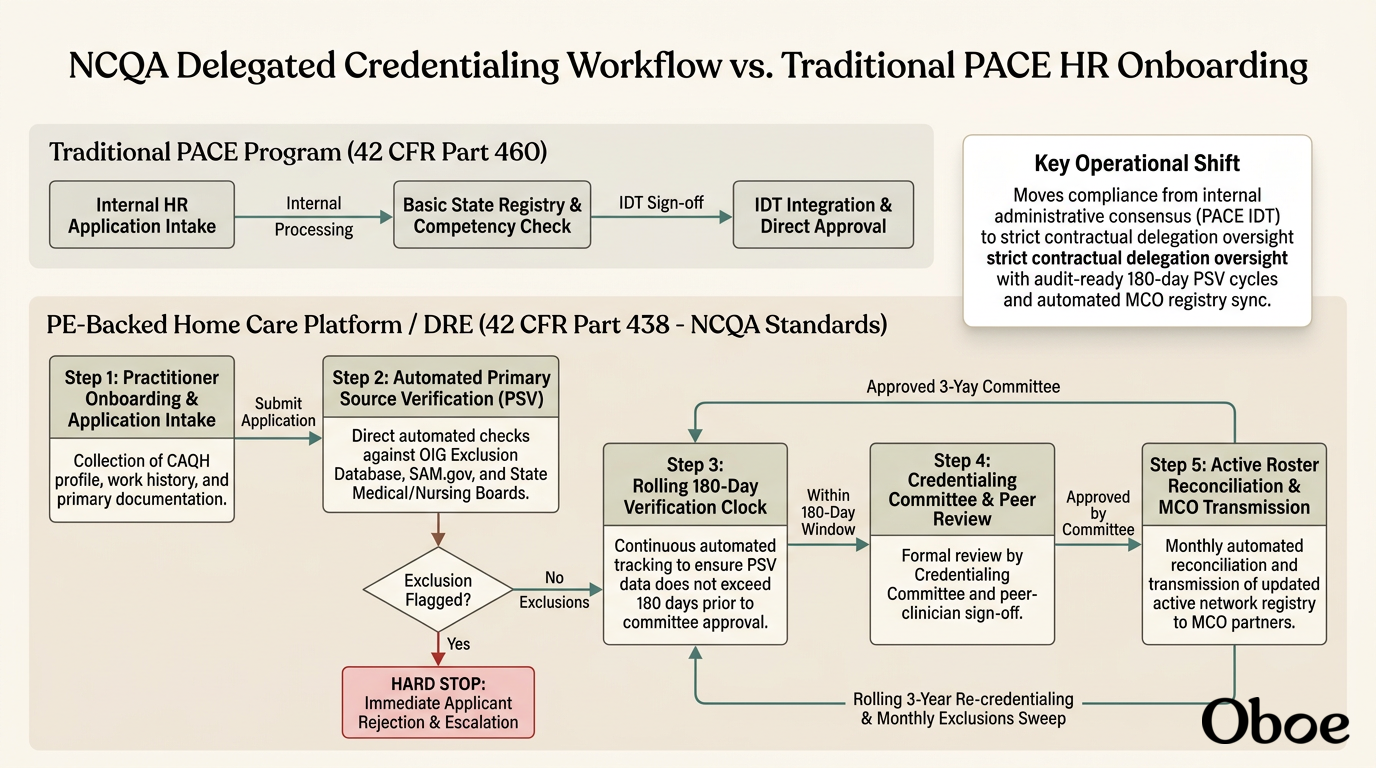
To visualize the transition from PACE's internal checks to the multi-payer model, let's examine the technical flow of an NCQA delegated credentialing workflow. Unlike PACE programs where the has unified control over staff onboarding, a delegated MCO environment operates through a sequence of formal verification gates. The diagram below displays how data, checks, and approvals flow to maintain an audit-ready state under .
NCQA Delegated Credentialing Workflow vs. Traditional PACE HR OnboardingDiagram
I have initiated the generation of the delegated credentialing workflow diagram. While the visual compiles, let us examine how this process feeds into your overall multi-plan audit readiness framework. In a private equity-backed model, you cannot afford to manage 20 different audit standards as isolated processes. Instead, you must map these requirements into a (UCF). This allows your team to perform a single, standardized verification that satisfies all your simultaneously.

To round out our mastery of MCO contracting overlaps before we progress to CalAIM and Community Supports, let's test how you would position this operational shift during an executive interview. Imagine the private equity operating partner asks how you plan to scale compliance operations across multiple sites without slowing down clinician hiring. Which approach represents the most scalable, growth-aligned answer?

How should a candidate with a PACE background describe their strategy for scaling credentialing compliance at a 20-site PE-backed home care platform?

Transition from PACE's localized, manual HR reviews to a centralized NCQA-aligned credentialing office that utilizes continuous primary-source verification and a unified control framework to automate MCO roster updates.

Credentialing
LV 1
Skills
Spot on. Transitioning to a centralized, NCQA-aligned credentialing office that utilizes continuous primary-source verification and a unified control framework is the only way to scale without adding administrative friction. This directly demonstrates to a PE board that you understand how to build operational leverage. Now that we have mastered how to bridge PACE and MCO contracting, we will advance to our second subtopic: (CalAIM) and its Community Supports framework.

Deconstructing CalAIM: Waivers, Community Supports, and ECM

To credibly interview for a VP role, you must understand the regulatory architecture of CalAIM. Unlike a PACE program, which relies on a unified PACE model, CalAIM operates under the authority of a dual federal waiver program: the and the . Together, these waivers allow Medi-Cal managed care plans (MCPs) to fund non-medical services—known as Community Supports or (ILOS)—as cost-effective alternatives to costly institutional care.
CalAIM Program ComponentRegulatory / Waiver AuthorityOperational Structure for Home Care PlatformsPACE Equivalent
Community Supports (ILOS)1915(b) Waiver & 1115 DemonstrationOpt-in services (respite, personal care, home mods) authorized individually by MCOs.Integrated 14-service package under 42 CFR 460
Enhanced Care Management (ECM)Managed Care State Plan BenefitLocal Lead Care Manager coordinates physical, behavioral, and social needs.PACE Interdisciplinary Team (IDT)
Billing & CodingMedi-Cal Managed Care ContractStandardized HCPCS codes (e.g., T1005 for Respite) submitted as claims encounters.Capitated tri-party encounter reporting
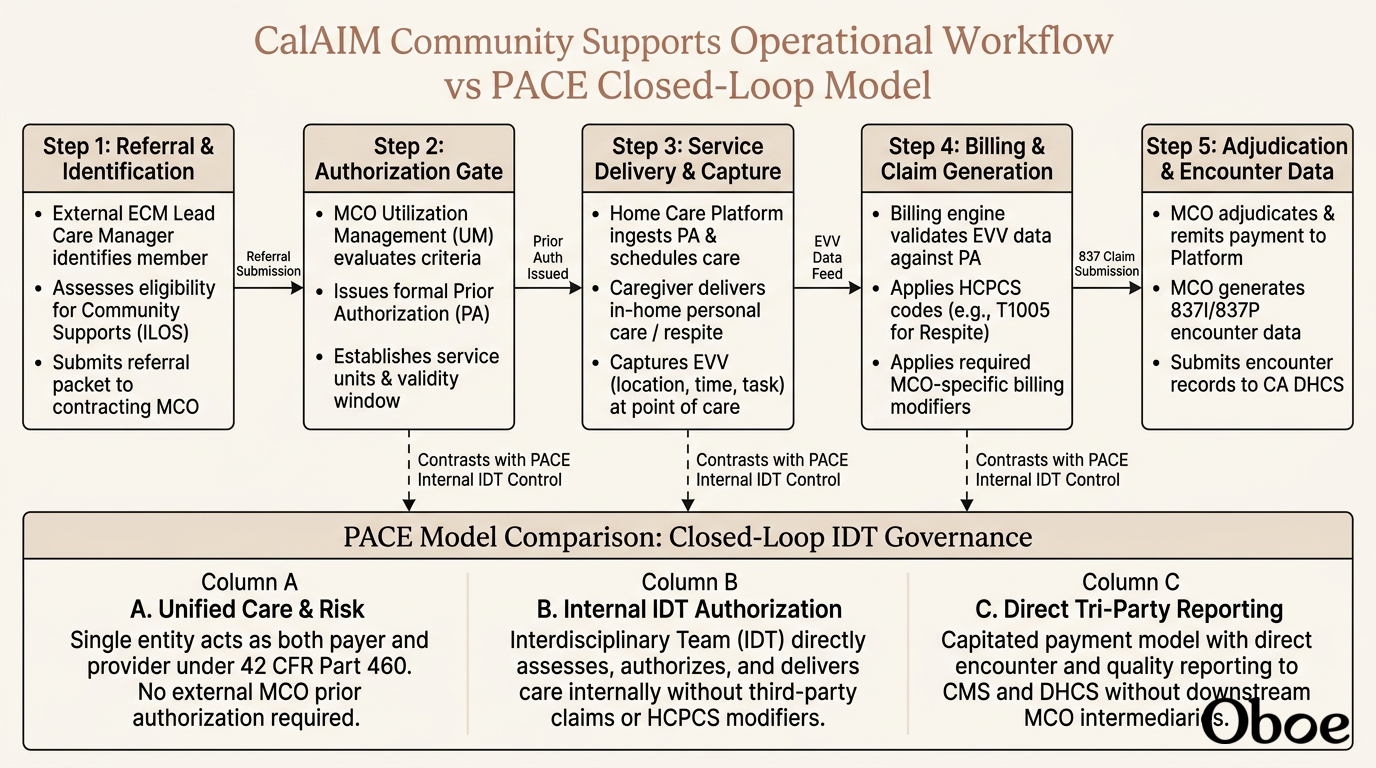
While PACE relies on a closed, fully integrated interdisciplinary team (IDT) to manage care directly, a home care platform under CalAIM must coordinate with a decentralized network of (ECM) providers. This requires your platform to build separate bilateral workflows for prior authorization, , and electronic encounter data exchange to secure payments from individual MCOs.
CalAIM Community Supports Operational Workflow vs PACE Closed-Loop ModelDiagram
I have initiated the generation of our CalAIM operational flow diagram. While the visual compiles, consider how you will communicate your grasp of this model during your VP interview. In your PACE background, you are accustomed to managing both the funding and delivery under one roof. To show you can lead a PE-backed home care platform, you must explain how you will coordinate care and ensure billing integrity across these external entities.

How do we manage prior authorization denials under CalAIM Community Supports?

Managing prior authorization denials under CalAIM Community Supports requires shifting from the internal clinical consensus model of a PACE to a highly structured, external appeal workflow. When a Medicaid Managed Care Plan (MCP) issues a denial, your compliance team must treat it as a formal under .
Denial TypeCommon Operational CauseCompliance Action ProtocolStrategic PACE Bridge
Administrative / TechnicalMissing or expired EVV data; incorrect billing modifier; incomplete intake files.Immediate review by your RCM team to correct modifiers or upload missing credentials and resubmit within 15 days.Replaces PACE's internal, informal billing updates with structured clearinghouse appeals.
Clinical / NecessityECM documentation fails to prove the member is at risk of nursing facility clinical placement.Coordinate with the external ECM Lead Care Manager to gather clinical records and file a formal appeal.Shifts clinical advocacy from internal PACE IDT consensus to structured external documentation.
Contractual Benefit LimitRequested hours exceed the MCO's specific Community Supports policy limits.Submit a formal request for a policy exception or transition the member to other waiver benefits.Replaces the flexible PACE care package with rigid, contract-specific limits.
To ensure your platform maintains a high authorization success rate, your Director layer should establish a weekly 'Denial Reconciliation Queue' with your revenue cycle management (RCM) team. By analyzing patterns in denials—whether they stem from missing primary care physician (PCP) signatures or specific MCO clinical review guidelines—your team can proactively update the to stop errors before claims are submitted. This systematic approach preserves cash flow and demonstrates to your private equity sponsors that you can manage revenue risk at scale.