
how the healthcare system works in the us. what is a healthcare system vs hospitals vs clinics. private vs as a business. how decisions get made. who the big healthcare giants are. how they work w pharma- big pharma, biotechs, universities. how we pay for it- taxes, out of pocket, insurance, other. insurance companies- benefit brokers and plan designers and tpas. carriers who process claims. direct to consumer vs what gets paid for with codes. fda regulation and getting approvals. DC and political leaders and lobbyists for regulations. med devices, robotics, software, ai. nursing homes, at home care. surgeons. pcps and rural healthcare. schools. what have been the biggest catalysts/ changes in healthcare over time and what big businesses have created/ added a ton of value for people as a result. i want to understand it from business and history of the market perspective.
Before we build our customized learning roadmap and start breaking down how the money flows, the clinical players, and the history, I want to make sure I tailor our deep dives to your specific goals.
To help tailor the depth and examples we use, what is your professional background or primary goal for mastering the business side of US healthcare?
I'm an investor/analyst looking to understand market opportunities.
That's fantastic. As an investor or analyst, you'll quickly see that the U.S. healthcare market is not a single, cohesive system, but rather a fragmented network of businesses trading trillions of dollars. To spot real market opportunities, we must first master how the basic units of this ecosystem differ, and how they actually make money.

The Anatomy of Delivery: Healthcare Systems vs. Hospitals vs. Clinics
outpatient
adjective
Medical procedures or tests that can be done in a medical center without an overnight stay.
- Clinics: These are focused, lightweight facilities handling care. Patients walk in, get diagnosed or treated, and walk out. From an investment perspective, clinics have low capital expenditure (CapEx) requirements and highly predictable, repeatable revenue streams. Examples include local primary care practices, specialized physical therapy offices, and urgent care chains.
- Hospitals: These are complex, capital-intensive facilities built for care—meaning overnight stays, emergency services, intensive care units (ICUs), and major surgeries. They require massive upfront CapEx, expensive medical machinery, and round-the-clock staffing. This makes their business model highly sensitive to patient volume and occupancy rates.
- Healthcare Systems: This is the corporate parent umbrella. A healthcare system is an integrated network of multiple hospitals, outpatient clinics, imaging centers, and sometimes even their own insurance plans. By consolidating under one corporate banner, they gain massive regional market share, leverage administrative efficiencies, and achieve immense negotiating power when bargaining over reimbursement rates with insurance companies.
To help visualize this structural hierarchy and see how patients move through these distinct layers of care, I've started generating a diagram.
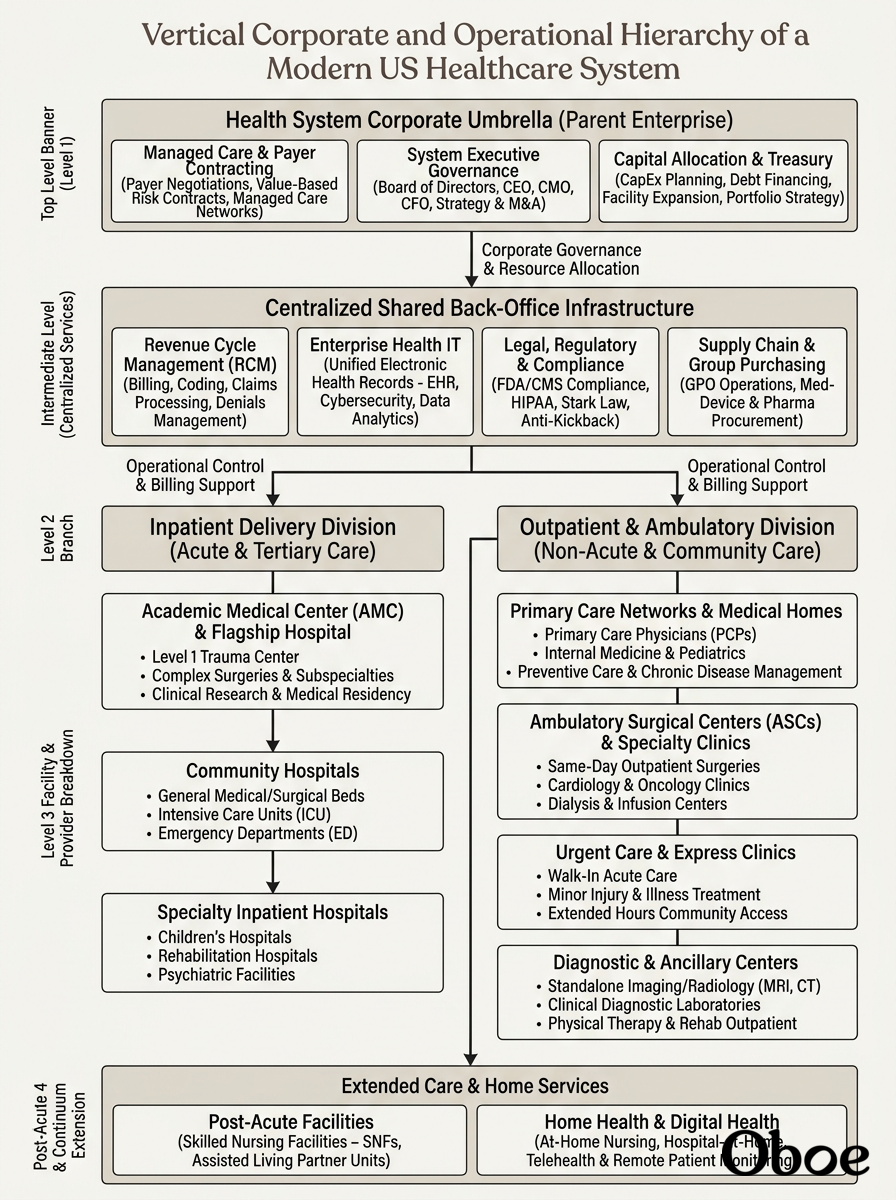
Next, we will look at how the money actually flows between these delivery assets and the entities that pay for them, or we can dive into the crucial business differences between non-profit and for-profit hospital systems. Which direction fits your analytical focus best?
Continue to non-profit vs. for-profit systems
Let's dive straight into the structural clash that shapes the entire supply side of U.S. healthcare delivery: the battle between non-profit and for-profit healthcare systems.
The Illusion of Difference: Missions vs. Balance Sheets
| Operational Dimension | Non-Profit Healthcare Systems | For-Profit Healthcare Systems |
|---|---|---|
| Tax Status | Exempt from federal, state, and local property taxes. | Pay standard corporate, state, and local property taxes. |
| Access to Capital | Can issue tax-exempt municipal bonds; rely heavily on philanthropic donations. | Tap public equity markets (issuing stock) and standard corporate debt. |
| Governance & Profit | Governed by community boards. Profits must be reinvested in clinical operations, facilities, or research. | Governed by corporate boards. Profits are distributed to public/private shareholders or reinvested. |
| Regulatory Mandate | Must demonstrate community benefit to maintain tax-exempt status. | No community benefit mandate; legally obligated to maximize shareholder value. |
Now that we have established how these delivery systems structure their businesses, we need to map how they interact with the entities that fund them. This brings us to the Core Triad: the relationship between Providers, Payers, and Patients/Employers.
Would you like to continue to the Core Triad, or would you prefer to run through a quick quiz to cement how these non-profit and for-profit capital models work?
Continue to the Core Triad
Excellent choice—understanding the core relationships here is the key to spotting actual investment opportunities and market inefficiencies. To understand how the money moves, we have to look at the Core Triad: the endless tug-of-war between , Providers, and Patients.
The Core Triad: A Structural Conflict of Interest
- Providers (Hospitals & Physicians): Their business goal is to maximize volume, optimize clinical capacity, and secure the highest possible for their services.
- Payers (Insurance Carriers & Self-Insured Employers): Their financial goal is to contain costs, minimize premium payouts, and restrict unnecessary utilization to protect their underwriting margins.
- Patients (The Consumers): Their goal is to maximize their clinical outcomes and access to premium care, while minimizing their out-of-pocket costs.
The core triad of US Healthcare displaying the bidirectional financial and clinical flows between Patients, Providers, and Payers.
I've generated a visualization mapping this triad to show exactly where the cash flows and where the friction points build up. From an investment perspective, this friction is where massive fortunes are made and lost.
Historically, the easiest way for an entrepreneur to build a highly valued healthcare company was to build a bridge right at these friction points—for example, software that helps providers automate billing to avoid denials, or tools that help employers bypass insurance carriers entirely.
Now that we've mapped this core tension, we should look at how these misalignments create major market opportunities for investors, or we can look at the transition from Fee-for-Service to Value-Based Care. Where should we head next?
Continue to stakeholder alignment and market opportunities
The Billion-Dollar Friction Points
- Revenue Cycle Management (RCM) & Billing Automation: Because insurers routinely deny claims to manage utilization, hospitals lose billions to . Startups utilizing AI and automated coding software help providers submit cleaner claims and automatically appeal denials, capturing value by recovering lost revenue.
- Employer Direct Contracting: To bypass the administrative bloat of traditional insurance carriers, large self-insured employers are increasingly contracting directly with health systems or dedicated primary care clinics. This removes the carrier middleman, lowers employer costs, and stabilizes provider patient volume.
- Administrative Friction Arbitrage: Businesses that sit between stakeholders to streamline prior authorizations, credentialing, and contract negotiations are highly valued. By reducing the headcount providers need just to bill for their services, these platforms scale rapidly.
To give you a clearer view of how these commercial opportunities fit into the broader system landscape, I have outlined a comprehensive market matrix worksheet that highlights key investment verticals, their core value propositions, and the prominent market players leading those spaces.

The worksheet above maps out the active fronts where financial sponsors are deploying capital to solve these structural misalignments.
Now that we have wrapped up the core architecture of the delivery side and identified where the market opportunities lie, we are ready to update our roadmap progress and move to the next major phase: how the money actually flows into the system via employer plans, government programs like Medicare and Medicaid, and the intermediaries who design these benefit plans.