I want to learn about the Exodus
Welcome! It is great to explore the book of Exodus with you. To help us kick off our journey and tailor the path, let's start with a quick question.
Are you interested in learning about the Exodus primarily from a biblical and theological perspective, or are you more interested in diving into the historical and archaeological debates surrounding the event?
I would love a mix of both!
I love that you are up for a mix of both! Looking at this story through a dual lens—as a powerful, sacred narrative and as an ancient mystery that historians and archaeologists are still trying to piece together—makes it so much more fascinating.

The Israelites in Egypt
A structured timeline showing the sequence of early events in Egypt, contrasting prosperity in Goshen with systematic enslavement, ending in the rise of Moses.
Let's continue to the plagues and the dramatic escape.
Let's dive straight into the epic conflict of the plagues. As Moses returns to Egypt, the narrative transitions from a quiet family story into a massive geopolitical and theological showdown. This isn't just a battle of wills between two men; it is a direct clash between the God of the Israelites and the , with each plague systematically targeting a specific Egyptian deity or natural force that the empire relied upon.
The Cosmic Showdown: The Ten Plagues
To understand how deeply personal this war of spiritual authority was, we can look at the sequence of the plagues. The water turning to blood directly insulted Hapi, the god of the Nile. The swarm of frogs mocked Heqet, the frog-headed goddess of fertility and childbirth. The pitch darkness that blanketed Egypt for three days was a direct strike against Ra, the powerful sun god whom Pharaoh was believed to physically represent on earth.
This strategic sequence is summarized in the table below, showing how each supernatural event challenged the very foundations of Egyptian society:
| Plague | Target of Divine Challenge | Cultural & Spiritual Significance |
|---|---|---|
| 1. Blood | Hapi (God of the Nile) | The lifeblood of Egypt's agriculture becomes source of death |
| 2. Frogs | Heqet (Goddess of Fertility) | Sacred symbol of life overruns the land, bringing rot |
| 9. Darkness | Ra (Sun God) | Symbolizes the complete eclipse of Pharaoh's cosmic authority |
| 10. Firstborn | Pharaoh & Osiris (Life & Afterlife) | Proves Pharaoh cannot protect his own royal successor |
This theological siege reaches its absolute climax in the tenth plague: the death of the firstborn. In Egyptian theology, the reigning Pharaoh was considered a living god, and his firstborn son was the next god in line to maintain cosmic order, or Ma'at. By striking down the firstborn, the narrative demonstrates that Pharaoh is entirely powerless to save his own household or preserve his empire's divine succession.
This final devastating blow breaks Pharaoh's stubborn resolve, leading directly to the pivotal night of the Passover. But before we look at how the Israelites prepared to flee Egypt during that fateful night, let's pause.
How do you feel about this idea of the plagues being a targeted, symbolic attack on Egypt's religious system, rather than just random natural disasters?
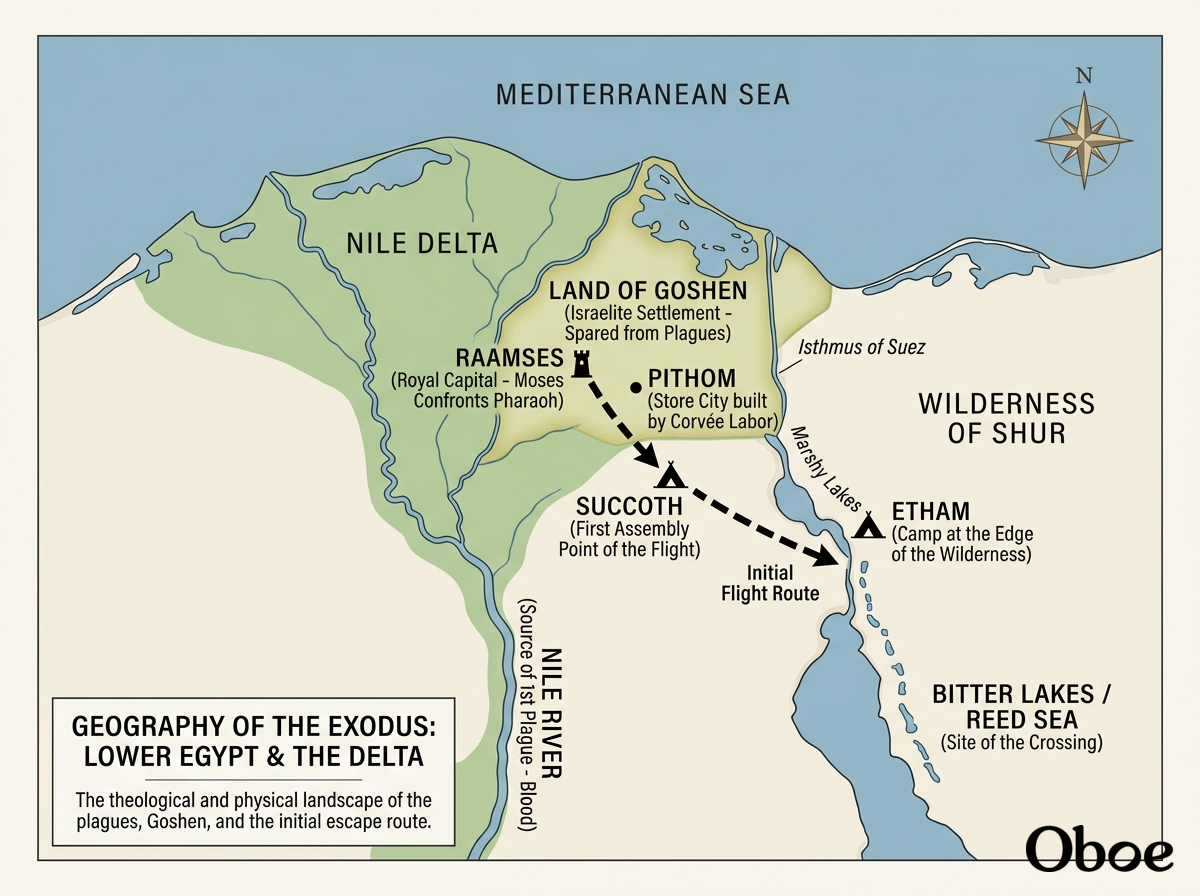
Can you show me a diagram map of the plagues and where they occurred?