No history yet

Plate tectonics

Welcome! I am excited to explore the dynamic world of plate tectonics with you. Before we dive into how the massive plates beneath our feet move and reshape our planet, I would love to know a bit more about what brings you here.

I know the basics but want to understand the mechanisms and geology deeper.

It is great to have you here! Since you already know the basics, we can skip the simple surface-level definitions and dive straight into the elegant mechanics that make the whole system run. To really understand how our planet reshapes itself, we have to look at the Earth not just as layers of rock, but as a giant heat engine.

The Theory of Plate Tectonics

At its heart, is the unifying scientific theory that explains how the Earth's rigid outer shell is broken into massive, moving pieces. It is the framework that connects seemingly unrelated geological events—like a volcanic eruption in Japan, an earthquake in California, and the slow rise of the Himalayas.
Before we look at how these plates jostle and collide, we need to understand exactly what they are made of. This requires us to look at the mechanical structure of Earth's outer layers, where a crucial boundary exists between the rigid and the weak, flowing layer directly beneath it.

Show me a diagram of Earth's layers

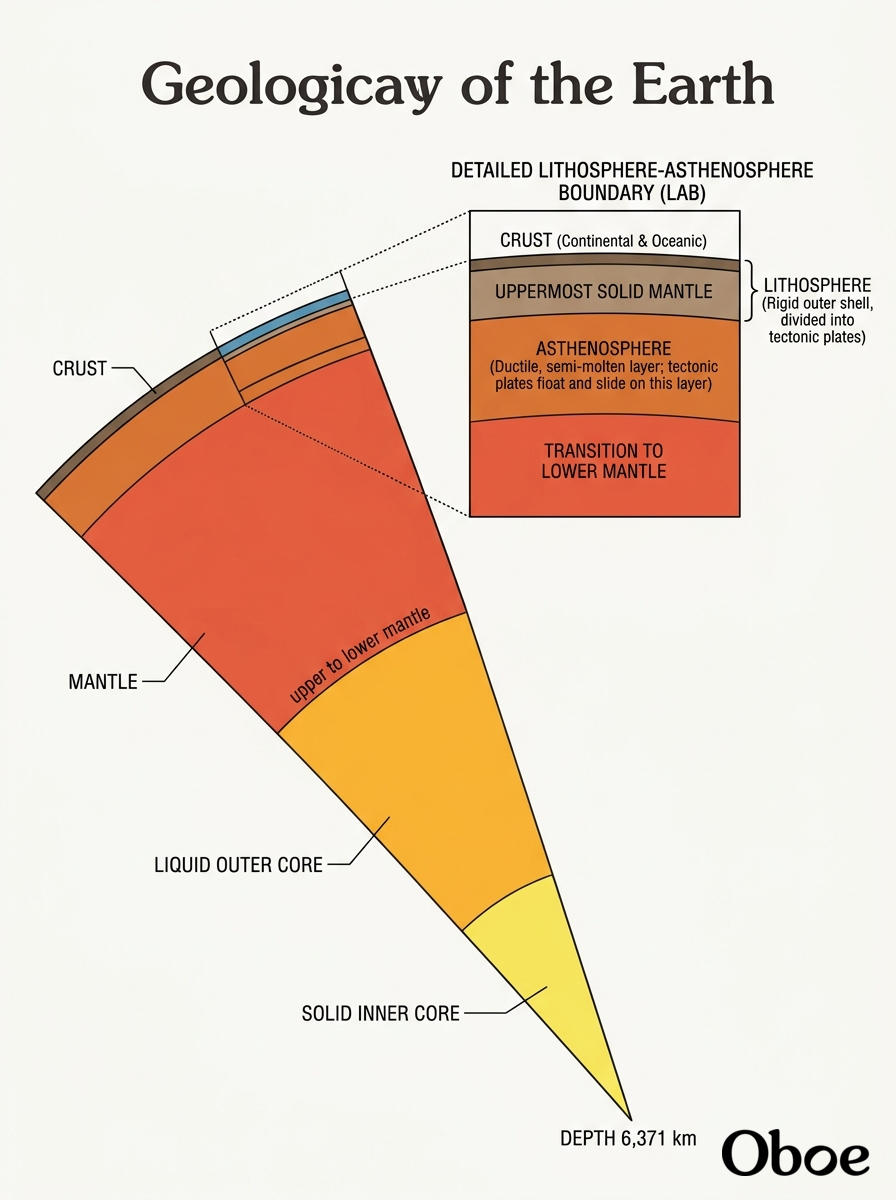
I have set up the diagram generator to draw a cross-section of the Earth's layers so we can visually pinpoint where the tectonic plates sit.

DIAG
Diagram
Generated course diagram
This visualization helps make a key concept clear: tectonic plates aren't just pieces of the continental crust. They are actually chunks of the , which acts like a brittle, solid lid.
These rigid lithospheric plates literally float on top of the , which is a hot, semi-molten layer of the upper mantle that flows very slowly under immense heat and pressure.