
ai agent
Welcome! I'm really excited to dive into the world of AI agents with you. Before we sketch out our learning path and get into how these autonomous systems actually think and act, I'd love to learn a little more about what brings you here.
To help me tailor our session, could you share what your goal is with learning about AI agents, and what experience you currently have with AI or programming?
I'm a developer looking to build and deploy my first production agent.
That is awesome. Building for production means we need to focus heavily on reliability, deterministic guardrails, and choosing the right tech stack. Before we map out our path, let's nail down your tools.
To make sure our hands-on examples hit home, what programming languages or frameworks (like Python, LangChain, LlamaIndex, or AutoGen) are you planning to use for your agent?
Python with LangChain
Now that we've established how agents act as autonomous goal-seekers, let's look at how we actually construct one in Python using . When you're building a production-grade agent, you aren't just sending a single prompt to a model; you are setting up a dynamic system designed to process, reason, and act.

The Four Core Pillars of a LangChain Agent
To get your first agent running in Python, you need to configure four primary building blocks that work in harmony. Think of these as the brain, the instructions, the hands, and the runtime engine of your system.
| Component | Role | What it represents |
|---|---|---|
| LLM | The Brain | The underlying language model that handles reasoning |
| Prompt Template | The Persona & Strategy | Instructions telling the LLM how to plan and select tools |
| Tools | The Hands | Python functions or APIs the agent can choose to execute |
| AgentExecutor / LangGraph | The Heartbeat | The runtime loop that keeps running the agent until the goal is met |
In older versions of LangChain, the AgentExecutor class was the default runtime. However, for modern, production-grade applications, is the standard. It gives you precise control over state management and circular loops, which is exactly what we need to prevent agents from getting stuck in infinite decision loops.
Make me a diagram of how these four pillars interact
To show you how the four pillars of a LangChain agent fit together, we can map out the flow of data as the system works.
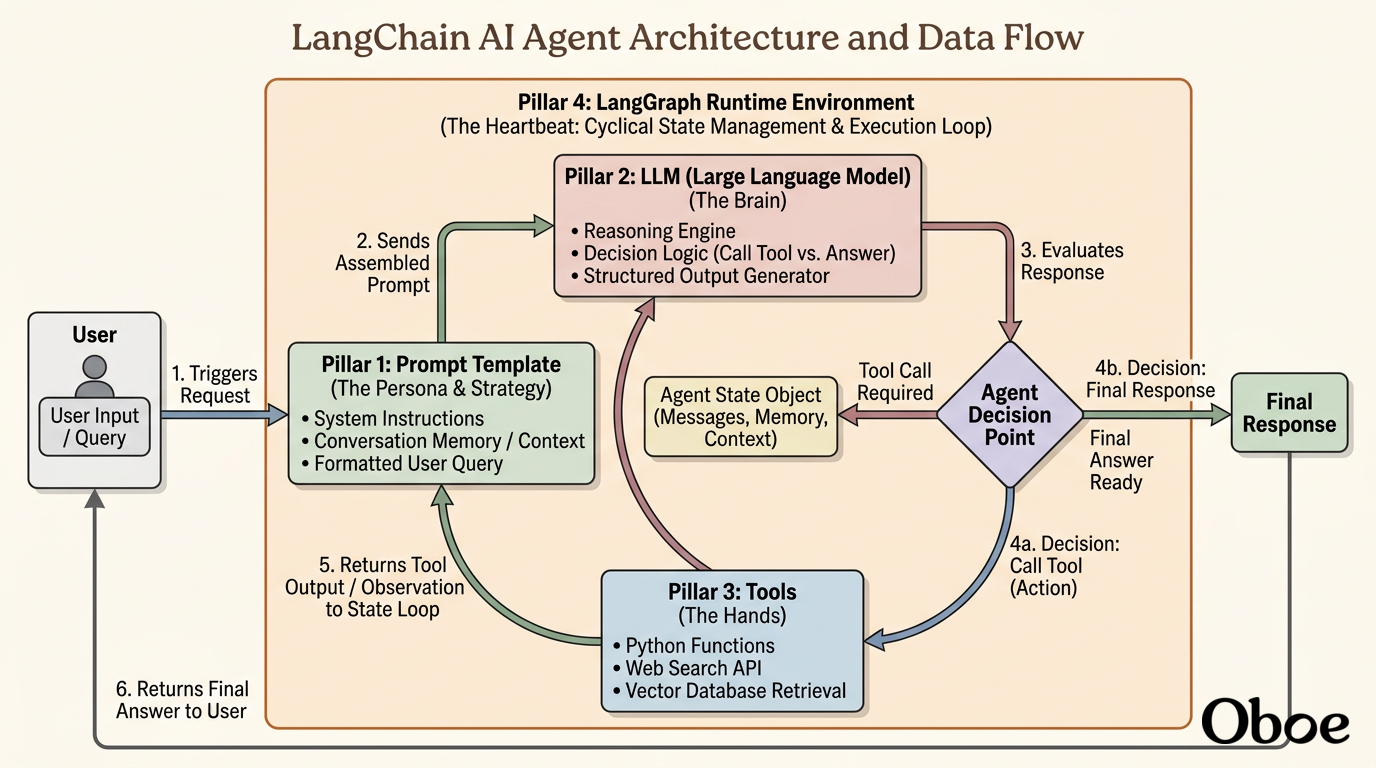
I have set up a diagram generator to map out this architecture for you. Notice how the flow isn't a straight line; it is a dynamic cycle where the continually processes new feedback from the tools until it decides the task is done.