
how do we get a tan?
It is great to have you here! Before we dive into the science behind how your skin changes color in the sun, I would love to know what brings you to this topic.
I am curious about how to tan safely.
It is wonderful that you are looking to approach tanning with safety in mind. Before we can talk about how to minimize the risks, we first need to understand what is actually happening at the cellular level when your skin changes color.

The Body's Defense System
A single epidermal cell protecting its central nucleus from incoming ultraviolet rays with a supranuclear shield of pigment granules.
Make a diagram of the skin layers
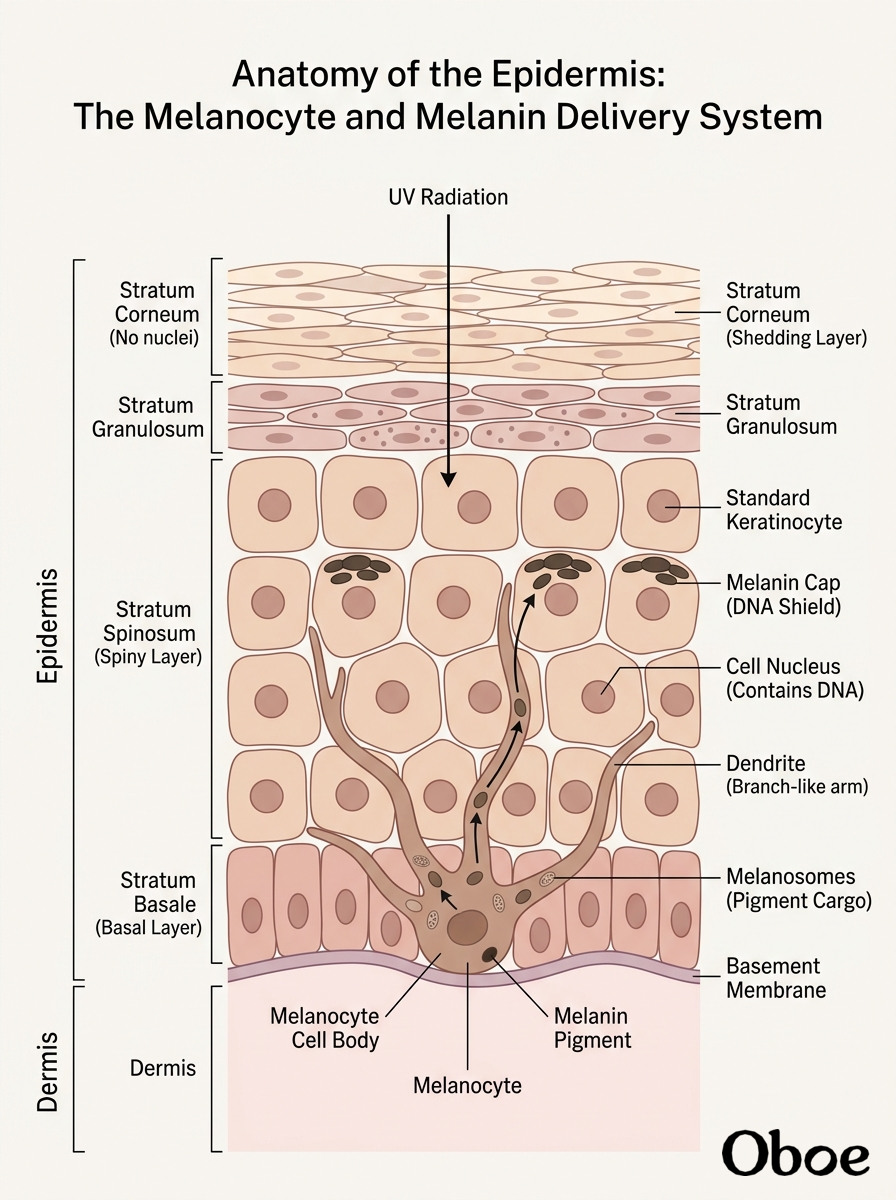
I would be happy to visualize that for you. To understand where these sun-shading cells live, we have to look at the very top layer of your skin, the .

How often does this outer skin layer renew itself?
The Umbrellas Deploy
A melanocyte cell with branching dendrites delivering circular melanosome packages to adjacent keratinocytes, where they aggregate as a protective cap above each nucleus.
I've started rendering an interactive visual to show this delivery mechanism in action. You will be able to see how those packages travel up the branches to form their physical shields.
Before we talk about how different types of sun rays change this process, let's make sure this "umbrella" system makes sense.
Continue to the difference between UVA and UVB rays
The Dual Threat: UVA vs. UVB
| Feature | UVA Rays | UVB Rays |
|---|---|---|
| Primary Target | Deep dermis | Surface epidermis |
| Immediate Effect | Oxidizes existing melanin (instant tan) | Direct DNA damage & sunburn |
| Melanin Production | No new melanin produced | Triggers brand-new melanin synthesis |
| Skin Protection | Does not protect against future burns | Builds a delayed, protective tan |
| Primary Danger | Premature aging & deep cellular damage | Sunburn & direct DNA mutations |