
The Golden Ratio in nature
Welcome! I'm so excited to explore the beautiful intersection of math and nature with you today.
Before we dive into the gorgeous spirals of sunflowers and pinecones, I'd love to know: what brings you to the today, and how comfortable do you feel with the math behind it?
I'm just curious about the patterns, and I prefer to keep the math fairly simple.
That is a perfect way to start. We will skip the complex algebraic equations entirely and focus on what makes this number so magical: the way simple, visual patterns come together.
Meet Phi, Nature's Favorite Number
To see where this number comes from, we don't need algebra. We just need to build a simple sequence of numbers. Let's see how nature starts counting.
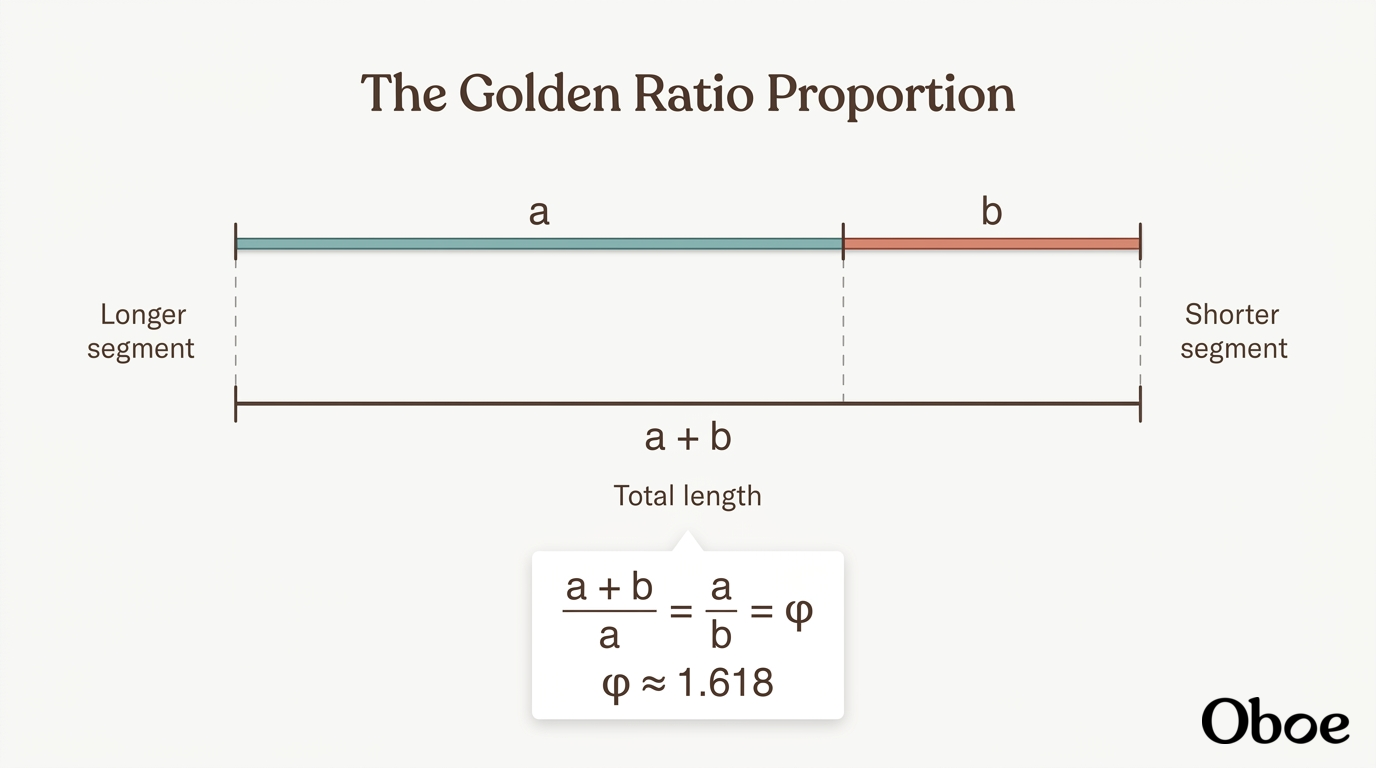
Show me a diagram of the Golden Ratio proportion
I would be happy to show you how this beautiful proportion looks visually. I've initiated a diagram that lays out the basic geometry of the Golden Ratio so we can see how those lengths relate to one another.
- We start with 1 and 1.
- Add them together: 1 + 1 = 2. Our sequence is now 1, 1, 2.
- Add the last two numbers: 1 + 2 = 3. Now we have 1, 1, 2, 3.
- Do it again: 2 + 3 = 5.
- And again: 3 + 5 = 8.