
Oboe
No history yet

The biology of deep-sea life

Welcome! I'm so excited to explore the mysteries of the deep ocean with you today. Before we dive into the pitch-black waters, I'd love to know what sparked your interest in the deep sea, and if you have any background in biology?

I've taken some general biology classes and want to go deeper.

It is great to have you here! Since you've already got some biology under your belt, we can skip the absolute basics and dive straight into the physical verticality of the ocean.

The Four Kingdoms of the Deep

To understand the creatures of the deep, we first have to understand their address. Scientists divide the deep ocean—which officially begins where sunlight fades at 200 meters—into distinct vertical slices. Each layer feels like an entirely different planet, defined by a steep gradient of disappearing light and climbing, bone-crushing hydrostatic pressure. Let's start our descent at the very top of the deep ocean: the , often called the twilight zone. Stretching from 200 down to 1,000 meters, this is a world of dim, filtered blue light where plants can no longer grow, but eyes are still incredibly useful. Below this lies the (1,000 to 4,000 meters), or the midnight zone, which is wrapped in absolute, perpetual darkness. Further down, we enter the vast (4,000 to 6,000 meters), a freezing, silent plain. Finally, we plunge into the deepest trenches on Earth: the (6,000 meters all the way to the ocean floor), named after Hades, the Greek god of the underworld.

I've started sketching out a visual breakdown of these four deep zones to help us visualize just how deep this journey goes.
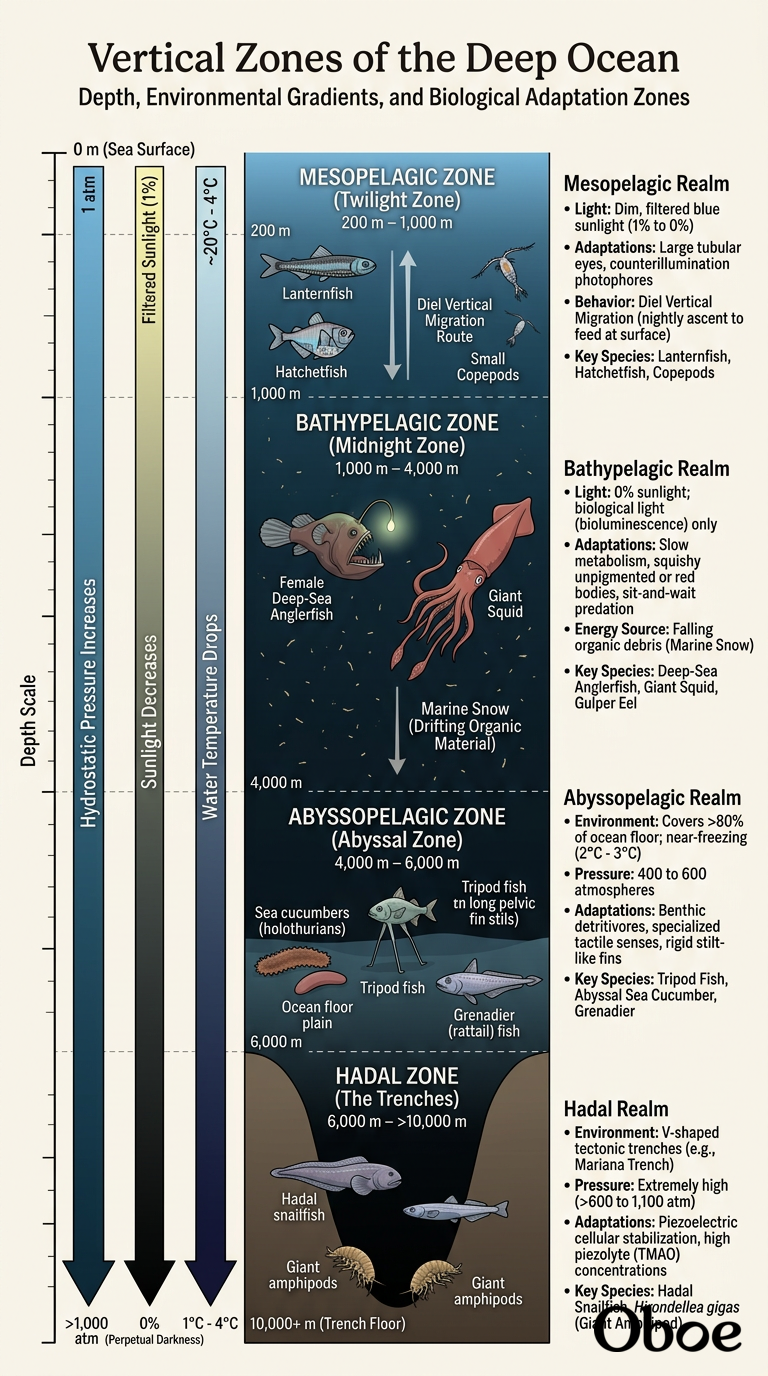
Vertical Zones of the Deep OceanDiagram

Now that we have mapped out the geography, we can look closer at the intense physical conditions of these zones, specifically how pressure and temperature change as we drop further down.

How do animals survive the pressure in the Hadal zone?

That is easily one of the most mind-blowing puzzles of ocean biology. At the bottom of the hadal trenches, the water pressure reaches over of depth, which is roughly equivalent to having an elephant standing on your thumb. For a normal land animal, or even a shallow-water fish, this pressure would instantly crush cell walls, distort delicate proteins, and turn cell membranes into rigid, non-functioning barriers. Yet, animals like the hadal snailfish thrive there. They do not get crushed because they do not fight the pressure; instead, they match it inside and out. Because they are made almost entirely of water—which is virtually incompressible—and lack any air-filled spaces like swim bladders, they do not cave in. But that is only half the battle. They also have to keep their internal cellular machinery running smoothly under that weight.

The Secret Chemistry of Piezolytes

To keep their cells from collapsing and their proteins working, hadal creatures rely on a special class of small molecules called . The most famous of these is trimethylamine N-oxide, or TMAO. TMAO binds tightly to water molecules, creating a microscopic, rigid network of water around the creature's proteins. This water-shield acts like tiny physical scaffolding, preventing the immense water pressure from warping the shapes of critical enzymes and structural proteins. Interestingly, the deeper a fish lives, the more TMAO its body contains. It is actually what gives deep-sea fish their characteristically "fishy" smell when they are brought to the surface.

Structural comparison of an unprotected protein collapsing under pressure versus a protein stabilized by a surrounding shell of TMAO molecules.

I've put together a quick interactive visualization of how these tiny TMAO molecules act as a physical shield for proteins, keeping them from warping when the pressure is dialed up. Beyond just their proteins, these animals also have to keep their cell membranes fluid. While cold temperatures and high pressure normally cause fats to pack together and freeze into a solid sheet, deep-sea creatures use highly unsaturated fatty acids to keep their membranes squishy, flexible, and fully functional.