
Oboe
No history yet

The biology of deep-sea life

Welcome to the deep ocean! It's great to have you here. Before we dive into the pitch-black waters and explore how life survives under crushing pressures, I'd love to know what brings you on this journey.

I'm just incredibly curious about weird deep-sea creatures

It's wonderful to have you here! Since you're driven by a curiosity for the weird and wonderful, you've picked the perfect place to explore.

To understand where these strange creatures live, we first have to understand their home. Oceanographers divide the deep ocean into distinct vertical layers based on how much light filters down from the surface.

The Layers of the Deep

Think of the deep ocean as a massive, multi-story apartment building, where each floor gets progressively darker, colder, and more pressurized. Our journey starts at the first true layer of the deep: the , often called the twilight zone. This layer stretches from 200 meters down to 1,000 meters. Here, only a faint, ghostly blue light penetrates—not enough for plants to grow, but just enough for specialized eyes to detect. Once we descend past 1,000 meters, we enter the , or the midnight zone. This layer runs down to 4,000 meters, and it's a world of absolute, unbroken darkness. The only light down here is produced by the creatures themselves.

A vertical profile of ocean depth zones showing the Epipelagic, Mesopelagic, and Bathypelagic boundaries.

I've started setting up an interactive profile of these ocean zones so you can see just how quickly the light fades and the pressure builds as you go down. Below these, we have even deeper floors: the abyssopelagic zone, which covers the vast abyssal plains, and the hadal zone, which consists of the deepest, darkest ocean trenches. Would you like to explore the extreme physical challenges—like the crushing hydrostatic pressure—that creatures face on these lower floors?

Make me a diagram of the ocean zones

You've got it! Visualizing how these vertical layers stack up really helps show how quickly conditions change from a sunny surface to a pitch-black abyss.
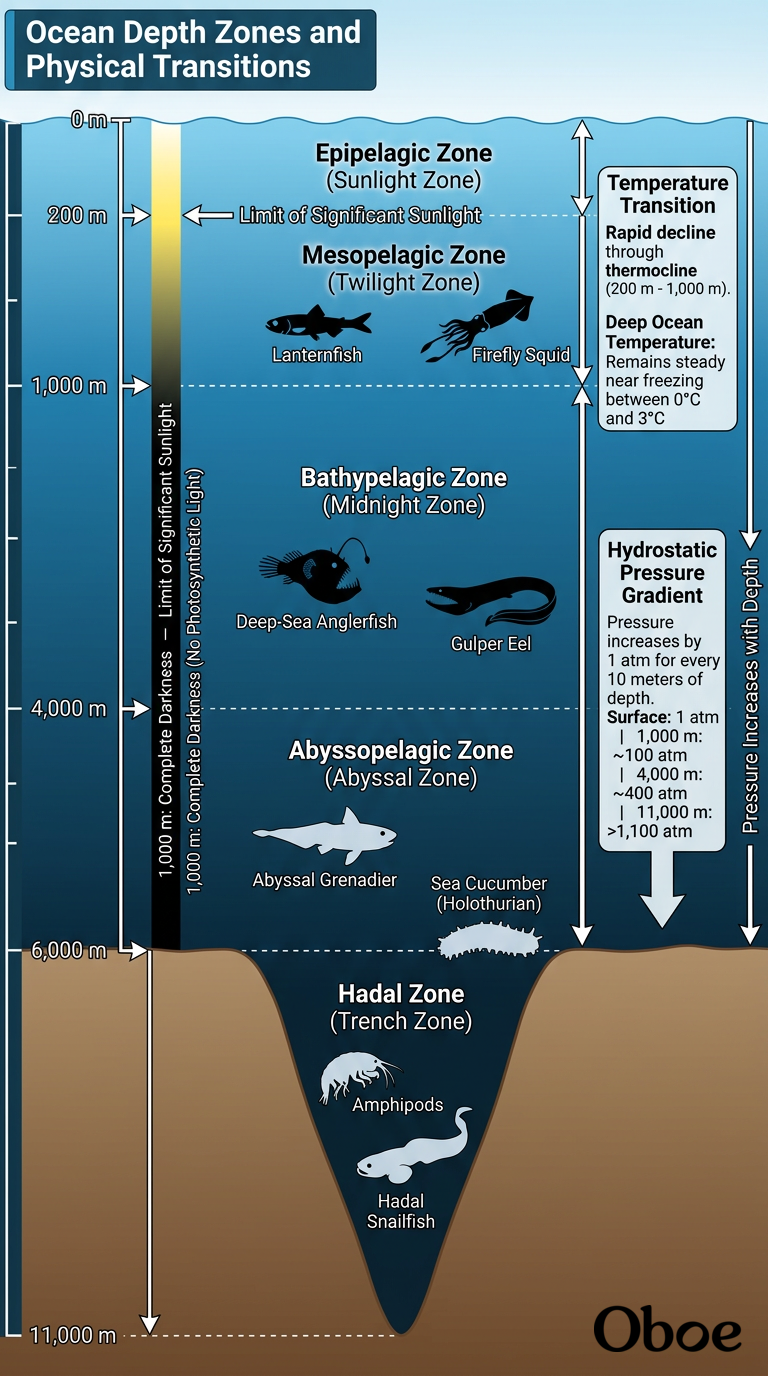
Ocean Depth Zones and Physical TransitionsDiagram

I've started generating a diagram that maps out these vertical zones so you can see how light, temperature, and pressure shift as you descend.

To give you an idea of the physical environment on those lower floors, by the time you reach the —which stretches from 4,000 to 6,000 meters—the temperature is hovering just above freezing.

But the real game-changer down here is the hydrostatic pressure. For every 10 meters you travel downward, the weight of the water above adds another atmosphere of pressure. By the time you get to the bottom of the abyssal plains, the pressure is equivalent to having an elephant standing on your thumb. It is an incredibly hostile environment, yet life has found a way to conquer it.

Continue to the extreme pressure and physical challenges

Let's plunge right into the physics of this crushing environment.

The Physics of Crushing Pressure

At sea level, you and I are walking around under 1 atmosphere (atm) of pressure, which is about 14.7 pounds of force pushing on every square inch of our bodies. We don't feel it because the fluids inside us are pushing outward with the exact same force.

But when you descend into the ocean, water is incredibly heavy. For every 10 meters you drop, the hydrostatic pressure increases by another full atmosphere. Let's look at how that pressure stacks up mathematically as you go deeper.

P(d)=1+d10P(d) = 1 + \frac{d}{10}
To put this in perspective, if you descend to 4,000 meters—the average depth of the abyssal plain—the formula shows us that the pressure is a staggering 401 atm. That is over 5,800 pounds of pressure squeezing every single square inch of a creature's body. So how does anything survive that? The secret lies in a basic law of physics: water doesn't compress easily, but air does. If you took a water-filled plastic bottle down to the abyss, nothing would happen to it because the water inside pushes back against the water outside. But if you took a cup filled with air, it would instantly be crushed into a tiny, distorted ball. Deep-sea animals survived by discarding their entirely. By filling their bodies and cells completely with water-filled tissues, they equalize the pressure inside and out, keeping their physical structures perfectly intact.

How do their cells work under pressure?

That is the ultimate mystery: getting rid of air pockets keeps a creature from imploding, but its individual cells still have to function under that massive weight. At sea level, cell membranes are fluid, and proteins constantly change shape to catalyze reactions. Under crushing deep-sea pressure, those delicate cellular structures would normally stiffen up and cease working entirely.

Cellular Shields Against the Crush

To keep their cells from freezing in place, deep-sea organisms utilize specialized molecular stabilizers. The most important of these is a tiny organic molecule called , or TMAO. TMAO acts as a physical shield for proteins. It binds tightly to water molecules, creating a protective cage around cellular enzymes. This prevents the surrounding water under high pressure from forcing its way into the protein's structure and distorting its shape, allowing vital metabolic processes to continue uninterrupted. Interestingly, the deeper an animal lives, the more TMAO its body must accumulate to fight off the rising pressure.
Alongside TMAO, deep-sea animals adapt by using and modified cell membranes. Instead of the rigid, tightly packed fats found in shallow-water membranes, deep-sea cells use highly unsaturated fats. These fatty acids have bent structures that keep the membrane loose and pliable, even when subjected to cold temperatures and immense pressure.
Speaking of cold, the deep sea is incredibly chilly—usually hovering just above freezing. Would you like to explore how these animals manage to keep their metabolisms running in temperatures between 0°C and 3°C?