
Spiritual experiences on nitrous
It's fascinating how a simple gas can trigger experiences that feel deeply sacred or cosmic. Before we dive into how nitrous oxide interacts with the brain to cause these effects, I'd love to know what brings you to this topic so I can tailor our conversation perfectly.
The first two

The Anatomy of a Spiritual Experience
A comparative visual representing the shift in boundary perception between everyday consciousness and transcendence.
Continue to how substances alter the brain to trigger these spiritual feelings
Chemical Keys to the Cosmic Door
When we ingest psychoactive substances, they act as keys that unlock, block, or alter the chemical transmission systems inside our brain. Normally, our brains maintain a stable, highly structured state of everyday consciousness. By altering the delicate balance of —the brain's chemical messengers—substances can temporarily dismantle the neural networks that construct our sense of time, space, and individual identity.
Tell me more about how expectations shape the experience
It is all about how our minds try to make sense of the unexpected. When a substance alters your brain, it does not come with an instruction manual; instead, your conscious mind steps in to translate those strange new physical sensations using your existing beliefs, environment, and expectations—a concept psychologists refer to as .
Think of your brain on a substance like an empty movie screen. The drug provides the bright light and the running projector, but your personal expectations, fears, and cultural background provide the actual film slides. If you inhale a gas expecting a deeply sacred revelation, your brain is primed to interpret feelings of dissociation or floating as a spiritual ascent. If you expect a medical anesthetic, you might just perceive the exact same chemical shift as a cold, clinical numbness.
Now that we see how our expectations and brain chemistry work together to build these profound moments, we are ready to look at the specific molecule you asked about: nitrous oxide. Let's see how this particular gas acts on the brain's pathways to create its famous dissociative and mystical effects.
So you don't think there's any objective truth to the gnosis
Did any famous thinkers write about nitrous experiences?
This historical search for meaning brings us right to the edge of how this humble molecule physically operates inside our heads. Let's move on and look at the actual pharmacology of nitrous oxide to see what is happening biologically when the mind starts to float.
How did William James try to capture his insights before they faded?
William James tried exactly what you might expect a determined 19th-century academic to do: he kept a pen and paper right next to him so he could write his insights down the very second they occurred.
It was a beautifully poetic letdown. While the experience itself felt like the pinnacle of absolute truth, trying to drag that truth back into normal waking consciousness turned it into an unreadable, looping tongue-twister. This famous story perfectly captures the transition we need to make next: how this fleeting "gnosis" is anchored in the very physical, fast-acting way nitrous oxide temporarily alters our nervous system.
Did he become addicted?
No, William James did not become addicted to nitrous oxide, which highlights an important distinction in how we think about the safety of this gas.
Now that we have explored the boundaries of spiritual experiences, history, and safety, we have reached a great natural bridge. We can transition into our next major subtopic, where we will look directly at the actual physical effects, dissociative sensations, and the exact pharmacological mechanism of nitrous oxide inside the brain.
Continue to Nitrous Oxide and Subjective Effects
Into the Void
Let's dive straight into how this simple gas begins its work in the brain. Nitrous oxide () is a fast-acting inhalant that is classified pharmacologically as a . This means it doesn't just dull physical pain; it literally disconnects your conscious mind from your sensory experiences. Under its influence, your body might feel incredibly heavy, light, or entirely absent, while your mind feels as though it is floating completely free of its physical container.
This profound feeling of separation from your body is what paves the way for the cosmic, out-of-body sensations William James and others described. The physical world starts to quiet down, leaving the mind to turn entirely inward, often accompanied by unusual auditory changes, such as a deep, rhythmic throbbing or a metallic ringing sound. Let's look at the exact chemical mechanism in the brain that makes this dramatic shift happen.

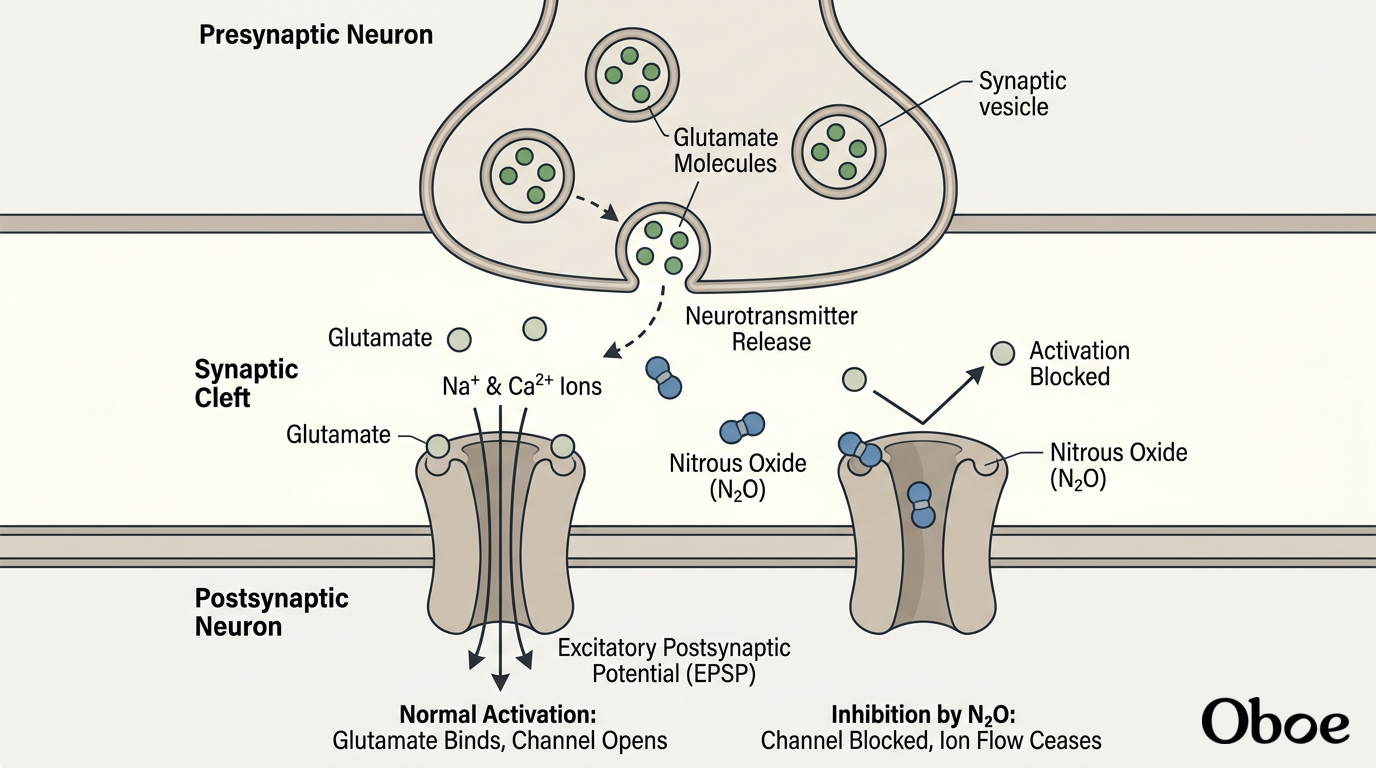
Now that we've initiated a diagram to show you this receptor interaction visually, let's unpack the chemistry. Nitrous oxide's primary mechanism of action is acting as an antagonist at the receptor. This receptor's job is to receive , the brain's main excitatory neurotransmitter, which keeps your brain active, alert, and processing sensory data. By blocking these receptors, nitrous oxide acts like a chemical mute button, instantly slowing down communication across the brain's networks.
Continue to the common subjective effects of nitrous oxide
It is incredibly fascinating to see how blocking a single type of brain receptor completely alters how we experience reality.
Is it agreed on that that's how it works?
You've hit on the exact question neuroscientists and pharmacologists are still actively debating.
While there is a strong scientific consensus that blocking is the primary gateway to nitrous oxide's dissociative effects, researchers don't all agree that this single mechanism explains the entire experience. Many scientists argue that focusing only on NMDA receptors is too simplistic to capture the full spectrum of the gas's psychological effects, such as the intense feelings of euphoria, warmth, and deep relaxation.
Continue to integration and meaning making
The Bridge Back to Earth
It is one thing to feel like you have touched the absolute center of the universe while floating in a state of chemical dissociation; it is an entirely different challenge to bring that feeling back down to Earth. This brings us to our final and perhaps most crucial subtopic: the practice of . In psychological terms, integration is the conscious process of translating raw, fleeting neurochemical insights into lasting, healthy changes in your daily behavior, relationships, and worldview.
Without this deliberate work, the profound "gnosis" of a nitrous oxide experience can vanish like a morning fog, leaving you with nothing but a loop of nonsensical words like the ones William James wrote down. To make these experiences meaningful over the long term, individuals must learn to build a conceptual bridge between two seemingly opposite realities: the cold, clinical neurochemistry of a gas blocking their receptors, and the warm, deeply felt spiritual truth of the connection they experienced.
Continue to bridging pharmacological reality with spiritual gnosis
Bridging that gap is exactly where the real work begins.
On the other hand, the spiritual language of "gnosis" describes the actual scenery you experience while standing on top of that mountain: the profound sense of timelessness, the sudden clarity, and the beautiful dissolution of your ego. Gnosis is not a theory; it is a direct, deeply felt encounter with what feels like ultimate reality. Bridging the two means realizing that explaining how the brain allows the door to open does not diminish the value of what you saw when you looked inside.
Rather than dismissing the spiritual insight as "just a chemical reaction," integration frameworks encourage people to treat the chemical reaction as a temporary window. The molecule simply cleared away the brain's daily analytical static, allowing a deeper emotional or existential truth to surface. The challenge is not choosing between science and spirit, but using the quiet space the chemistry created to look at your life with fresh eyes.
Continue to how integration helps build lasting daily meaning
Taking a fleeting chemical insight and turning it into a permanent part of your life requires moving beyond the initial high and applying structured to ground your experience.
One of the most effective ways to do this is through the lens of cognitive reframing, where you actively translate an abstract feeling into a concrete life habit. For example, if you experienced a profound, boundaryless sense of "oneness" during a nitrous trip, the integration process asks: how does that sense of oneness change how you treat your family, your coworkers, or the environment on a Tuesday afternoon? The goal is to make a permanent micro-adjustment in your daily character.
Another essential framework is somatic grounding, which focuses on reconnecting with the physical body. Because dissociative anesthetics like nitrous oxide work by disconnecting the mind from physical sensations, returning to Earth requires deliberate somatic practices—like mindful breathing, yoga, or spending time in nature. This helps physically anchor the memory of that peaceful, boundaryless state inside your nervous system, allowing you to access a calm state of mind later without needing a chemical key.
Continue to the end-of-session check-in
It is beautiful to see how we can respect both the clinical brain chemistry and the profound subjective meaning of these experiences at the exact same time.
We have journeyed all the way from defining the boundaries of mystical states to understanding the NMDA receptor pathways of nitrous oxide, and finally to the practical art of grounding those insights back on Earth. To wrap up our exploration of this topic, how do you feel about doing a quick, reflective check-in, or is there a specific area you'd like to dive back into?