
Oboe
No history yet

Define solid waste. Explain the different types and sources of solid wastes with suitable examples.

Welcome! We will explore solid waste, looking at its definition, different types, and sources with practical examples. Here is our roadmap for this session:

Your path
Types of Solid Waste
Sources and Real Examples

You can adjust this learning path at any point if you want to focus on specific areas. To help tailoring this session, are you studying this for an environmental science class or exam, or do you want a general overview of solid waste management?

I am studying for an environmental science class/exam.
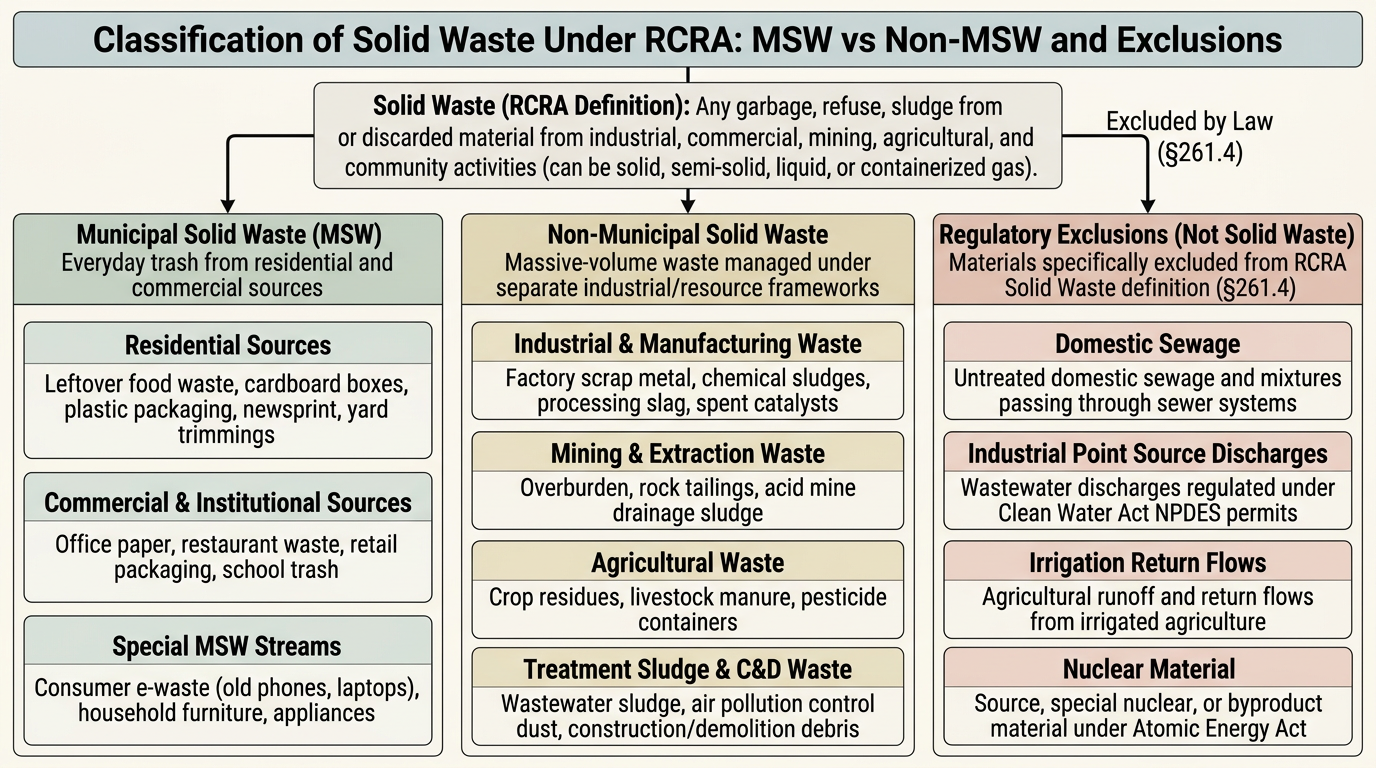
In environmental science, the legal and scientific foundation of waste management begins with how we define our target. According to the Resource Conservation and Recovery Act (RCRA) of 1976, is defined as any garbage, refuse, or sludge from wastewater treatment plants, water supply treatment plants, or air pollution control facilities. It also encompasses other discarded materials resulting from industrial, commercial, mining, agricultural, and community activities.
The scope of solid waste is incredibly broad, but it is critical for environmental science students to distinguish between the two primary legal categories: municipal solid waste (MSW) and non-municipal solid waste. MSW represents the everyday trash generated by households, offices, and schools. Conversely, non-municipal solid waste encompasses the massive volume of waste generated by industrial processes, mining operations, agricultural activities, and demolition, which are regulated under different frameworks.
To help visualize these legal parameters, I am generating a diagram highlighting the primary regulatory distinctions between municipal solid waste (MSW) and non-municipal solid waste, showing the typical sources and exclusions of each category. Let us test your understanding of these introductory definitions.
Classification of Solid Waste Under RCRA: MSW vs Non-MSW and ExclusionsDiagram
Which of the following would NOT be legally classified as a solid waste under typical environmental regulatory frameworks like RCRA?

Which of the following would NOT be legally classified as a solid waste under typical environmental regulatory frameworks like RCRA?

Domestic sewage discharged from a point source

Waste Management
LV 1
Skills
That is correct. Domestic sewage discharged from a point source is indeed excluded from the legal definition of solid waste under RCRA because it is already regulated under other clean water frameworks. Now that we have established these regulatory baselines, we can explore how environmental scientists classify solid wastes based on their physical and chemical properties rather than just their origin.
One of the most fundamental ways we categorize waste streams is by dividing them into and non-biodegradable materials. Biodegradable waste, often referred to as moist waste, consists of organic materials that can be broken down naturally by microorganisms. Conversely, non-biodegradable waste, or dry waste, contains inorganic substances that resist biological decomposition, remaining in the environment for decades or centuries unless they are targeted for physical .
Beyond simple biodegradability, modern society generates specialized waste streams that require unique management due to their toxic or complex nature. Among these, represents one of the fastest-growing environmental concerns globally. It contains highly toxic materials like lead, cadmium, and mercury, which can leach into soil and water systems if they are not processed in specialized reclamation facilities.

Which of the following properties distinguishes biodegradable waste from non-biodegradable waste in a landfill environment?

Its capacity to be broken down by microbial activity into simpler natural compounds

Waste Management
LV 1
Skills
You nailed it. That is the exact biological distinction between the two groups. Now we must turn our attention to the critical criteria that environmental scientists and regulatory bodies use to separate benign waste from . Under federal frameworks like RCRA, a solid waste is legally classified as hazardous if it exhibits at least one of four core characteristics: ignitibility, corrosivity, reactivity, or toxicity.
Let us break these four properties down. Ignitibility applies to wastes that easily catch fire, typically liquids with flashpoints below 60 degrees Celsius. Corrosivity identifies strong acids or bases that can corrode steel containers. Reactivity targets unstable materials that react violently with water or release toxic gases. Finally, toxicity is measured using the Toxicity Characteristic Leaching Procedure (TCLP), which simulates how metals and organic chemicals might leach into groundwater if the waste were disposed of in a landfill.
Alongside industrial hazards, environmental managers must isolate from regular waste streams. Generated by hospitals, veterinary clinics, and research laboratories, this waste includes infectious materials, human tissues, sharps like needles, and discarded pharmaceuticals. Because these items carry immediate pathogens, they cannot be mixed with municipal trash and generally undergo specialized sterilization via autoclaving or high-temperature incineration to protect public health.
Lesson image
To confirm your understanding of these critical hazardous and medical waste parameters before we explore their direct environmental sources, let us tackle this question. Which of the following tests is explicitly designed to determine if a waste is toxic under RCRA by simulating landfill leachate conditions?

Which of the following tests is explicitly designed to determine if a waste is toxic under RCRA by simulating landfill leachate conditions?

The Toxicity Characteristic Leaching Procedure (TCLP)

Hazardous Waste Management
LV 1
Waste Management
LV 1
Skills
You are exactly right. The Toxicity Characteristic Leaching Procedure (TCLP) is the precise regulatory test used to simulate the acidic liquid conditions of a landfill to evaluate if toxic elements will leach into the surrounding groundwater. Now that we have mastered the different legal definitions and properties of waste, we can transition to studying the environmental sources and real-world examples of how these materials are generated across different sectors.
Your path
Our first major category is , which encompass single-family homes and multi-family apartments. In these living spaces, everyday human activities generate waste stream components like organic kitchen scraps, yard clippings, and heavy amounts of packaging. When we look closely at the physical composition of household trash, consistently make up the largest percentage by weight before recycling efforts are factored in.
Which of the following materials typically constitutes the largest percentage by weight in unseparated municipal residential solid waste streams before recycling?

Which of the following materials typically constitutes the largest percentage by weight in unseparated municipal residential solid waste streams before recycling?

Paper and cardboard products

Waste Management
LV 1
Skills
You are spot on. Paper and cardboard make up the largest proportion of typical residential solid waste by weight before sorting, highlighting how packaging and printed materials dominate modern domestic waste streams.
Now let us shift our attention to sources of solid waste. Commercial waste generators include retail stores, offices, and restaurants, while institutional sources encompass schools, universities, and hospitals. While these sectors produce general trash similar to residential areas, they generate concentrated volumes of specific materials like heavy from shipping, massive quantities of office paper, and large amounts of food waste from cafeterias.
Next, we have of solid waste, which originate from manufacturing processes, chemical plants, and refineries. This sector generates large volumes of process , scrap metals, and fly ash from coal combustion. Unlike typical municipal waste, these industrial streams are highly uniform and are often handled under distinct, specialized on-site management and regulatory protocols because of their potential chemical hazards.
Finally, represent a major sector that produces massive amounts of organic and chemical solid wastes. These include crop residues left in fields after harvesting, animal manure from livestock operations, and spent pesticide containers. While crop residues and manure are organic and frequently recycled back into the soil as nutrients, modern high-density farming operations must carefully manage these streams to prevent nutrients from running off into nearby waterways.

To test your comprehension of these diverse waste sources, let us examine this scenario. Which of the following solid waste components would be classified as an industrial source of waste rather than a commercial or agricultural source?

Which of the following solid waste components would be classified as an industrial source of waste rather than a commercial or agricultural source?

Fly ash and air pollution control scrubber sludge from a coal-fired power plant

Waste Management
LV 2
Skills
You are absolutely correct. Fly ash and air pollution control scrubber sludge from a coal-fired power plant are classic examples of industrial solid waste, characterized by their high uniformity and chemical nature that require specialized, non-municipal disposal systems. This is distinguished from commercial and agricultural sources which focus on business packaging and farming operations respectively.
Now, let us examine the remaining sectors of our study, focusing on commercial, institutional, and agricultural systems. sources generate a massive volume of waste that looks similar to residential trash, but it is produced at a much higher, more concentrated scale. For example, retail department stores discard immense amounts of cardboard packaging, while universities and schools generate tons of office paper and food waste from dining halls. This concentrated flow of high-quality, uniform materials like corrugated boxes makes commercial waste highly valuable for targeted recycling streams.
To round out our understanding of these distinct environmental sources, we must look at . Unlike modern urban waste, agricultural waste is overwhelmingly organic, comprised of crop residues left in the fields and animal manure from livestock. While these materials are traditionally returned to the soil as natural fertilizers, intensive high-density farming can create hazardous nutrient runoffs. In addition to organic matter, modern farms also produce chemical container waste, such as discarded pesticide jugs, which require strict decontamination and disposal procedures.

To confirm your mastery of how these different sources contribute to the overall waste stream, let us try this scenario question.

Which of the following scenarios describes an agricultural solid waste source that requires specialized chemical handling, rather than simple organic recycling?

Pesticide containers and chemical fertilizer bags from a farming cooperative

Waste Management
LV 2
Skills
You are absolutely right. Pesticide containers and chemical fertilizer bags from a farming cooperative represent agricultural solid waste that requires highly specialized decontamination and disposal protocols due to their chemical toxicity, distinguishing them from compostable organic crop residues or manure.
Now that we have explored residential, commercial, industrial, and agricultural sources individually, we can synthesize how these diverse sectors feed into the broader, comprehensive waste stream. Environmental managers look at this entire collective output to develop macro-level management strategies. By understanding that integrates residential and commercial outputs, while non-municipal systems handle the massive bulk of industrial and agricultural byproducts, scientists can design targeted recycling and hazardous containment programs that protect both public health and ecosystem stability.
Let us review how all these pieces fit together across the different sectors. Which of the following statements best synthesizes the relationship between the various source sectors and the overall division of solid waste?

Which of the following statements best synthesizes the relationship between the various source sectors and the overall division of solid waste?

Residential and commercial sectors primarily generate municipal solid waste (MSW), whereas industrial and agricultural sectors generate the bulk of non-municipal solid waste.

Waste Management
LV 2
Skills
You are absolutely correct. Residential and commercial activities generate municipal solid waste, while industrial and agricultural sectors are responsible for the vast majority of non-municipal solid waste, marking the primary macro-level division in environmental planning.
Now that we have successfully navigated through the entire planned curriculum, from the core legal definitions under RCRA to the physical characteristics and diverse environmental sources of waste, let us transition into our comprehensive review phase to make sure you are fully prepared for your environmental science exam.
To give you a powerful tool for your final study sessions, I am generating a comprehensive exam preparation study guide. This document will synthesize key regulatory frameworks like RCRA, chemical properties like TCLP leaching, waste classification categories, and source-specific examples into an organized, high-yield summary.
Solid Waste Study GuideStudy Guide
The study guide has been generated above to consolidate your learning. To ensure you have absolute mastery of these synthesis concepts before your exam, would you like to attempt a comprehensive, multi-concept practice quiz, or would you prefer to review specific regulatory exclusions in detail first?

Explain municipal, residential, commercial, institutional, industrial, agricultural and construction & demolition wastes in detail.

To prepare you thoroughly for your exam, let us perform a detailed, structural breakdown of each waste category. Every sector generates unique materials with distinct physical compositions, , and disposal challenges.
Waste CategoryPrimary CompositionTypical ExamplesRegulatory & Management Pathway
Municipal Solid Waste (MSW)Mixed organic and inorganic urban streamsHousehold trash, office packaging, retail wasteManaged by local municipalities; sent to landfills, recycling facilities, or waste-to-energy plants
Residential WasteHighly organic and packaging-heavy materialsFood scraps, cardboard boxes, yard trimmings, plasticsCollected curbside; organic fractions are increasingly diverted to composting facilities
Commercial WasteHigh-volume, uniform recyclables and organicsCorrugated shipping boxes, administrative paper, restaurant food wasteManaged by private waste contracts; highly targeted for commercial recycling loops
Institutional WasteMixed administrative, cafeteria, and non-clinical wasteClassroom papers, university dining scraps, cafeteria plasticsManaged similarly to commercial waste; requires strict separation from hazardous laboratory streams
Industrial WasteUniform process byproducts and chemical residuesCoal fly ash, wastewater treatment sludges, metallurgical slagsRegulated under specific industrial permits; often managed on-site in private containment ponds
Agricultural WasteHighly organic biomass and specialized chemical containersCrop harvesting residues, livestock manure, pesticide jugsOrganic waste is recycled on-site as soil nutrients; chemical containers require specialized triple-rinsing
Construction & Demolition (C&D)Heavy, inert, and bulky structural debrisConcrete blocks, bricks, structural steel, asphalt, drywallRegulated under distinct debris permits; heavily sorted for salvage and concrete crushing operations
Let us highlight the final unique category: . C&D waste is generated during the construction, renovation, and demolition of buildings, roads, and bridges. This stream is characterized by heavy, bulky materials like concrete, steel, and wood. Unlike household trash, C&D waste is largely inert, meaning it does not biologically decompose to produce methane. However, its sheer volume can quickly overwhelm local landfills, which is why environmental managers prioritize crushing concrete for aggregate and salvaging structural metals.

To check your understanding of how these categories differ, let us look at this scenario. Consider a pile of broken concrete, discarded wooden drywall framing, and copper wiring pulled from a building renovation site. Which of the following classifications best fits this entire waste group?

Consider a pile of broken concrete, discarded wooden drywall framing, and copper wiring pulled from a building renovation site. Which of the following classifications best fits this entire waste group?