What is private capital in Macfarlanes context?
Welcome! I'm glad you've brought up this topic, as understanding how elite law firms approach the market is a fantastic way to grasp commercial practice.
Before we dive into the specific way Macfarlanes positions itself to serve private capital clients, I'd love to learn a little more about what brings you here today. Having this context will help me tailor our commercial discussions.
Both, or I'm just generally curious about elite law firm strategies.
It is great to have you here, and your curiosity about how elite law firms navigate the market is spot-on.

Continue to the lifecycle support details
Let's dive straight into the heart of the fund lifecycle and see how Macfarlanes supports a private capital manager's business from start to finish.
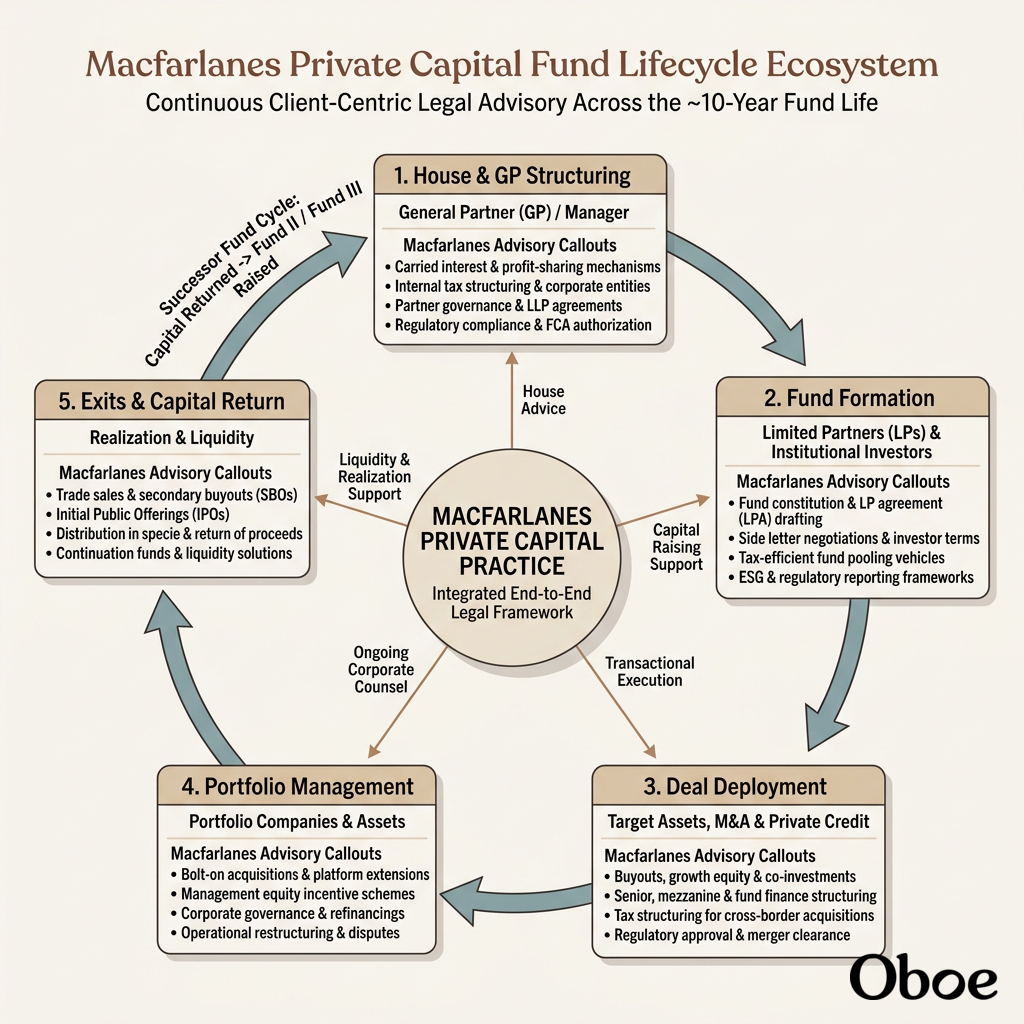
The Five Stages of the Fund Lifecycle
- House and GP Structuring: Before a single dollar is raised, the manager (the ) has to establish their own internal house structure. This includes determining how profit-sharing (carried interest) is distributed among partners, setting up internal tax entities, and establishing governance.
- Fund Formation: This is where the manager raises capital from external investors like pension funds and sovereign wealth funds. Macfarlanes' fund formation lawyers draft the constitution of the fund and negotiate the complex investment terms with these heavyweight .
- Deal Deployment: Once the fund has capital, it must buy assets. This is the highly publicized transactional phase. Macfarlanes lawyers act on the buyouts, structuring the debt and equity needed to acquire target businesses or real estate.
- Portfolio Management: After buying a business, the fund must manage it. The firm advises on portfolio company corporate governance, bolt-on acquisitions, employment incentive schemes, and operational restructurings.
- Exits: The final stage is returning cash to investors. The firm structures the exit—whether through a sale to another private equity buyer, a strategic trade sale, or an initial public offering (IPO). Once the cash is returned, the cycle starts immediately again with the GP raising 'Fund II' or 'Fund III'.
I've started creating a diagram to help you visualize exactly how a private capital manager moves through these phases and how Macfarlanes embeds its lawyers at each turn.