
Present simple
Welcome! I'm excited to help you master the today.
Before we dive in, how comfortable do you currently feel using the Present Simple, and is there anything specific you want to focus on today?
I'm a beginner and want to start from the absolute basics.
Starting from the absolute basics is the perfect way to build a rock-solid foundation! Since we have our path ready, let's take a look at the road ahead.

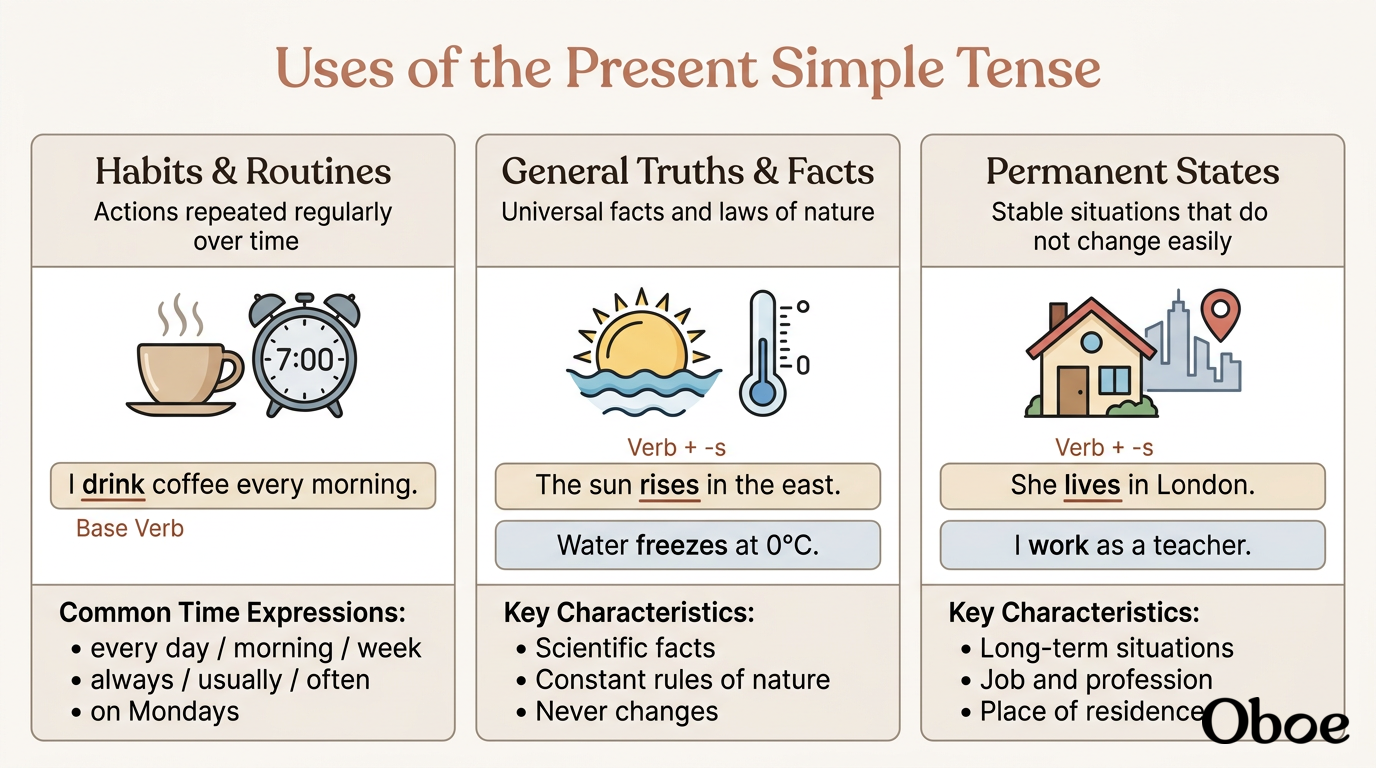
- Habits and Routines: Things you do repeatedly. For example, "I drink coffee every morning" or "They watch TV every night."
- General Truths and Facts: Constants in the world that don't change. For example, " at zero degrees" or "The sun rises in the east."
- Permanent States: Things we view as stable and unchanging. For example, "She lives in London" or "I work as a teacher."
Can we make a diagram of these three buckets?
I would love to! Visualizing these categories makes them so much easier to remember and recognize when you are reading or speaking.
- Always (100% of the time): "I always brush my teeth."
- Usually (about 80-90%): "We usually eat dinner at home."
- Often (about 50-70%): "He often reads books."
- Sometimes (about 20-40%): "They sometimes go to the park."
- Never (0%): "She never eats meat."
- Every day / week / year: "I study English every day."
Give me a quick translation exercise with these
You got it! Translating is an amazing way to train your brain to stop translating word-for-word and start feeling the natural rhythm of English.
Let's do three quick translations together, focusing on how we use those like always and never. Since we are using the base verb form for "I" and "they" at this stage, we won't worry about adding "-s" to the verbs just yet.
How would you translate this first sentence into English?
"Yo siempre bebo café por la mañana." (Hint: 'to drink' is 'drink', and 'coffee' is 'coffee'.)