
Money math
Welcome to Money Math. Before we dive into the fun world of counting coins and bills, I'd love to know what brings you here today so I can tailor our practice.
Are you learning money math for a specific grade level, or are you working on practical, everyday money skills for yourself?
I want everyday life skills
It is great to have you here! Since you are focusing on practical, everyday life skills, we will skip the school-style drills and focus on the math you actually use when buying groceries, paying bills, and managing your wallet.

| Coin | Value in Cents | Value in Dollars | Physical Description |
|---|---|---|---|
| Penny | 1¢ | $0.01 | Copper-colored, smooth edge |
| Nickel | 5¢ | $0.05 | Thick, silver-colored, smooth edge |
| Dime | 10¢ | $0.10 | Thin, silver-colored, smallest coin, ridged edge |
| Quarter | 25¢ | $0.25 | Large, silver-colored, ridged edge |
| Half Dollar | 50¢ | $0.50 | Very large, silver-colored, rarely used |
Show me a diagram of the coins to help me compare them.
You've got it! A visual is the perfect way to lock in these relative sizes and values so you can identify them at a glance without having to squint.
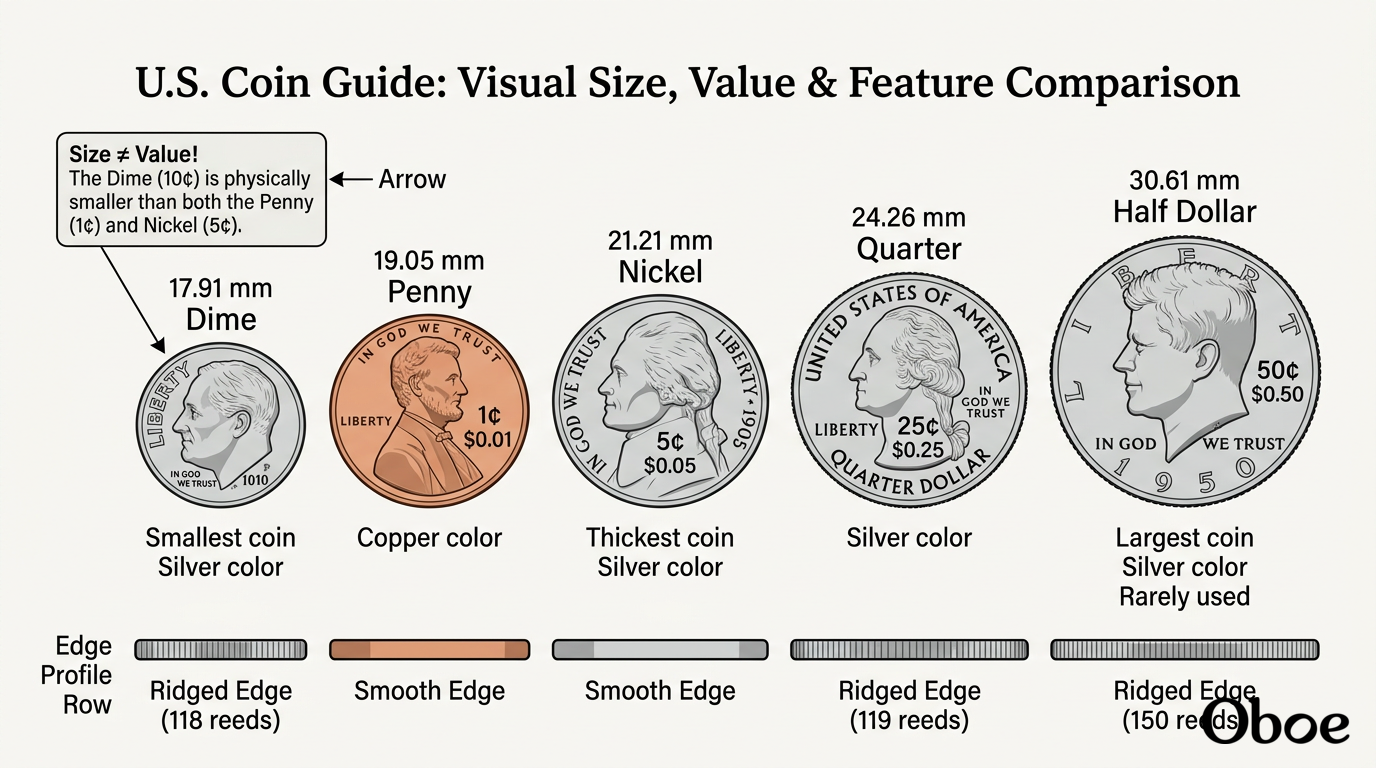
I have set up that diagram for you. It really helps to see how the dime is actually the smallest physical coin, which is the most common pitfall when counting quickly under pressure at a checkout register.
Now that you have a visual sense of these, let's step up to the next crucial skill: counting mixed collections of these coins and bills quickly and accurately in real life.
Continue to counting mixed collections
Let's dive straight into counting. When you are standing at a busy cash register, you don't want to count your physical cash one piece at a time in a random order.
To see this in action, let's look at a quick, step-by-step walkthrough. Imagine you open your wallet and find these loose coins rolling around:
- One nickel (5¢)
- One quarter (25¢)
- Two dimes (10¢ each)
Instead of grabbing whatever coin your fingers touch first, you immediately sort them in your mind from highest value to lowest:
- Quarter (25¢)
- Dimes (10¢, 10¢)
- Nickel (5¢)
Now, we skip count our way through them step-by-step:
| Step | Coin Added | Value | Running Total |
|---|---|---|---|
| Start | Quarter | 25¢ | 25¢ |
| Step 1 | First Dime | +10¢ | 35¢ |
| Step 2 | Second Dime | +10¢ | 45¢ |
| Step 3 | Nickel | +5¢ | 50¢ |
Starting with the largest value makes the math smooth and clean. If you had started with the nickel and dimes first, you'd end up trying to add 25¢ to 25¢, which is much more prone to mental hiccups when you are in a rush.
Would you like to try a quick scenario yourself to practice sorting and skip counting, or would you prefer to see how we write these totals using correct decimal notation first?
Make me a quick worksheet to practice this
You've got it! Practice is where these quick counting habits really become second nature, especially when you want to build up speed.
I have put together a custom practice worksheet for you! It features five real-life scenarios designed to help you organize mixed change in your head and skip count it step-by-step from the highest value to the lowest.
Take your time working through those practical exercises. Once you feel comfortable with the sorting and skip counting process, we can move on to looking at how to write these values down correctly using dollar and cent notation.