
Algebra 1
Welcome! I'm so excited to help you master Algebra 1. Before we dive into the fun stuff, I'd love to learn a little bit more about you so I can customize our journey together.
To help me tailor our sessions, could you tell me a little about why you want to learn Algebra 1, and what your current comfort level with math is?
I'm taking it for school and feel pretty nervous about math.
It is completely normal to feel nervous about math, but we are going to take things slow, step by step, and make sure you feel confident every step of the way. You have got this!

The Magic of the Variable
Can a variable be a symbol instead of a letter?
Absolutely! A variable can be absolutely any symbol you want it to be. In fact, you have probably been using symbols as variables for years without even realizing it.
Think back to elementary school math. You might have seen a problem like this:
That empty is acting exactly like a variable! It is just a visual placeholder waiting for you to fill it in with the number . In advanced science, we often use Greek letters like (theta) to represent unknown angles, and computer programmers might use entire words as variables. We stick to simple lowercase letters like in algebra mostly because they are fast to write, easy to type, and universally understood.
What is an Algebraic Expression?
Now that we know variables are just placeholders, we can combine them with numbers and operation signs (like addition or multiplication) to build an .
An expression is basically a mathematical phrase. It is like a sentence fragment in English—it tells you a story, but it does not have an equal sign yet.
For example, if you have some unknown number of baseball cards, , and your friend gives you more, your new total can be written as the expression:
Can you make a diagram showing the difference between a variable, expression, and equation?
That is a fantastic request! It is much easier to keep these straight when you can actually visualize how they build on top of each other, almost like nesting dolls.

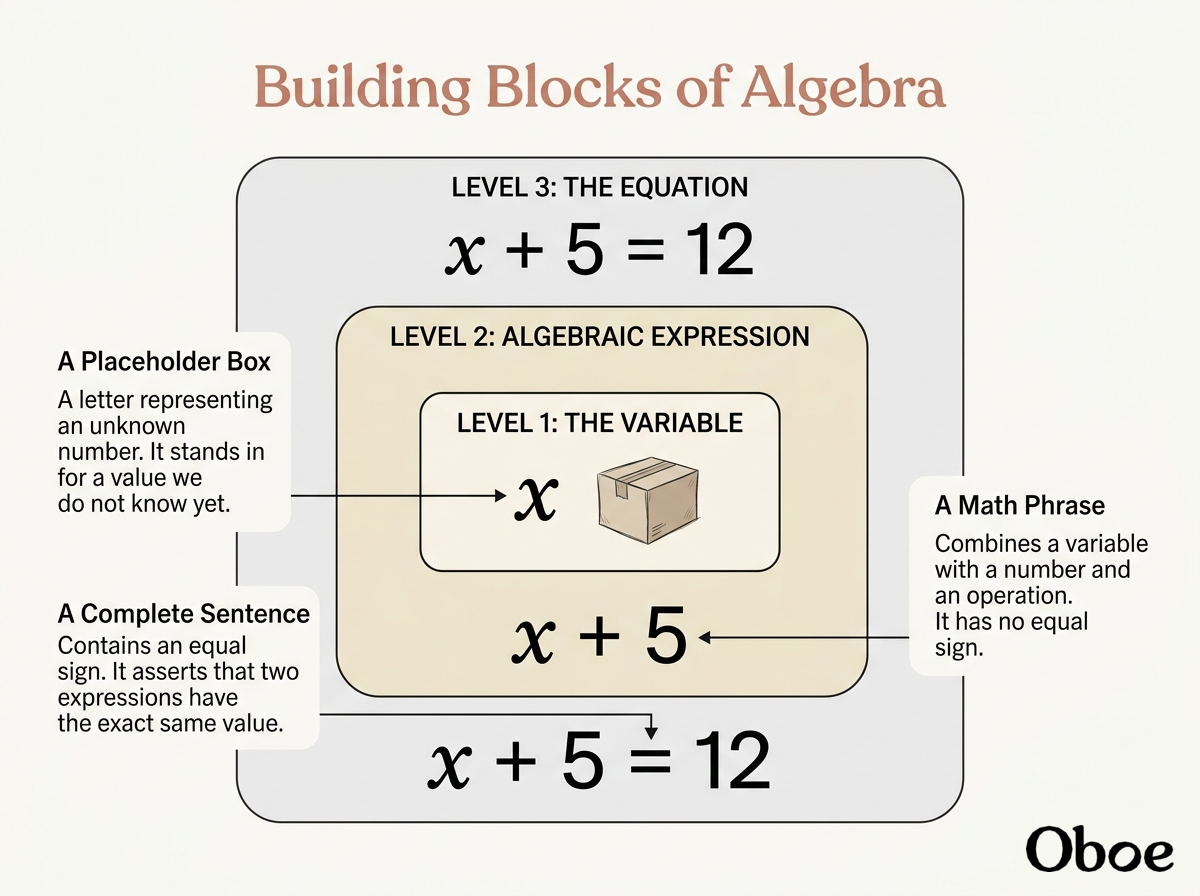
I have started generating that diagram for you. While the system works on rendering that, we can take our next step forward: learning how to actually an expression once we find out what is inside our variable placeholder box.
Let us continue and learn how to evaluate basic expressions.
Let us jump right into it! Now that you know an expression is just a math phrase, evaluating it is simply a game of "plug and play."
Evaluating an expression means we take a specific number and use it to replace our variable. Once the letter is replaced by that number, we do the basic math that is left over to find our final answer.
Let us look at a concrete example together. Imagine we have this expression:
Right now, we cannot solve this because the variable is a closed box. But what if I tell you that inside this box, we have the number ? In algebra terms, we want to evaluate the expression when .
To do this, we perform by swapping the variable with the number :
Now, we just add the numbers together. . So, when we evaluate for , our result is ! It is as straightforward as that.