
More about the book "How to Stand the F Out" by Louis Grenier and his philosophy on brand and marketing
Welcome! I'm thrilled to dive into Louis Grenier's masterclass on radical differentiation. Before we build your custom roadmap, I have one quick question to help tailor our session to your goals.
Are you looking to apply Louis Grenier's marketing philosophy to a specific business or brand of your own, or exploring it purely out of general interest?
I'm looking to teach other small businesses how to use it. We'll do that by teaching small groups of students the philosophy so that they can go out and help those small businesses, and then they'll be able to apply it after they internalize it.
That is an incredibly smart and high-leverage way to scale this philosophy. By training your students to act as advisors, you aren't just teaching them theory; you're equipping them with a practical system to rescue small businesses from what Louis Grenier calls the "sea of beige"—that crowded, low-barrier market where everyone looks and sounds exactly the same.

The Cost of Playing It Safe
Continue to the four stages of the framework
Let's crack open the difference between being differentiated and being distinctive first, as this is the single biggest point of confusion for young marketing advisors.
To put it simply, differentiation is about why people buy you, while distinctiveness is about how they remember you.
| Concept | Differentiation | Distinctiveness |
|---|---|---|
| Core Purpose | Giving the right people a compelling reason to choose you over alternatives. | Sticking in people's minds as a memorable shortcut so they think of you first. |
| Focus Area | The actual product, service, and positioning (solving ignored struggles). | Brand assets (logos, colors, slogans, unique terminology, tone of voice). |
| The Action | Designing a unique solution for a specific niche. | Standing out visually and behaviorally without needing to act like a gimmick. |
Make a diagram of the 4-stage framework
You've got it! I have initiated the creation of a clear visual diagram illustrating Louis Grenier's so your students can see exactly how a business journeys from invisible to unforgettable.
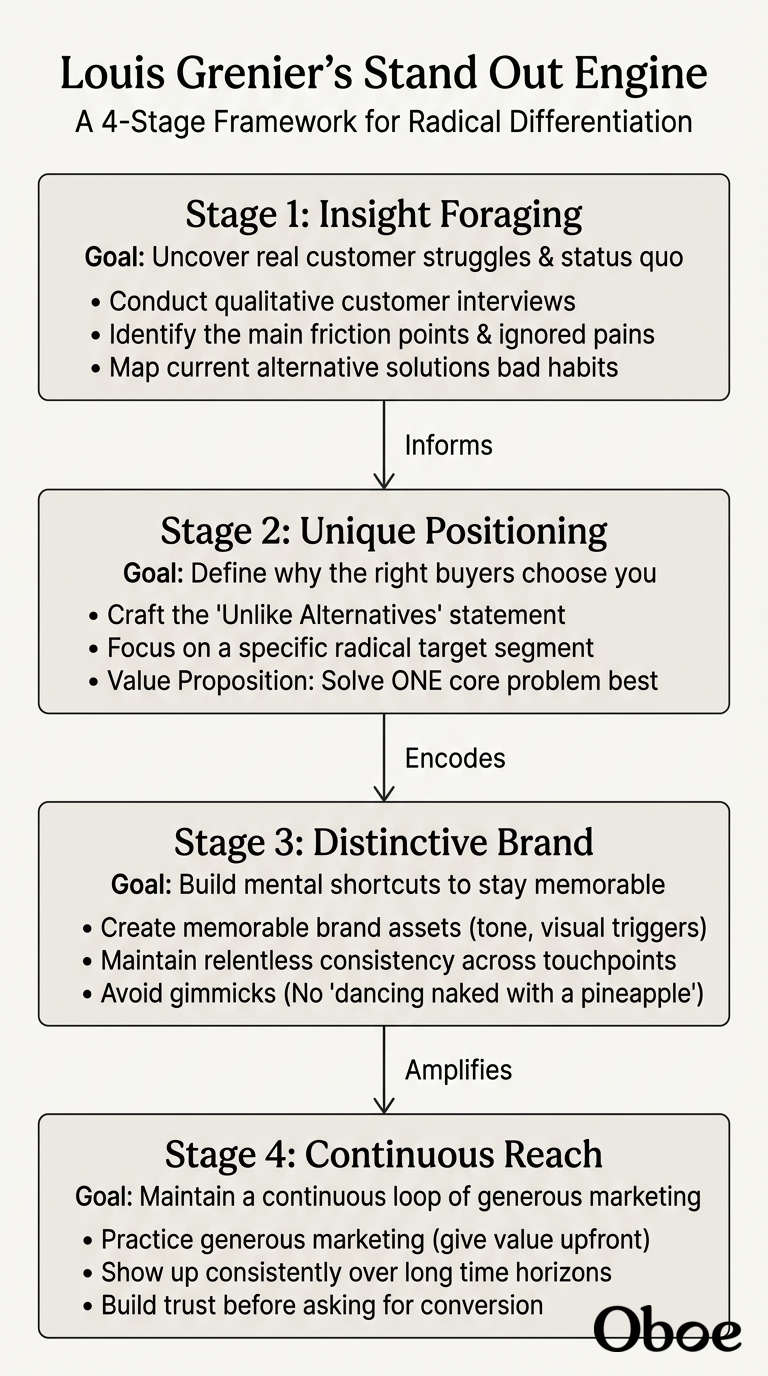
- Insight Foraging: Instead of asking customers what they want, advisors help clients dig up the status quo and identify the frustrating, ignored struggles that competitors are completely overlooking.
- Unique Positioning: Advisors use those raw insights to construct a positioning statement: Unlike alternatives, our brand is the only one in the category to solve these ignored struggles for this specific target segment.
- Distinctive Brand: Here, advisors help the client turn that rational position into consistent, repeatable brand assets (like specific colors, sounds, or terminology) that make the brand memorable without resorting to silly gimmicks.
- Continuous Reach: Finally, the business uses generous marketing—giving immense value away for free first—to systematically build trust and capture market share over the long haul.
What makes a customer struggle 'ignored'?
An "ignored struggle" is the key to escaping the sea of beige, and it's built on a simple truth about human behavior: most businesses are completely blind to what actually frustrates their customers.
The Anatomy of an Ignored Struggle
Continue to Stage 1: Insight Foraging Methods
To turn your students into world-class advisors, they must first master the art of the dig. Stage 1 is all about , and it begins with understanding the ultimate heavyweight champion of market resistance: the status quo.
The Silent Competitor
- Unscripted Customer Interviews: Talk to recent buyers who just switched from a competitor, or those who almost bought but walked away. Ask them to walk you through the exact day they decided to look for a solution. What was the tipping point?
- Digital Wiretapping: Quietly hang out where the target customers naturally vent their frustrations. Go to Reddit, specialized Facebook groups, or Amazon 1-star book reviews for the industry. Look for recurring phrases like 'I hate when...' or 'Why is it so hard to...'
- Shadowing Customer Support: Listen to live support calls or read helpdesk tickets. This is where customers are at their most honest because they are experiencing active, real-time friction.
Once your students gather this raw transcript data, they need to look for patterns. They are searching for the line where standard, expected complaints end, and a true, unaddressed 'ignored struggle' begins.
How do we help them spot that exact difference?
Give me an example of an unscripted interview question
To pull back the curtain on what your clients' customers are actually experiencing, your students must teach them to stop asking hypothetical questions like "What do you want in a service?" and start asking retrospective, narrative-driven questions instead.
- "What did you try first to fix it before you found us?" (This exposes their real status quo workarounds).
- "What almost stopped you from buying?" (This reveals the exact anxieties and friction points in their purchase process).
- "How did you feel right after you finally made the switch?" (This uncovers the immediate emotional relief they paid for).
Do you want to explore how to teach digital wiretapping and customer support shadowing, or should we look at how to organize this qualitative data to spot patterns?
Continue to spotting patterns in qualitative data
Now that we have the raw, emotional stories from our customer research, we have to make sense of them. If your students leave their clients with dozens of pages of interview transcripts and messy notes, those clients will get overwhelmed and default right back to their comfortable status quo.
The Post-it Note Sieve
To find the patterns, your students should guide their clients through a simple qualitative sorting exercise. The goal is to distill hours of conversation into a few recurring themes. They can do this physically on a whiteboard or digitally in a tool like Miro.
First, have them comb through the transcripts and write every single raw customer quote, pain point, and trigger onto individual sticky notes. Instruct them to use the customer’s exact words. If a customer said, "I felt like an idiot trying to figure out their software," write exactly that—do not sanitize it into "User experienced interface friction."
Next, group these sticky notes into clusters based on shared themes. As the clusters form, they will notice they naturally fall into two distinct piles. One pile represents standard, superficial complaints, while the other contains true, . Recognizing the line between these two piles is where your students will prove their value as advisors.
| Category | Standard, Superficial Complaints | True, Ignored Struggles |
|---|---|---|
| What It Is | General, surface-level annoyances that are expected in the industry. | Specific, emotionally-charged tipping points where the status quo broke. |
| Competitor Response | Competitors already know about these and promise generic fixes. | Competitors ignore these because they require changing how they operate. |
| Customer Emotion | Mild irritation or minor inconvenience. | Deep frustration, anxiety, or feeling stupid. |
| Example (Software) | "The software is too expensive." | "I feel completely abandoned by support when something breaks on a weekend." |
To show your students how to spot a true ignored struggle, let’s look at a classic example from the software world. A standard complaint is "I want a simpler dashboard." If a software company listens to that, they just redesign their UI.
But if you dig into the patterns of why they want a simpler dashboard, the real ignored struggle emerges: "I am terrified of making a mistake that deletes our customer records, and I feel stupid every time I try to run a weekly report for my boss."
That isn't a UI problem; it’s an anxiety problem.
By organizing the research data this way, your students can point to a cluster of sticky notes and show their client: "Look, your competitors are all screaming about having 50+ features. But your customers are actually terrified of feeling stupid. If we position your brand as the only stress-free, idiot-proof alternative, we win."
Once they have grouped these patterns, they are ready to transition to Stage 2 and build a rock-solid positioning statement that locks this insight into place.
Continue to Stage 2: Engineering Unique Positioning
Welcome to Stage 2. Now that your students have harvested those rich, messy customer stories, it's time to build the strategic engine of the entire methodology: Engineering Unique Positioning.
The Internal Compass
The Five-Ingredient Formula
positioning
noun
The strategic act of defining how a brand uniquely solves a specific customer problem compared to all available alternatives in the mind of the target audience.
| Ingredient | Description | Example (A Boutique Agency) |
|---|---|---|
| 1. Unlike Alternatives | The current status quo workarounds or competitors the buyer is using. | Unlike standard, automated recruiting software, |
| 2. Brand/Product | The name of the client's business or product. | TalentCraft |
| 3. Category | The existing mental bucket the customer already understands. | is the only hiring consultancy |
| 4. Ignored Struggles | The specific, emotional friction points competitors overlook. | that eliminates the anxiety of high-turnover ghosting and bad culture fits |
| 5. Target Segment | The hyper-specific group of people experiencing this pain. | for fast-growing, remote-first SaaS startups with 10 to 50 employees. |
Should we look at a worked example of how to build one of these statements step-by-step with a real small business client, or should we talk about why leaning on existing customer mental models is so much easier than trying to change their minds?
Show me a step-by-step worked example of building this statement
Let's walk through exactly how your students can help a real business build this statement. We will use a fictional client: a local commercial cleaning company called EcoShine.
The EcoShine Breakthrough
Before working with your students, EcoShine is completely stuck in the . Their website looks like every competitor's: pictures of spray bottles, promises of "high quality," and a list of services. They are constantly forced to slash their prices just to win clients.
Your students step in and take them through the positioning formula, ingredient by ingredient:
Step 1: Pin down the Alternatives
Your students ask, "If you didn't exist, what would your customers do?" EcoShine's owner says, "They'd hire national cleaning franchises or cheap, under-the-table independent cleaners."
- Ingredient 1 (Alternatives): National cleaning franchises and cheap independent cleaners.
Step 2: Define the Brand
This one is simple.
- Ingredient 2 (Brand): EcoShine.
Step 3: Anchor the Category
What mental bucket do clients put them in? We don't want to invent a new category because changing people's minds is too hard. We lean on what they know.
- Ingredient 3 (Category): Commercial office cleaning service.
Step 4: Uncover the Ignored Struggles
Your students interview EcoShine's best clients. They discover the real friction isn't dusty desks. The actual, emotional struggle is that office managers are incredibly stressed by cleaners who show up late, skip rooms, lock the keys inside, or leave the alarm sounding at $2:00 AM, triggering urgent middle-of-the-night security phone calls.
- Ingredient 4 (Ignored Struggles): The anxiety of unreliable cleaners, missed areas, and middle-of-the-night security alarm scares.
Step 5: Narrow the Target Segment
Instead of "all local businesses," your students guide them to focus on the office spaces where security and reliability matter most: local high-security professional offices (like law firms, wealth managers, and medical clinics) with 15 to 100 employees.
- Ingredient 5 (Target Segment): Local professional firms (lawyers, medical clinics, wealth advisors) with 15 to 100 staff members.
Now, your students fuse it all together into the final internal compass statement:
"Unlike national franchises or cheap independent cleaners, EcoShine is the only commercial office cleaning service to eliminate the anxiety of unreliable staff, skipped rooms, and middle-of-the-night alarm scares for local high-security professional firms with 15 to 100 employees."
Suddenly, EcoShine has a filter for every business decision. When they recruit cleaners, they focus heavily on background checks and reliability. When they sell, they don't talk about "clean windows"—they talk about their "zero-alarm-scare guarantee."
Does this step-by-step walkthrough help clarify how your students can apply the formula, or should we discuss how to select a tight, profitable niche without giving in to client panic?
Create a worksheet for this positioning statement formula
I've kicked off a customized, interactive worksheet designed to help your students master and apply Louis Grenier's positioning statement formula step-by-step with small business clients.
Continue to Stage 3: Distinctiveness
Let's plunge straight into Stage 3 of Louis Grenier's philosophy: Distinctive Brand. Your students need to teach their clients how to become deeply memorable without ever resorting to cheap tricks.
Sticking in Their Minds
| Asset Type | What It Means | Real-World Application |
|---|---|---|
| Signature Colors | Choosing a highly unexpected, non-traditional color for the industry. | A plumbing company ditching standard blue/water motifs for a vibrant, hot pink truck fleet. |
| Unique Terminology | Coining custom, proprietary names for standard processes or ideas. | Instead of "Our Onboarding Process," calling it "The 24-Hour Kickstart Blueprint." |
| Specific Tone | Adopting a highly distinct, unwavering style of communication. | Writing invoice emails with warmth, humor, and a signature sign-off phrase every single time. |
| Mascot or Character | A recognizable visual anchor associated with the brand experience. | A local software team using a hand-drawn, slightly grumpy owl on all their support pages. |
Think of it this way: differentiation is the lock (the specific problem you solve), and distinctiveness is the bright red key tag (making sure they can find the key in a crowded drawer).
By keeping assets simple and using them everywhere—from the website favicon to the email signature—the small business naturally stakes out a permanent home in the customer's brain.
How do we choose brand assets that fit our positioning?
To make sure your clients' brand assets actually match their new strategy, your students must teach them to treat their positioning statement as a filter. We don't just pick random colors or fun catchphrases because we like them; we choose them because they physically represent the promise we made in our positioning.
The Mirror Principle
To keep brand assets aligned, your students can use the . The concept is simple: every brand asset must act as a direct, sensory reflection of the internal positioning statement. If a brand's positioning is about bringing absolute peace of mind and eliminating stress, its visual and verbal assets should actively project that calm.
| Strategic Promise (Positioning) | Aligned Distinctive Asset Choice | Misaligned/Gimmicky Trap |
|---|---|---|
| Extreme Reliability (EcoShine's zero-alarm guarantee) | A live, real-time "security-clearance green" dashboard for clients to see when cleaners check out. | A goofy cartoon raccoon mascot holding a mop on the homepage. |
| Sleek Speed and Efficiency | Short, single-sentence emails; a brand palette of stark, fast-moving high-contrast black and yellow. | Long, poetic blog posts about the history of the industry written in a warm, chatty tone. |
| Ultimate Creative Originality | Custom, hand-drawn charcoal illustrations of client team members on the website. | Standard stock photography of smiling people in business suits pointing at a whiteboard. |
Let's apply this back to our local cleaning client, EcoShine.
Their positioning is all about eliminating the anxiety of late cleaners, missed rooms, and terrifying middle-of-the-night alarm scares. If they use a bright, playful cartoon mascot, it completely breaks the trust. That's a gimmick.
Instead, your students can guide them to align their assets directly with that "unshakable peace of mind" promise. For example:
- The Visual Asset: Every single EcoShine field manager wears a crisp, tailored, dark charcoal uniform with a visible "Security Cleared" physical badge. This instantly signals high-level security, not just low-level dusting.
- The Verbal Asset: Instead of a generic customer portal, they name their tracking system "The Zero-Alarm Protocol".
- The Behavioral Asset: They send a automated, beautifully clean SMS to the office manager at exactly $9:00 PM every clean night with two simple checkboxes: "Securely Locked. Alarm Armed."
This is how your students help clients bridge the gap between abstract strategy and real-world brand assets. It turns distinctiveness into a weapon that reinforces the positioning at every turn.
Continue to Stage 4: Continuous Reach
Now we arrive at the fourth and final pillar of the methodology: Stage 4: Continuous Reach. This is how your students ensure their clients' beautifully positioned, highly distinctive brands actually get noticed by the market day after day.
The Power of Generous Marketing
What are some examples of 'gifts' a service business can offer?
Four Killer Service Gifts
| Gift Type | How It Works | Real-World Example (B2B Advisor) |
|---|---|---|
| The Proprietary Audit | A self-guided scorecard that lets clients grade themselves against industry benchmarks. | A "Beige-Brand Audit" where a marketer helps a business grade their website's distinctiveness. |
| The Actionable Checklist | A highly granular, step-by-step checklist to execute a complex task without errors. | A "24-Point High-Security Office Move Checklist" offered by a commercial cleaning firm. |
| The Ungated Template | A ready-to-use template or script that solves an immediate, highly specific operational headache. | An exact, copy-and-paste email template to handle difficult client contract negotiations. |
| The Diagnostic Framework | A logical visual chart or matrix that helps a client diagnose exactly where their system is broken. | A "Leak Finder Matrix" used by a software developer to identify where a SaaS app is losing users. |
Make me a worksheet on designing high-value gifts
I've kicked off the creation of a dedicated worksheet to help your students map out and design incredibly high-value "gifts" that establish trust for their clients.
Now that we have created a systematic way to build these valuable gifts, the final challenge is keeping a sustained presence in the market.
Louis Grenier points out that well-intentioned business owners almost always fail here because they jump from tactic to tactic. They try a newsletter for three weeks, then jump to TikTok, then launch a webinar. It is exhausting, and it yields zero results.
To build sustained reach, your students must teach clients to find one marketing channel they actually enjoy—be it writing, podcasting, or networking—and show up there generously and consistently for years. Real trust is built on relentless, predictable presence, not sporadic bursts of noise.
Continue to the end of Stage 4 and summarize our learning session
The Journey from Beige to Radical
We have just traveled through the entire landscape of Louis Grenier's radical differentiation method. From the moment we decide to reject safe marketing down to the long-term consistency of continuous reach, you now have the exact blueprint to train your student-advisors.
Let's pull all of these pieces together into a single, cohesive snapshot of the entire four-stage roadmap your students will use to rescue small businesses from the :
- Stage 1: Insight Foraging: Your students ignore standard competitor checklists. Instead, they run retrospective customer interviews, dig through digital forums, and shadow support channels to find the specific, emotionally-charged ignored struggles that are breaking the default status quo.
- Stage 2: Engineering Unique Positioning: They take those raw insights and construct a five-ingredient internal positioning statement. By anchoring the client in a familiar category and focusing on a tight target segment, they build a behind-the-scenes compass that guides every business decision.
- Stage 3: Distinctive Brand: They turn that strategic positioning into real-world, sensory brand assets—colors, terminology, tone, or mascots—using the Mirror Principle to ensure they build strong mental shortcuts without resorting to cheap gimmicks.
- Stage 4: Continuous Reach: Finally, they help the business show up consistently on a chosen channel, using high-utility "gifts" like scorecards or actionable templates to trigger reciprocity and build long-term, compounding trust.
Now that we have walked through every stage of the framework and generated practical worksheets for your curriculum, we are at the perfect transition point. To make sure your students can go out and confidently apply this with real clients, we should decide how to shape the final phase of your training prep.
Create a study guide summarizing the entire learning session
I've enqueued the generation of a comprehensive study guide for you, designed to serve as a master reference text for your student-advisors as they internalize this entire marketing philosophy.
I have set the wheels in motion to construct a master reference study guide that will act as the ultimate blueprint for your student-advisors as they internalize Louis Grenier's philosophy.
The study guide is being assembled with structured takeaways, concrete examples from our session, and key frameworks to make their training highly practical.
Now that you have the complete framework from foraging to continuous reach, along with the custom worksheets and a comprehensive study guide, you are fully armed to train your team. Since we have covered all four core stages of the curriculum outline, what would be the most valuable next step for you?
How do we wrap this all up?
To wrap this up beautifully, we want to transition from theory to action so your student-advisors are fully equipped to run this playbook in the real world.
The Advisor's Graduation
Now that you have the core framework, the practical worksheets, and the comprehensive study guide, you have a complete curriculum ready to deliver. The absolute best way to ensure your students internalize this philosophy is to move them directly from reading the material to practicing it under pressure.
Before you go out and launch this training program, we can run one final, rapid-fire exercise right here to test your own readiness, or we can look at the high-level roadmap of how to structure your very first student workshop.
I'm ready to wrap up the session here
It's been an absolute pleasure walking through this curriculum with you. You've got everything you need to train your student-advisors and rescue small businesses from the sea of beige.
Your students are going to be incredibly lucky to have this structured, practical, and highly actionable blueprint. By teaching them to focus on the raw truth of customer struggles, align brand assets with the Mirror Principle, and lead with genuine, high-utility gifts, you're helping them build marketing careers on a foundation of true value.
Whenever you're ready to start your workshop or if you ever want to dive back into more strategic deep dives, just let me know. Go make some noise out there!