Oboe
No history yet

I want to learn how to be a CEO

Here is a proposed learning path designed to guide you through the strategic, operational, and leadership milestones required to become and succeed as a CEO:

Your path
Key Executive Leadership Competencies
Strategic Decision Making and Execution
Paths and Strategies to Become CEO

You can fully customize this roadmap at any point as we progress. To help tailor the examples and focus of our upcoming sessions, I have a quick question for you:

What brings you to this topic today—are you aspiring to become a CEO in a corporate career, planning to start your own company as a founder, or just curious about what the role involves?

I am a CEO. I just hired a chief of staff which has freed me up

Your path
Core CEO Responsibilities and Focus Areas
Executive Leadership and High-Stakes Decision Making
Scaling Personal Impact and Company Growth

Congratulations on making this crucial hire. Bringing on a Chief of Staff (CoS) is a major milestone that transforms your role from managing day-to-day operations to driving high-level strategy.

At its core, a Chief of Staff acts as a powerful for you. Instead of acting merely as an administrative assistant, a CoS helps resource your executive leadership team with capital, clarity, and care so you can focus entirely on your organization's . This role is designed to absorb the operational noise, manage cross-functional alignment, and run point on critical communications so your cognitive bandwidth is preserved for the highest-leverage decisions.
The CEO & Chief of Staff Alignment FrameworkDocument

I have initiated the generation of an Executive Alignment Framework document to help you and your new CoS map out responsibilities, define communication cadences, and set up your first 90 days for success. Let's make sure we customize this transition plan specifically for your current organizational challenges.

How do I decide which operational tasks to hand over to my Chief of Staff first?

Deciding what to hand over first is about separating the tasks that keep the company running from the strategic decisions that define where the company is going. A useful way to approach this is through the of delegation, specifically adapted for the CEO-CoS dynamic.

To make this transition seamless, you can categorize your daily and weekly responsibilities into three distinct buckets:

CategoryDescriptionExamples to Hand Over First
Immediate DelegationOperational, recurring tasks that eat up your cognitive bandwidth but do not require your specific executive authority.Meeting management, project tracking, cross-functional follow-ups, and draft communications.
Shared ResponsibilityInitiatives where the CoS does the heavy lifting, research, and prep work, but you make the final decision.Board meeting preparation, strategic planning research, and executive team alignment syncs.
Non-Delegable PrioritiesHigh-leverage, core CEO duties that only you can execute.Vision setting, capital allocation, executive hiring/firing, and key investor relations.
When you are ready to begin, the easiest place to start is with Immediate Delegation. Handing over administrative gatekeeping and operational tracking gives your Chief of Staff a quick win, establishes their authority with the rest of the leadership team, and immediately returns hours of focus time back to your calendar.

How do I build trust with my CoS during this initial handoff?

Building deep, reciprocal trust with your new Chief of Staff during this initial transition requires a deliberate shift from a standard manager-employee dynamic to a true . The foundation of this relationship is built on three core pillars: radical transparency, clear context sharing, and psychological safety. Rather than waiting for trust to develop organically over several months, you can accelerate this process immediately by opening up your calendar, sharing your unfiltered thoughts, and giving them the context behind your executive decisions.
To make this practical, you must establish structured communication loops that move beyond simple task delegation. During the first few weeks, implementing a rhythm of highly structured ensures that your CoS is fully aligned with your thought process. This structured time allows you to download the subtle context, office politics, and strategic nuances that aren't captured in formal emails, transforming them into a true extension of your office.
CEO-CoS Trust Building & Alignment CadenceWorksheet

I have set up a Trust Building and Communication Cadence Worksheet to help you and your Chief of Staff immediately structure your weekly check-ins, align on decision-making boundaries, and practice joint context-sharing exercises.

How do we define clear decision-making boundaries so they know when to act on my behalf?

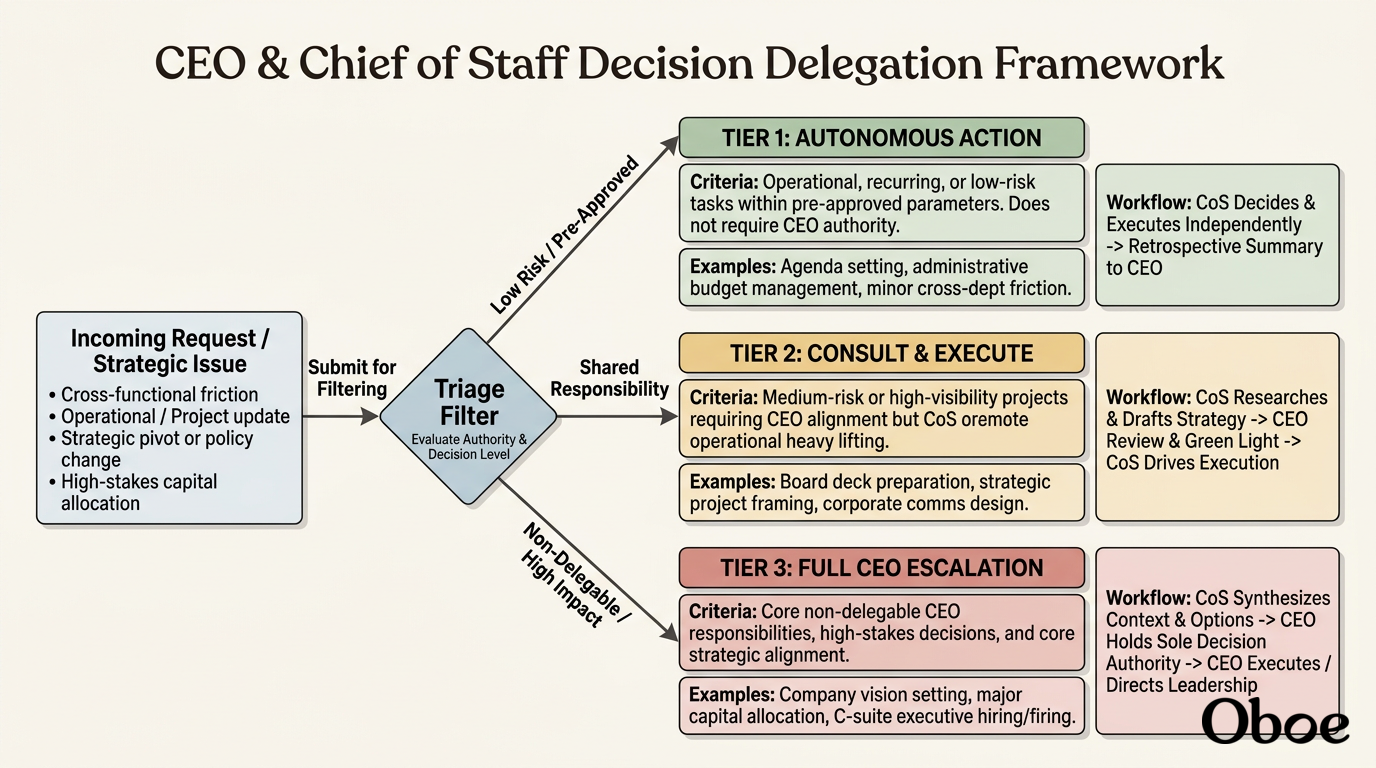
Defining decision-making boundaries is not about restricting your Chief of Staff, but about providing the guardrails that allow them to run at full speed without constantly checking in. To achieve this, top organizations use a to clearly map who owns what, which protects your cognitive bandwidth while ensuring operational momentum.
To establish these boundaries, you can categorize all company decisions and actions into three primary operational tiers:
Authority TierCoS Operating RuleConcrete Examples
Tier 1: Autonomous ActionCoS decides and executes independently. They only provide a retrospective summary.Resolving minor cross-departmental friction, managing administrative budgets, and setting meeting agendas.
Tier 2: Consult & ExecuteCoS drafts the strategy and gathers data, consults you for a green light, and then executes.Preparing the board deck, framing strategic partnership proposals, and designing internal corporate communications.
Tier 3: Full EscalationCoS handles research, but you retain sole decision-making and execution authority.Strategic pivots, allocating major capital budgets, and hiring or firing C-suite executives.
Once you and your CoS align on these tiers, the final step is ensuring . Your broader executive team must understand that your Chief of Staff has the authority to make Tier 1 decisions and drive Tier 2 processes. If the leadership team does not see the CoS as an extension of your voice, they will bypass them and land right back on your calendar, defeating the purpose of the hire.
CEO & Chief of Staff Decision Delegation FrameworkDiagram

I have initiated the creation of a Decision Delegation Flow Chart diagram to help you visually map out this workflow. This visual tool will make it incredibly simple to show your Chief of Staff and the rest of your executive team exactly how decisions flow through your office.

How do I operate like a CEO

Operating like a CEO requires making a fundamental mental transition: you must stop viewing yourself as the primary operator who gets things done, and start viewing yourself as an enterprise leader. When you are bogged down in the daily gears of the business, you are acting as a manager. True executive leadership means stepping back to work on the business rather than in it, shifting your focus entirely toward that scale your company's long-term impact.
To sustain this mental shift, you can think of your role as managing three primary accounts. If you try to do anything outside of these three buckets, you are likely slipping back into old manager habits. Your entire job now boils down to three core responsibilities:
The CEO's Three AccountsCore FocusWhat This Looks Like in Practice
1. Holding the VisionDefining the destination and keeping everyone aligned.Communicating the North Star consistently, keeping the board aligned, and setting long-term strategy.
2. Recruiting & Managing TalentBuilding a world-class leadership team to execute that vision.Hunting for top executive talent, assessing performance, and coaching your direct reports.
3. Resourcing the TeamSupplying the fuel: Capital, Clarity, and Care.Raising and allocating financial capital, ensuring organizational clarity on goals, and cultivating a healthy culture.
With your Chief of Staff now filtering the operational noise, you finally have the space to manage these three accounts. Operating like a CEO means resisting the urge to jump in and solve every minor problem. Instead, you must protect your calendar, practice , and trust your team to execute while you focus on providing the ultimate clarity, capital, and care they need to succeed.

Continue to the next step: Holding the Vision

To lead as a true enterprise executive, your first and most vital account to manage is Holding the Vision. This is not about passive daydreaming; it is about establishing a definitive, crystal-clear destination—your —and then formulating the high-level roadmap that guides your executive team there. When you step out of day-to-day operations, your primary vehicle for driving the company forward is this long-term strategy.
As a company expands, a CEO's greatest strategic threat is . Without continuous, explicit communication of the core vision, individual departments naturally begin to optimize for their own local goals rather than the enterprise's primary objective. Your job is to constantly beat the drum of your strategic vision, ensuring that every operational milestone, executive hire, and capital allocation decision is directly evaluated against how well it advances you toward that long-term destination.
To prevent this drift, you must translate your high-level vision into for your executive team. This bridge between abstract vision and daily execution is where your strategic focus is tested. By establishing key macro-metrics and clear quarterly guardrails, you give your Chief of Staff and broader C-suite the precise boundaries they need to execute autonomously, keeping the organization moving at maximum speed without requiring your constant intervention.

Create a vision-to-milestones alignment framework

Transitioning a high-level vision into tactical reality is one of the most challenging aspects of enterprise leadership. To help you and your Chief of Staff bridge this gap seamlessly, I have initiated the generation of a Vision-to-Milestones Alignment Framework document. This structured resource will allow you to outline your long-term objectives and break them down into concrete, trackable outcomes for your executive team.
Vision-to-Milestones Alignment FrameworkDocument
While the document generator builds out this framework, we can look at how to practically implement this translation. This process relies on establishing a highly structured cascade of accountability, ensuring that your long-term strategy is at every organizational level. By doing so, you can step away from daily tracking, confident that your C-suite leaders are driving toward the exact same destination.
To begin mapping your vision, you and your Chief of Staff can collaborate to break down your highest-level goals into three actionable horizons:
Strategic HorizonFocus WindowOperational OwnershipKey Deliverables
Horizon 1: North Star5 - 10 YearsCEO (held with Board alignment)Core purpose, market category definition, and long-term enterprise value goals.
Horizon 2: Strategic Pillars1 - 3 YearsCEO & Executive Team (facilitated by CoS)High-level business model expansions, core technological shifts, and market positioning milestones.
Horizon 3: Quarterly Milestones90 DaysExecutive Team (monitored and unblocked by CoS)Departmenal key results (OKRs), project completions, and immediate resource allocations.
Once these horizons are defined, your Chief of Staff takes on the role of operational guardian. They oversee the tracking of the Horizon 3 quarterly milestones, ensuring that your department heads remain aligned and on schedule. This crucial buffer allows you to focus your energy on Horizon 1 and 2, intervening only when major strategic roadblocks require your or when capital needs to be reallocated.

How does my Chief of Staff track these milestones without micromanaging the executive team?

Tracking quarterly milestones without micromanaging your executive peers is the ultimate test of a Chief of Staff's effectiveness. If they push too hard, they risk alienation; if they are too hands-off, the strategy stalls. To navigate this, the CoS must transition from a traditional gatekeeper to an , using structured frameworks rather than personal pressure to drive accountability.
The key to tracking progress seamlessly is establishing a highly standardized, objective reporting cadence. This removes personal opinion from the equation and lets raw data do the talking. You and your Chief of Staff can implement three core mechanisms to keep the C-suite aligned:
Tracking MechanismFrequencyCoS RoleExecutive Team Action
Traffic Light DashboardWeekly (Asynchronous)Aggregates and highlights execution risks.Updates milestone status via Red/Yellow/Green indicators.
The Unblocking SyncBi-Weekly (15 mins)Targets 'Yellow' and 'Red' milestones to offer support.Collaborates with CoS to source resources or shift timelines.
Quarterly Business ReviewEvery 90 DaysFacilitates the retrospect and prepares strategic briefings.Presents outcomes, key learnings, and targets for the next quarter.
To prevent your team from feeling micromanaged, your Chief of Staff must focus entirely on unblocking bottlenecks rather than auditing work. When a milestone slips to yellow or red, the CoS should not demand explanations; instead, they should ask, 'What resources do you need to get this back on track?' This supportive posture preserves your because the CoS handles the operational troubleshooting, allowing your 1-on-1s with your direct reports to remain focused on mentorship, professional development, and long-term vision alignment.

Give me a dashboard template my CoS can use

To establish an effective operating rhythm, your Chief of Staff needs a highly visual, centralized source of truth. A well-designed CEO-CoS dashboard acts as the primary for your office, ensuring that you can assess the health of your entire enterprise in less than five minutes without digging through departmental spreadsheets.
By combining key performance indicators, strategic horizons, and operational roadblocks into a unified template, your CoS can proactively manage the executive team's deliverables while preserving your cognitive bandwidth for long-term strategy.
Executive CEO-CoS Dashboard TemplateDocument
I have started the generation of the CEO-CoS Dashboard Template document, which includes a ready-to-copy markdown structure, complete with RYG status guidelines, a bottleneck log, and operational instructions for your CoS to manage asynchronous updates.
While that template is generating, let's explore how to structure the data within this dashboard to ensure it remains a high-leverage tool. A great dashboard does not just list data; it groups information by decision urgency. You and your Chief of Staff should organize the dashboard around three core structural sections:
Dashboard SectionTarget AudiencePrimary FocusKey Metrics Included
1. Enterprise Health VitalsCEO & CoSImmediate corporate health indicators.Cash runway (months), revenue vs. target, employee NPS, customer retention.
2. Horizon Milestone ProgressCoS & Exec TeamTracking execution speed against strategy.Horizon 2 strategic initiatives, Horizon 3 departmental key results (OKRs) with RYG status.
3. CEO Intervention LogCEO (curated by CoS)High-stakes bottlenecks that need your authority.Tactical blockers, critical hires pending offer approval, board communication deadlines.
To make this system work without adding meeting bloat, your CoS must establish strict asynchronous update cadences. Department heads should update their respective Horizon 3 metrics directly in the dashboard by Thursday afternoon. Your CoS then reviews this data on Friday morning, filters out the noise, and presents a pristine, curated dashboard during your sync. This rhythm ensures you are always starting your week with perfect operational clarity.

Continue to the next step: Recruiting and Managing Talent

With your Chief of Staff successfully managing your strategic dashboard, you are fully positioned to master your second critical account: Recruiting and Managing Talent. Operating as an enterprise leader means shifting away from managing daily workflows and instead dedicating your energy to building, onboarding, and coaching a world-class executive team.
The transition from an operational manager to an executive talent curator requires a major change in how you spend your time. Instead of auditing tasks, your responsibility is to ensure you have the right leaders in the right seats, and then to resource them so they can execute autonomously. When you scale, your personal leverage is realized entirely through the caliber of your direct reports.
Talent Focus AreaTraditional Operator MindsetEnterprise CEO Mindset
RecruitingHiring for immediate task execution and functional skills.Hunting for strategic leaders with high learning agility and long-term vision.
OnboardingHanding over a login, a project tracker, and a list of urgent tasks.Aligning on decision-making guardrails, company culture, and strategic outcomes.
ManagingChecking in daily to review project timelines and operational details.Providing mentorship, unblocking organizational friction, and building trust.
To scale successfully, you must master the art of C-suite recruitment. Unlike hiring mid-level staff, searching for executives requires assessing deep cultural alignment, strategic thinking, and emotional intelligence. Once they are in the door, your job is to build a where these high achievers can thrive, while your Chief of Staff maintains the operational rhythm that keeps them synchronized.
Executive Search and C-Suite Onboarding PlaybookDocument

I have launched the creation of an Executive Search and C-Suite Onboarding Playbook to give you and your Chief of Staff a repeatable framework for hunting, interviewing, and integrating top executive talent into your organization.

How should I structure my 1-on-1s with C-suite executives to focus on coaching rather than status updates?

Shifting your 1-on-1s from tactical status updates to strategic coaching is the single most effective way to empower your C-suite. When you stop using this time to review project trackers—a task your Chief of Staff now handles asynchronously—you transform these meetings into a high-leverage forum for professional growth and organizational alignment. To achieve this, you must structurally redesign the agenda to focus on roadblock unblocking, career development, and deep .
Meeting SegmentTime AllocationPrimary FocusKey Coaching Questions to Ask
1. Personal Connection & Well-being5 - 10 MinsGauging energy, motivation, and mental bandwidth.How are you managing your energy levels this week? Where do you feel stretched?
2. Roadblock Unblocking15 - 20 MinsIdentifying system bottlenecks and political friction.What is currently slowing your division down? How can I help you clear this path?
3. Strategic Co-Working15 - 20 MinsForward-looking brainstorming on mid-term horizons.If you had twice the budget for your top initiative, how would you redeploy it?
4. Professional Growth & Alignment10 MinsLong-term career tracking and enterprise values.What leadership skill are you focusing on right now, and how can I support you?
To make this cadence sustainable, you and your Chief of Staff must align on the requirements. Executives should submit their strategic discussion topics 24 hours in advance, allowing you to review their thoughts beforehand and enter the room ready to coach rather than digest data. This simple operational boundary preserves your cognitive energy, ensuring that your face-to-face time is spent entirely on high-impact mentorship.
C-Suite Coaching 1-on-1 Agenda and Alignment WorksheetWorksheet

I have created a C-Suite Coaching 1-on-1 Agenda and Alignment Worksheet to help you and your leadership team immediately transition your meetings into highly productive, growth-oriented coaching sessions.

Continue to the next step: Preserving enterprise culture and values during scaling

With your Chief of Staff managing your dashboards and your executive check-ins structured around growth, you have the foundational leverage to tackle the ultimate guardian of enterprise scale: your corporate culture. Enterprise culture is not a soft operational afterthought; it is the vital operating system of your business. As you scale, the greatest threat to your organization's momentum is .
When you are a small team, your company values are absorbed almost entirely through osmosis. However, once you scale past a handful of direct reports, preserving that requires you and your Chief of Staff to transition from passive role models to active architects of the company's culture.
Culture Preservation ToolStrategic FocusCEO RoleChief of Staff Role
Culture-to-Value CodingHardcoding abstract values into behavioral metrics and interview rubrics.Defines and owns the core ethical standards.Integrates values into candidate evaluation rubrics and HR systems.
Cultural Ritual AuditsReviewing and refining recurring company rituals to reflect current scale.Champions high-level gatherings and sets the moral tone.Redesigns communication channels to keep remote or scaled teams integrated.
The Alignment FilterReviewing major executive decisions against organizational values.Has the final executive say on cultural misalignments.Surfaces operational behaviors that violate core values before they escalate.
To make your values truly actionable, they must be integrated into every single people system you own. This means your Chief of Staff should ensure that your executive search rubrics, quarterly performance reviews, and promotions are explicitly tied to how well individuals demonstrate your core values. When your team sees that rewards and advancement are based as much on 'how' the work is done as 'what' is accomplished, you build a resilient, high-performing, and self-policing enterprise culture.

Continue to the next subtopic: Executive Leadership and High-Stakes Decision Making

Welcome to your third core responsibility: Executive Leadership and High-Stakes Decision Making. When you operate at the highest level of an enterprise, you are no longer making routine operational choices; you are navigating massive uncertainty, managing , and steering the ship through complex market shifts. Your Chief of Staff handles the day-to-day coordination, leaving you with the cognitive space required to make the heavy decisions where data is incomplete and the stakes are survival-level.
To master high-stakes choices, you must adopt a structured approach to decision-making under uncertainty. When complete information is impossible to gather, waiting for 100% certainty leads to . Instead, enterprise leaders rely on clear mental models to classify and execute decisions based on their reversibility and impact.
Decision TypeCharacteristicsCEO Action RuleExecutive Practice
Type I (Irreversible)High-impact, 'one-way door' decisions. Massive capital or structural changes.Slow down. Gather diverse perspectives, run scenarios, and decide with deep care.Acquiring a competitor, pivoting the core product, or changing the capitalization structure.
Type II (Reversible)Low-to-moderate impact, 'two-way door' decisions.Delegate completely to your CoS or C-suite. Prioritize speed over perfection.Testing a new marketing channel, launching a pilot program, or updating internal software.
By clearly separating Type I and Type II decisions, you prevent your organization from slowing down. Your Chief of Staff can guard your calendar from Type II decisions, ensuring your mind is clear when a critical Type I scenario demands your absolute focus. Next, we will explore how you can lead your executive team through sudden crises and execute major strategic pivots when the market demands a rapid course correction.

Create a high-stakes decision-making playbook for my executive team

To empower your C-suite and align them around high-stakes decision-making without constant oversight, I have initiated the generation of the High-Stakes Decision-Making Playbook for your executive team. This framework will serve as their primary guide for navigating uncertainty and evaluating systemic risks autonomously.

Executive High-Stakes Decision-Making PlaybookDocument
While the document generator builds out this playbook, we can examine how you, as CEO, should structure your cognitive approach to and risk management. During a crisis, your team does not need you to solve tactical problems; they need you to establish absolute clarity, define acceptable risk boundaries, and protect the organization's moral and operational focus.
To manage these volatile periods effectively, you and your Chief of Staff must divide responsibilities clearly. While you focus on the macro-level pivot and stakeholder confidence, your CoS acts as the , keeping the operational wheels turning and ensuring that departmental heads remain aligned to your emergency directives.
Strategic Focus AreaCEO Strategic RoleChief of Staff Operational RoleExpected Outcome
1. Asymmetric Risk GuardrailsDefines the maximum tolerable downside and strategic boundaries.Implements risk-tracking metrics and monitors operational exposure.Prevention of catastrophic Type I decision failures.
2. Emergency ResponseServes as the decisive authority and the public/board face of the company.Runs the crisis war room, coordinates communications, and gathers real-time data.Swift, coordinated response with minimal internal panic.
3. Strategic PivotsFormulates the new vision and matches it with critical capital reallocation.Translates the pivot into immediate Horizon 3 milestones and OKRs.Rapid organizational realignment behind the new strategic direction.
With these crisis guardrails in place, the final component of high-stakes leadership is managing the external forces that influence your company's trajectory. You must balance the immediate demands of your board of directors and investors with the long-term strategic execution of your executive team. By leveraging your Chief of Staff to prepare , you can manage these relationships with minimal disruption to your daily focus.