ITIL 5
Welcome to the session! To kick off our exploration of ITIL 5, let's first figure out how this knowledge will be most useful to you.
Are you learning ITIL 5 to prepare for an upcoming certification exam, or are you looking to apply it in your current work role?
Just general curiosity but also curious about the certification.
It is completely natural to wonder how the certification path is laid out, especially since ITIL 5 introduces some exciting new designations alongside its updated framework.
Would you like a quick overview of how the ITIL 5 certification pathway is structured before we dive into the core concepts, or should we start right into what's new in ITIL 5?
Give me a quick overview of the certification pathway
The Four Tiers of the ITIL 5 Path
| Designation | Core Audience & Purpose |
|---|---|
| ITIL Foundation | The mandatory entry point. Teaches the basic vocabulary, key models, and the unified lifecycle. |
| ITIL Managing Professional (MP) | For hands-on leaders who design, deliver, and run digital products (includes ITIL Product, Service, and Experience). |
| ITIL Strategic Leader (SL) | For high-level managers aligning digital services with broader business strategy and AI governance. |
| ITIL Practice Manager (PM) | For technical specialists proving practical, operational excellence in specific service clusters. |
Would you like us to look closer at these three modular practice clusters, or are you curious about how the bridge works for people transitioning their ITIL 4 credentials to ITIL 5?
Continue to the three modular practice clusters
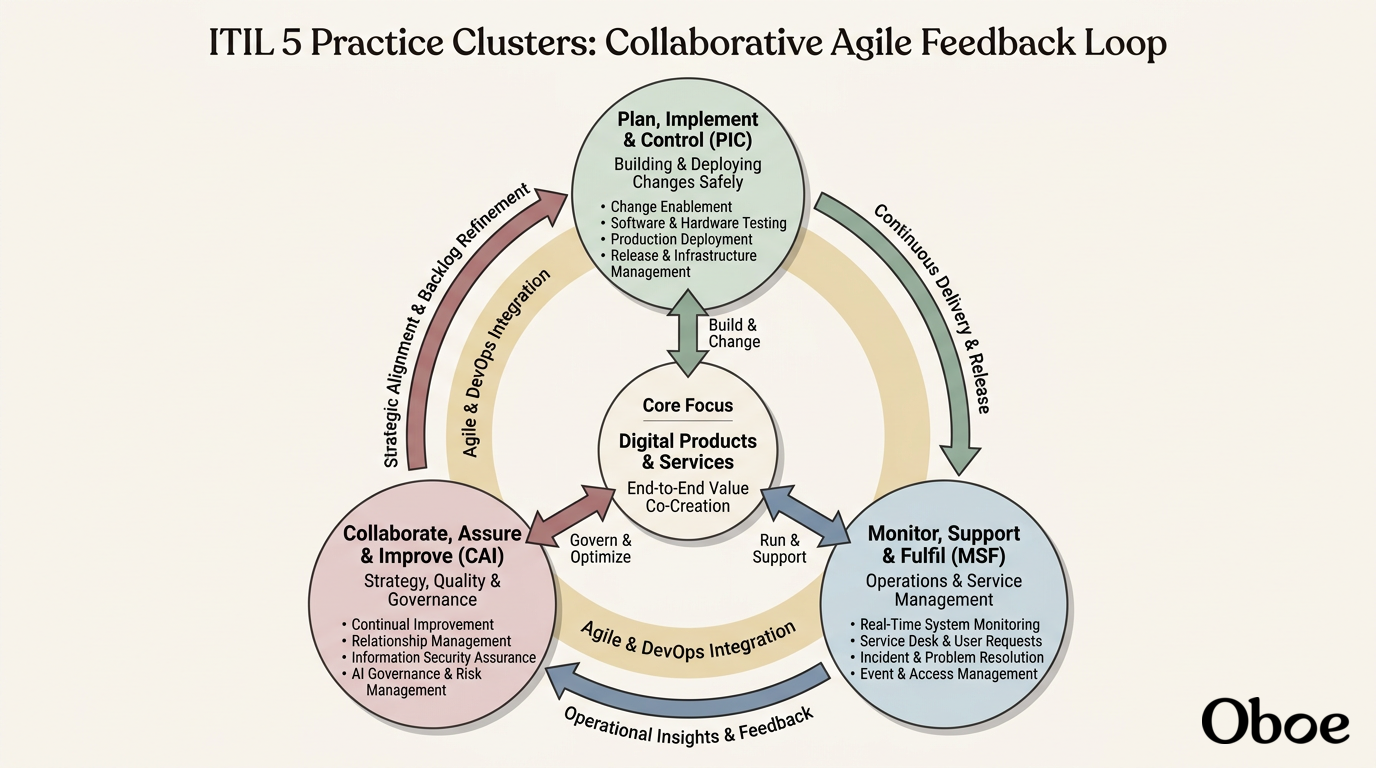
Let's zoom in on those three modular practice clusters. This is where the actual day-to-day work of ITIL 5 gets organized, grouping related tasks so teams don't work in isolated silos.
The Three Modular Practice Clusters
| Cluster | Focus Area | Core Activities |
|---|---|---|
| Monitor, Support & Fulfil (MSF) | Keeping the lights on and users happy | Real-time monitoring, service desk, resolving incidents, and fulfilling user requests |
| Plan, Implement & Control (PIC) | Building and deploying changes safely | Managing upgrades, change enablement, testing, and pushing code or hardware to production |
| Collaborate, Assure & Improve (CAI) | Strategy, quality, and long-term growth | Continual improvement, relationship management, and ensuring service quality and security |
Make me a diagram of the three practice clusters
I've kicked off the generation of a diagram to map out how these three practice clusters organize the daily flow of ITIL 5.