
Influencer marketing social media agency operation
Welcome! I'm excited to help you dive into the mechanics of building and running a successful influencer marketing agency.
To make sure we tailor this session perfectly to your goals, tell me a bit about your situation: Are you planning to start your own agency, grow an existing one, or working within an agency context?
I'm planning to start my own agency from scratch.
Starting an agency from scratch is an exciting journey, and we're going to map out exactly how to build it step by step. Let's begin by looking at the high-level roadmap of how your agency will go from a concept to a fully operational business.

Choosing Your Agency's Identity
1. Campaign Management (Brand-Facing)
2. Talent Representation (Creator-Facing)
3. The Hybrid Model
As we build your agency from the ground up, which of these models feels like the most natural starting point for you? Do you want to build campaigns for brands, manage the careers of creators, or are you curious about how the hybrid model balances both?
I am planning to build a social media marketing agency but operate in global perspective, make an alliance with some agencies in each country. For example for software companies it is hard to run a local marketing campaigns or creator campaigns. So they just focus on usa or uk oriented agencies and spread the same content in other countries. So I want to learn both
That is an incredibly smart, high-value angle. Software and B2B tech companies struggle hard with localization, and trying to run multi-country creator campaigns from a centralized hub in the US or UK is a massive operational bottleneck.
The Global Agency Alliance Model
When you want to run a global agency from day one without hiring dozens of local employees, you build a . Under this structure, your US/UK agency acts as the master campaign manager (the "prime contractor"). You secure the enterprise tech client, design the overarching global strategy, and create the master brief.
Then, instead of trying to manually DM French or Japanese software developers yourself, you partner with independent, local boutique agencies in those target countries to execute the local scouting, negotiation, and compliance.
How White-Label and Partner Networks Operate
In a cross-border alliance, your operational relationships with partner agencies will typically fall into two categories:
- White-Labeling: The local agency does all the execution under your brand name. The client has no idea they exist. They scout, vet, and contract local tech influencers, but present everything to you so you can show it to the client under your own logo.
- Co-Branded Partnerships: You openly pitch to the client as an alliance (e.g., "We are executing this in partnership with our local European network affiliate"). This can build immense trust with enterprise software clients who want to know they have real, local boots on the ground.
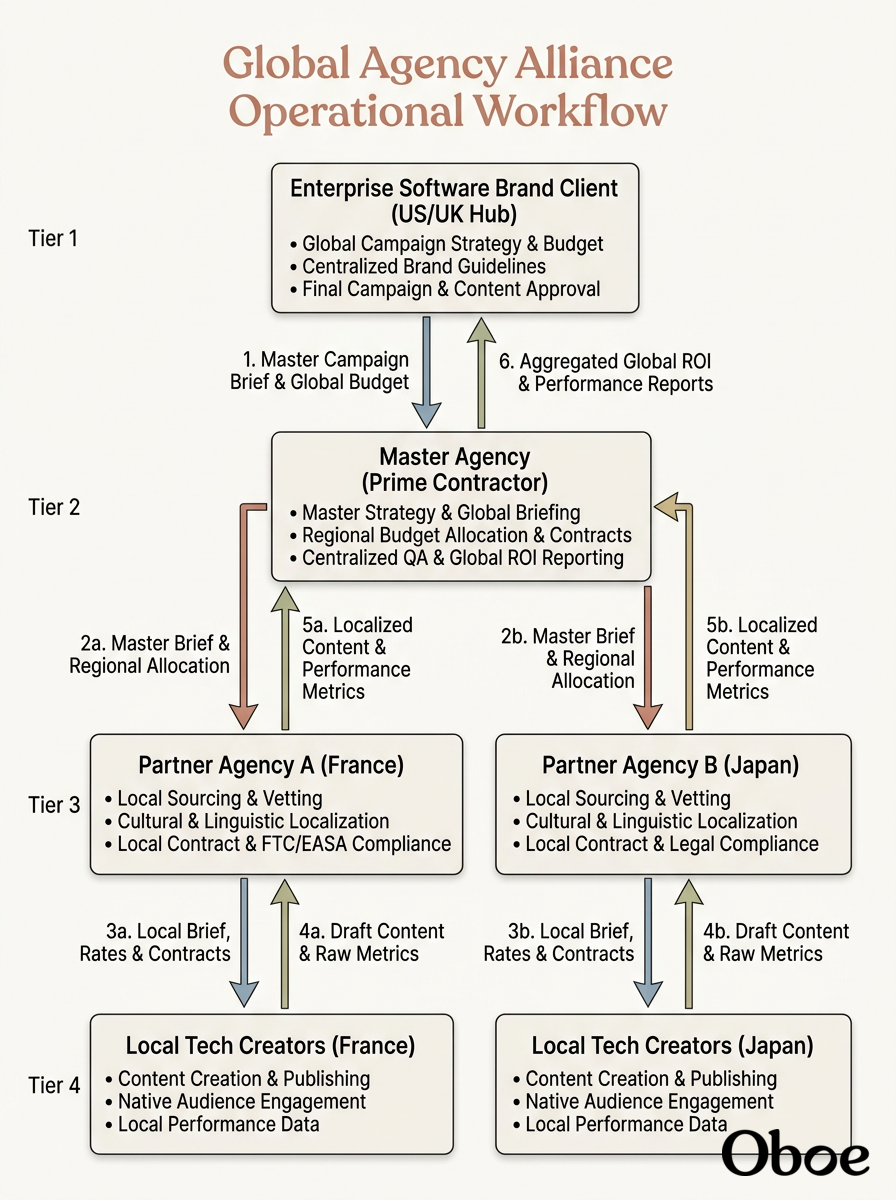
I've kicked off a diagram that maps out this global alliance structure so you can easily visualize how the operational flow, creative briefs, and client approvals travel between the brand, your master agency, your local partners, and the influencers.
Before we dive into how to split the revenue and margins with these partner agencies, let's look at how you balance the hybrid model (doing both brand campaigns and talent representation) within this kind of global framework.