
I want lear about hydropower plant design, maintenance or etc
Welcome! I'm excited to dive into the world of hydropower with you. Before we get into the details of plant design, turbine selection, and maintenance strategies, I'd love to know a bit more about your background so we can tailor this session perfectly.
To help me tailor this session, what is your background in engineering or hydropower, and are you interested in a specific area like design, maintenance, or operations?
I work in plant operations/maintenance and want to sharpen my practical skills.
It is great to have someone with hands-on experience in operations and maintenance here. Since you are looking to sharpen your practical skills, let's make sure we customize this entire journey around your day-to-day realities.
To kick things off, what specific type of plant do you work at (e.g., run-of-river, reservoir, or pumped-storage), and what key equipment or maintenance challenges are you most focused on right now?
All above
It is great to have your hands-on perspective from operations and maintenance, as you deal directly with the equipment that keeps these massive systems running safely and reliably. Since you work with run-of-river, reservoir, and pumped-storage configurations, we will break down the essential principles that apply across all of them.

The Core Magic: Gravity and Flow
Now that we have established this basic energy transfer, we can explore how different plant configurations manipulate water to meet grid demands.
Show me a diagram of the basic energy conversion process
I have started generating a customized system diagram of a typical hydropower plant to help you trace exactly how water pressure and flow convert into electrical energy.
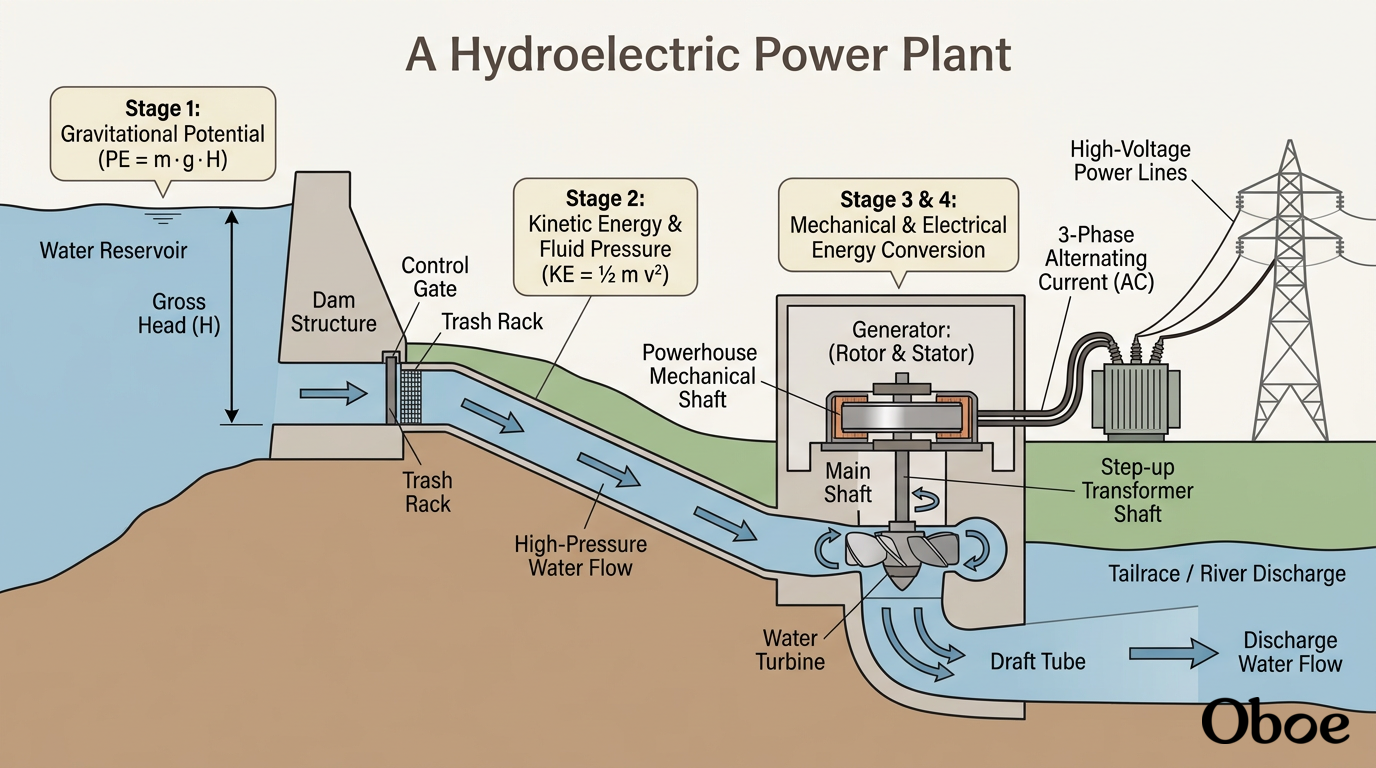
This visualization will show the physical layout from the high-elevation intake down to the , highlighting where potential energy shifts into kinetic force to spin the machinery. While the diagram is building, we can zoom out to look at how different plant configurations manage this water flow to support the electrical grid.
How does tailrace design affect turbine backpressure?
You've hit on one of the most critical, yet frequently overlooked, aspects of powerhouse design. The isn't just an exit channel; it dictates the boundary pressure conditions under which your turbine operates.
The Physics of Backpressure and Net Head
To understand backpressure, we have to look back at our net head. Net head is the actual, effective pressure drop across your turbine runner. If water cannot escape the powerhouse smoothly, it backs up in the tailrace, raising the tailwater level. This decrease in physical elevation difference directly eats away at your net head, meaning less energy is transferred to the turbine blades.
When that tailwater level rises, your net head shrinks, and your power output drops right along with it.
The Triple Threat: Efficiency, Cavitation, and Flooding
As an operator, bad tailrace hydraulics present three major headaches on the floor. First is the immediate loss of turbine efficiency, because the pressure differential across the blades decreases. Second is a massive spike in . If the tailwater level fluctuates wildly, it disrupts the draft tube's pressure profile, creating localized vapor bubbles that collapse violently and pit your runner blades. Finally, during high-flow river events, a poorly sized tailrace can cause water to back up directly into the powerhouse, risking catastrophic equipment flooding.
To manage these hydraulic conditions, plant designs must change based on how they source their water. Let's look at how we compare different plant configurations—like run-of-river, storage, and pumped storage—and how they handle these tailrace and flow challenges.