
Oboe
No history yet

The Hubble Space Telescope

Welcome! I'm absolutely thrilled to dive into the story of the Hubble Space Telescope with you. Before we launch into the cosmos, I'd love to learn a little bit about what brings you here today so I can tailor our journey perfectly.

What brings you to learning about the Hubble Space Telescope today, and how much prior knowledge do you have about it?

I know a bit about space but want to understand Hubble's technical design and discoveries in depth.

It is great to have you here, and I am excited to help you dive deep into the technical design and groundbreaking discoveries of the Hubble Space Telescope. Let's start at the beginning of the journey by mapping out our path through the cosmos.

Your path
Design, Optics, and Servicing Missions
Key Scientific Discoveries and Cosmology
Solar System and Exoplanet Insights
Legacy and Joint Operations with Webb

The Ultimate High Ground

To understand why we put a massive, $1.5 billion telescope into space, we first have to look at the air right in front of our faces. Ground-based telescopes, no matter how large or advanced, must peer through Earth's atmosphere. This atmosphere acts like a turbulent, moving liquid blanket. It bends, scatters, and blocks light, causing stars to twinkle and blurring the fine details of distant cosmic structures. By launching the into aboard the Space Shuttle Discovery on April 24, 1990, scientists bypassed this atmospheric distortion entirely. From its vantage point roughly 340 miles above the surface, Hubble enjoys a perfectly clear, dark, and undistorted view of the cosmos. It does not just see the visible light that our eyes can detect; it also observes the universe in ultraviolet and near-infrared wavelengths, revealing cosmic processes that are otherwise completely invisible from the ground.

A side-by-side comparison of starlight passing through Earth's turbulent atmosphere to a ground telescope versus traveling directly to an orbiting space telescope.

I have set up a visualization above to illustrate exactly how Earth's atmosphere degrades ground-based observations, and why getting above it changes everything.

Generate a diagram of Hubble's orbit

You've got it! Visualizing how Hubble moves is a fantastic way to grasp its daily operations, so I have initiated a detailed diagram of Hubble's orbit around the Earth.
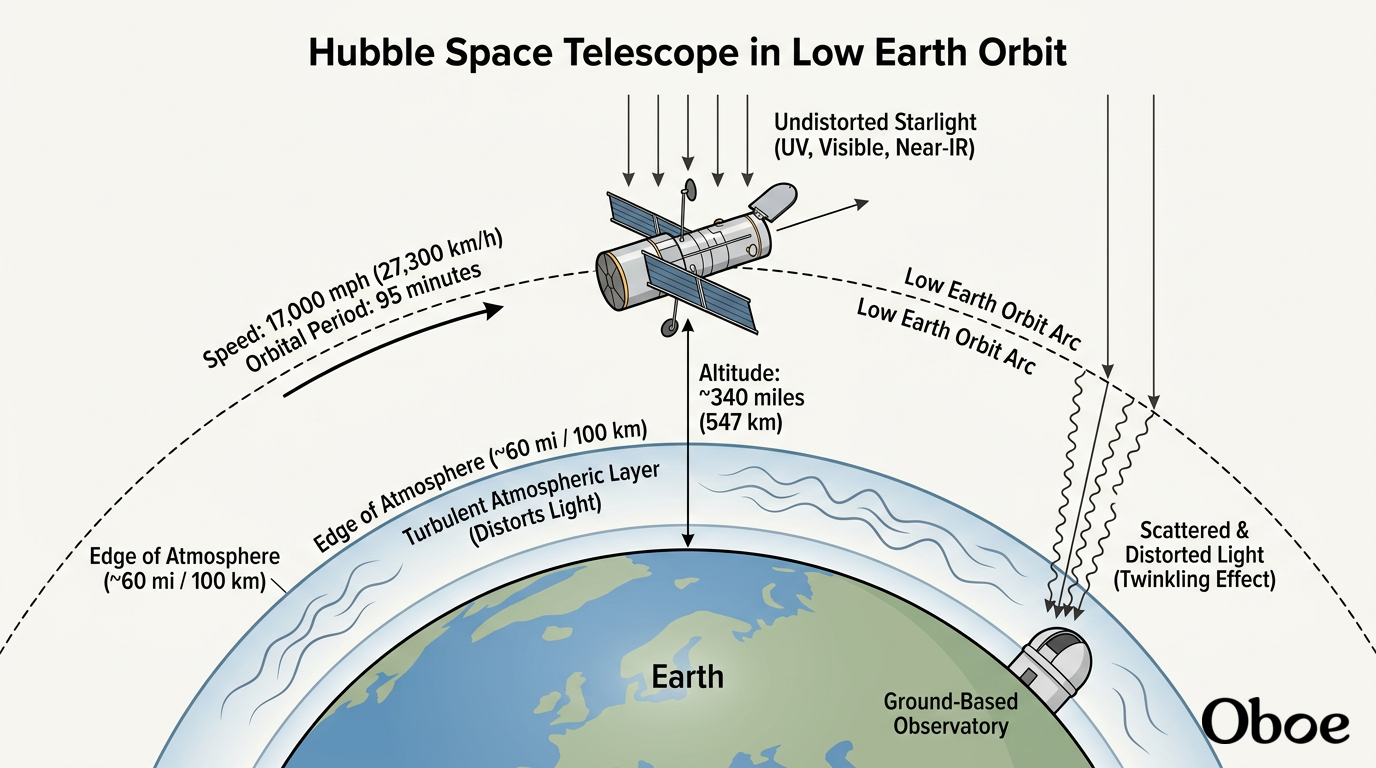
Hubble Space Telescope in Low Earth OrbitDiagram
While that orbit diagram is being generated, let's look at how Hubble actually captures the universe. To achieve its groundbreaking goals, the observatory relies on a specific to see what human eyes cannot. Unlike ground telescopes that are blind to certain types of light because our atmosphere blocks them, Hubble can observe from the ultraviolet, through the visible spectrum, and into the near-infrared. This means it can spot everything from the super-hot, energetic birthing grounds of young stars to the cool, dusty envelopes of dying ones. All of this light is gathered and focused by Hubble's before being sent to its onboard scientific instruments.