
Oboe
No history yet

The Hubble Space Telescope

It's wonderful to explore the cosmos with you today! Before we dive into the incredible journey of the , I'd love to know what sparked your interest in it and how much you already know about this famous cosmic observer.

I'm quite familiar with it, but I want to go deep into its technology and legacy.

I love that you want to skip the basics and plunge straight into the high-end technology and historical engineering of the telescope. It's a remarkably sophisticated machine, and its biggest advantages come down to where it is parked.

The Ultimate High Ground

To understand why we put a 12-tonne telescope into , we have to look at the atmosphere not as life-giving air, but as an astronomical enemy. Earth's atmosphere acts like a turbulent, dirty window. It constantly wiggles the light passing through it—which is why stars seem to twinkle to our eyes, a phenomenon astronomers call atmospheric scintillation. For a ground-based telescope, this twinkling smears fine details into a blurry fuzz. By launching Hubble into space, NASA and the ESA bypassed this "atmospheric seeing" limit entirely, allowing the telescope to achieve its theoretical diffraction limit.
But blurring is only half the problem. Our atmosphere is also highly selective about what light it lets through. It completely blocks ultraviolet light and absorbs large bands of infrared light to protect us. This is great for our skin, but terrible for astronomers who want to study the highly energetic processes of the universe, like newborn stars. Operating in space gives Hubble a crystal-clear, unblocked view across three distinct spectra: ultraviolet, visible, and near-infrared light.

A cross-section of Earth's atmosphere receiving ultraviolet, visible, and infrared light rays from space.

I have set up a visualization above to help illustrate exactly how Earth's atmosphere blocks and distorts these different wavelengths of light compared to Hubble's clear view in orbit.

Shall we look at the engineering of how Hubble was actually launched and positioned back in 1990, or would you prefer to dive straight into the physics of its primary mirror?

Create a diagram of Hubble's light path

You've got it! Visualising the path light takes through the telescope is the best way to understand its elegant engineering.
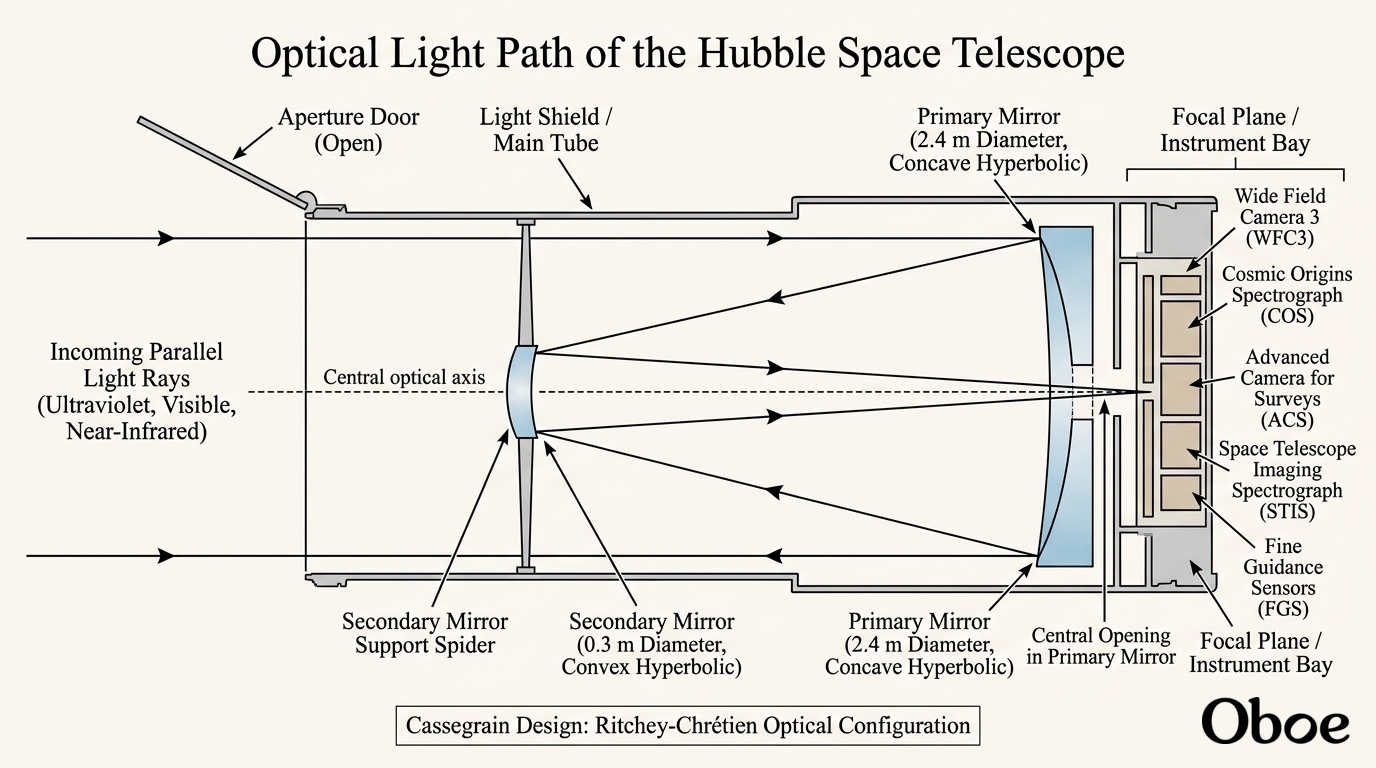
Optical Light Path of the Hubble Space TelescopeDiagram
I've initiated a detailed optical diagram to map this light path for you. Hubble is a design. Light enters the open front of the telescope, travels down the tube, and bounces off the 2.4-metre primary mirror. From there, it converges forward onto a smaller secondary mirror, which bounces the light back through a hole in the very centre of the primary mirror to reach the instruments waiting behind it. Now, there is a famous catch to this story: when Hubble first opened its eyes in 1990, the images were blurry because of a microscopic error in that giant primary mirror. Would you like to explore the physics of that mirror flaw next, or continue on to the timeline of the launch and its primary scientific goals?