
Oboe
No history yet

I want to learn how GenAi works

Here is a proposed learning path designed to help you understand how Generative AI models work, taking you from foundational concepts to the mechanics of text and image generation.

Your path
How Text Models Predict Words
How Image Models Create Visuals
Prompts, Capabilities, and Limitations

We can adjust this plan at any time to focus on what interests you most. To help me tailor our session, what background do you have with AI, and is there a specific type of AI (like ChatGPT or image generators) you're most curious about?

The learning path looks perfect, let's get started!

To understand how generative AI works, it helps to first look at how it differs from . Traditional AI systems are designed to analyze data, find patterns, and classify things under strict rules. For example, a traditional model might scan a photo and tell you whether it contains a cat or a dog.
In contrast, generative AI uses to build entirely new content from scratch. Instead of just identifying a cat, generative AI learns the general patterns of what a cat looks like from billions of examples and synthesizes a completely new, unique cat image that has never existed before.

How does it actually learn to do this? Let's take a closer look at how these models are trained to recognize and generate patterns.

Can you make a diagram showing the difference between traditional and generative AI?
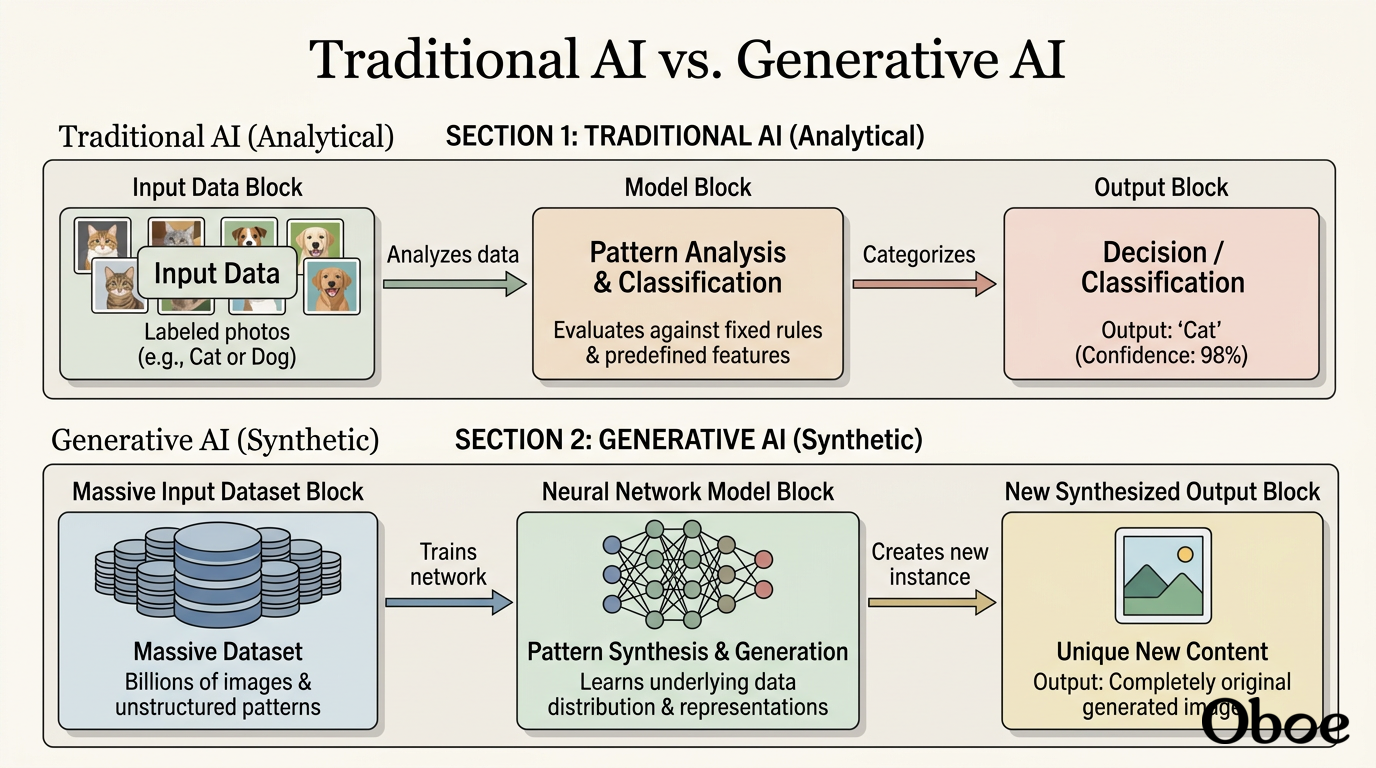
I have initiated the generation of a diagram that illustrates the core architectural difference between traditional and generative AI systems. This visual comparison highlights how they process input data to deliver fundamentally different kinds of outputs.
Traditional AI vs. Generative AIDiagram
This diagram shows how traditional systems act as analytical classifiers, while generative systems act as creative . Let's look at how the training process enables generative AI to make these new creations.

Continue to how models are trained on massive datasets

To train a generative AI model, you cannot just give it a few textbook examples. You have to feed it , which consists of massive datasets compiled from billions of public webpages, books, scientific articles, and open-source repositories. During this initial stage, the model's inner brain is completely untrained. It operates on a series of random starting values, meaning its very first attempts to predict words or generate pixels are nothing more than meaningless static.
So how does it go from random static to highly coherent outputs? The secret lies in the adjustable connections within its neural network, known as or weights. These weights act like millions of tiny dials inside the system that determine how signals flow through the network. When the model makes a prediction, it compares its output to the actual training data. If the prediction is off, a mathematical process called runs backward through the system, slightly turning those dials to make a correct prediction more likely next time. By repeating this process trillions of times, the network slowly transforms its random connections into precise patterns.

Explain weights and parameters with an analogy

To understand how weights and parameters function, imagine a massive in a professional music recording studio. Instead of just a few sliders for volume and bass, this giant sound board has billions of tiny dials and knobs, each representing a single parameter in the neural network.
At first, all these dials are set completely at random. When you play music through the board, the output is nothing but . The model’s job is to adjust every single dial by a fraction of a millimeter until the output transforms from chaotic static into a perfectly balanced, beautifully mixed song.
This is where backpropagation comes in. When the output doesn't match the target, the system calculates the error and sends a signal backward through the board, whispering exactly which dials need to be turned up or down. Gradually, this continuous fine-tuning turns the random static into meaningful .

How does the model know if the output is correct or incorrect?

To determine whether its output is correct, the model relies on a mathematical yardstick called a . The loss function acts as an automated grading system, calculating a numerical score that represents exactly how far off the model's guess was from the actual target in the training data. In the early stages of training, this loss score is incredibly high, prompting massive mathematical corrections through backpropagation. As training progresses and the predictions improve, the loss score drops closer to zero, indicating that the model is successfully identifying and replicating the patterns of human data.
However, mathematical correctness during initial training is only half the battle. To ensure the model behaves in ways that are safe, helpful, and natural to humans, developers apply a second phase of evaluation called , or RLHF. During this stage, human testers review multiple outputs from the model and rank them based on clarity, accuracy, and safety. The model then uses these rankings to build a secondary system that rewards helpful responses and penalizes toxic, inaccurate, or confusing behaviors. This human guidance is what transforms a raw statistical machine into a conversational partner that feels truly collaborative.
Now that we understand how generative models learn patterns from training data and refine them using human feedback, we can move on to the next phase of our journey. Let's see how large language models specifically use these trained patterns to process prompts and predict individual words.

Continue to how text models predict words.

When you type a prompt into an AI model, the system does not actually read and process whole words the way a human does. Instead, it breaks language down into smaller, manageable chunks called .
Once a prompt is broken into these chunks, the Large Language Model uses its trained parameters to calculate a for what token should come next. The model looks at the sequence of tokens you provided, references the patterns it learned during its massive training phase, and determines which word piece is the most statistically likely continuation of your sentence.
To make these predictions accurate, the model relies on a temporary memory space known as a . The context window determines how many preceding tokens the model can look back at and analyze when generating its very next prediction. If a word or instruction falls outside of this window, the model completely forgets it, meaning the length of this window directly dictates how complex, coherent, and conversational the AI's long-form writing can actually be.
How do these models handle complex relationships between words that are far apart in a sentence? Let's explore how the transformer architecture acts as the ultimate engine for tracking these connections.

Continue to how transformers process context

To process language efficiently, modern language models rely on a breakthrough neural network design known as the . Developed by researchers in 2017, the Transformer replaced older systems that analyzed text strictly word-by-word, which often caused the model to lose track of the beginning of a sentence by the time it reached the end. Instead, Transformers process entire sequences of text all at once, allowing them to capture the complex relationships between words regardless of how far apart they sit in a prompt.
The secret behind the Transformer's ability to maintain context is a mechanism called . Self-attention allows the model to dynamically calculate how different words in a sentence relate to and influence one another. For instance, in the sentence 'The bank of the river was muddy,' the model uses self-attention to link 'bank' to 'river' rather than financial institutions, instantly clarifying the word's contextual meaning. By calculating these mathematical weights between all tokens simultaneously, the model builds a rich, multi-layered understanding of your entire prompt.
When we bring all these components together—tokenization, probability distributions, context windows, and the self-attention of Transformers—we get the complete process of . The model receives your prompt, slices it into tokens, maps those tokens through its self-attention layers to analyze context, and projects a probability list for the very next token. Once it selects that token, it appends it to the existing prompt and repeats the entire loop. This rapid, recursive feedback loop is what generates the fluid, coherent paragraphs of text you see in conversational AI.
This completes our look at the mechanics of text-based language models. Now that we have covered how models predict and generate words, are you ready to explore how image models utilize similar patterns to build detailed visuals out of random static?

Continue to how image models create visuals

To understand how image models create detailed visuals, we have to look at a process that seems completely counterintuitive: starting with total chaos. The most popular technology behind modern image generators is the . During training, these models learn how to construct images by studying how to destroy them.
The training process begins by taking a perfectly clear training image and gradually adding to it, step by step, until the original picture is completely lost and turned into pixelated static. The model's job during this phase is to look at the noisy images and learn to predict exactly how much noise was added at each step so it can subtract it. By learning to reverse this process, the model learns the underlying patterns of shape, color, and texture.
But how does the model know whether to turn that static into a dog, a landscape, or a spaceship? This is where come in. When you type in a prompt, a separate text model translates your words into numerical values that map concepts together. During training, the image model learns to pair these mathematical concepts with visual features. By feeding your prompt's mathematical representation into the denoising process, the model is guided to subtract noise in a way that slowly reveals the exact shapes and colors described in your text.

I can generate a visual diagram to show this process of turning noise into a clean image if you would like to see how the mathematical steps look in action. Otherwise, we can move forward.

Continue to prompts, capabilities, and limitations

Your path
We have reached our final subtopic, where we will examine how we actually direct these powerful systems and look at the realistic boundaries of what they can and cannot do. At the very front end of this interaction is , which is the practice of structuring, refining, and designing the inputs we give to an AI to get the most accurate and useful outputs possible. Instead of just asking a simple question, effective prompt engineering involves providing clear context, specific instructions, and concrete examples to guide the model's probabilistic predictions down the right path.
When we guide these models correctly, they unlock a staggering array of core capabilities. Generative models excel at , which compresses massive documents into key insights, and translation across hundreds of languages. They also demonstrate impressive reasoning, code generation, and , allowing users to merge completely different concepts into cohesive new ideas. However, these systems do not possess genuine comprehension; they are still calculating mathematical probabilities, meaning they operate without any real-world understanding of the text they generate.
This lack of real understanding brings us directly to their major limitations and risks. Because these models are statistical predictors, they are highly prone to , which are moments where the model confidently generates facts, citations, or stories that are entirely fabricated. Furthermore, because they are trained on massive scrapes of the public internet, they naturally inherit human biases, struggle with privacy concerns, and remain strictly limited by their pre-training data and context window limits. Let's see how we can test our knowledge on these critical safety boundaries.

Why do generative AI models experience 'hallucinations'?

Because their context windows slide out of view, causing the system to deliberately make up fictional stories to fill the blank space.

That is not quite how it works, but it is a very common misconception! The correct answer is D: hallucinations occur because generative AI models are statistical word predictors calculating mathematical probabilities, rather than database systems that query and retrieve verified facts.
When a model generates a response, it evaluates based on the patterns it learned during training. It does not possess a real-world concept of truth or a mechanism to fact-check its own statements against a database. Because its primary objective is simply to generate the most statistically plausible next token, it will seamlessly write grammatically flawless sentences that are completely fabricated if that combination of words matches its mathematical weights.
While do cause the system to forget older parts of a long conversation, they do not actively force the model to lie. Instead, when the model lacks accurate context or reaches the limit of its pre-training data, it simply continues predicting words based on whatever prompt details remain, often leading to a persuasive but entirely made-up answer.
This brings us to the end of our journey exploring how generative AI operates under the hood. We have covered everything from neural network parameters and massive training datasets to transformers, diffusion models, and prompt boundaries. To help wrap up everything we have discussed, I can compile a comprehensive summary of our session.

Continue to the session wrap-up

You have done an incredible job exploring the inner workings of generative artificial intelligence. From analyzing how models learn during training to exploring the complex mechanics of text and image generation, you have built a comprehensive foundation of knowledge. Let's look back at the key milestones of your learning journey.

GenAI Quick ReferenceStudy Guide

I have created a comprehensive study guide that synthesizes every major concept we have explored today. It serves as a permanent reference of your progress, covering everything from neural network parameters to the self-attention mechanisms that power modern transformers.

With this complete overview of generative AI, you are well-equipped to understand how these systems operate in the real world. Where would you like to go from here? We can wrap up our conversation, dive deeper into specific architectural details, or test your overall knowledge with some custom practice questions.

Test my knowledge with a quiz on these concepts

You have built an outstanding foundation across all of our core topics, from the foundational mechanics of network weights to the complex self-attention and noise-reduction processes of modern text and image models. To celebrate your progress and consolidate what you have learned, let us dive straight into your custom review quiz.

A developer is frustrated because their generative model keeps outputting highly structured, fluent, and convincing explanations about a historical event that never actually occurred. Based on what we have covered, what is the primary underlying cause of this behavior?

The model is functioning as a statistical next-token predictor prioritizing stylistic probability over real-world factual verification.

Generative AI
LV 1
Skills
Spot on. You recognized that the model is functioning as a prioritizing stylistic probability over real-world factual verification. This is the absolute core of why hallucinations occur, as the system does not query a database of verified facts to answer questions, but instead relies on mathematical weights to predict what word should come next.
When developers train these networks on , the mathematical formulas adjust their parameters to find patterns in how humans structure language. While this allows the system to produce remarkably sophisticated and creative synthesis, it also means that the model has no innate concept of truth or reality, making human verification and oversight a critical step in using these tools.

This brings us to the end of our journey exploring how generative artificial intelligence works under the hood. You have built an outstanding foundation across all of our core topics, from the foundational mechanics of network weights and backpropagation to the complex self-attention and noise-reduction processes of modern text and image models.

We have completed our learning path, but our exploration doesn't have to stop here. Would you like to wrap up our session, dive deeper into a specific technical concept we covered, or run through another custom practice question to continue testing your skills?

Continue to wrap up the session

You have done an absolutely outstanding job completing this learning journey. By tackling the custom review quiz and recognizing how these systems function as statistical next-token predictors rather than factual databases, you have demonstrated a superb grasp of the material.
Throughout this session, we have explored the entire engine of generative technology. You started with the basic foundation of how act like adjustable dials during training on massive datasets. From there, you advanced to the mechanics of text models, analyzing how tokens, context windows, and the self-attention mechanism of the Transformer architecture track complex relationships. Finally, you investigated how diffusion models generate crisp images by reversing random noise under the guidance of text embeddings, and concluded with a critical look at prompt engineering and the reality of machine hallucinations.

This completes our formal learning path. We can wrap up our conversation here, or if you would like to keep practicing, we can run through another custom quiz question or dive deeper into any of the specific technical concepts we covered today. What would you like to do?