
How do batteries store energy?
Welcome! I'm excited to help you unpack the magic of how batteries store and release energy.
To make sure we tailor this session perfectly to you, what is your background with science or physics, and what brings you to study batteries today?
I'm a beginner looking for a simple, everyday explanation
It's wonderful to meet you! Since you're looking for a simple, everyday explanation, we'll keep things clear and use real-world analogies to show how these little powerhouses work.
Let's kick things off by revealing a fun truth: batteries don't actually store electricity at all. Instead, they act like tiny chemical storage units.
Your path

Chemical Potential and Energy Storage
Discharging: Converting Chemical to Electrical
Charging: Reversing the Chemical Process
The Three Essential Parts
Inside every battery, whether it's a giant car battery or the tiny one powering your phone, you'll find the exact same three core components working together:
- The Anode: This is the negative side of the battery. You can think of it as a crowded room filled with that are absolutely bursting to leave.
- The Cathode: This is the positive side of the battery. It's the opposite of the anode—a quiet, empty room that is highly attractive to those impatient electrons.
- The Electrolyte: This is a chemical barrier, like a liquid or a gel, sandwiched right between them. It plays a critical role as a strict gatekeeper.
Basic Components of a Battery CellDiagram
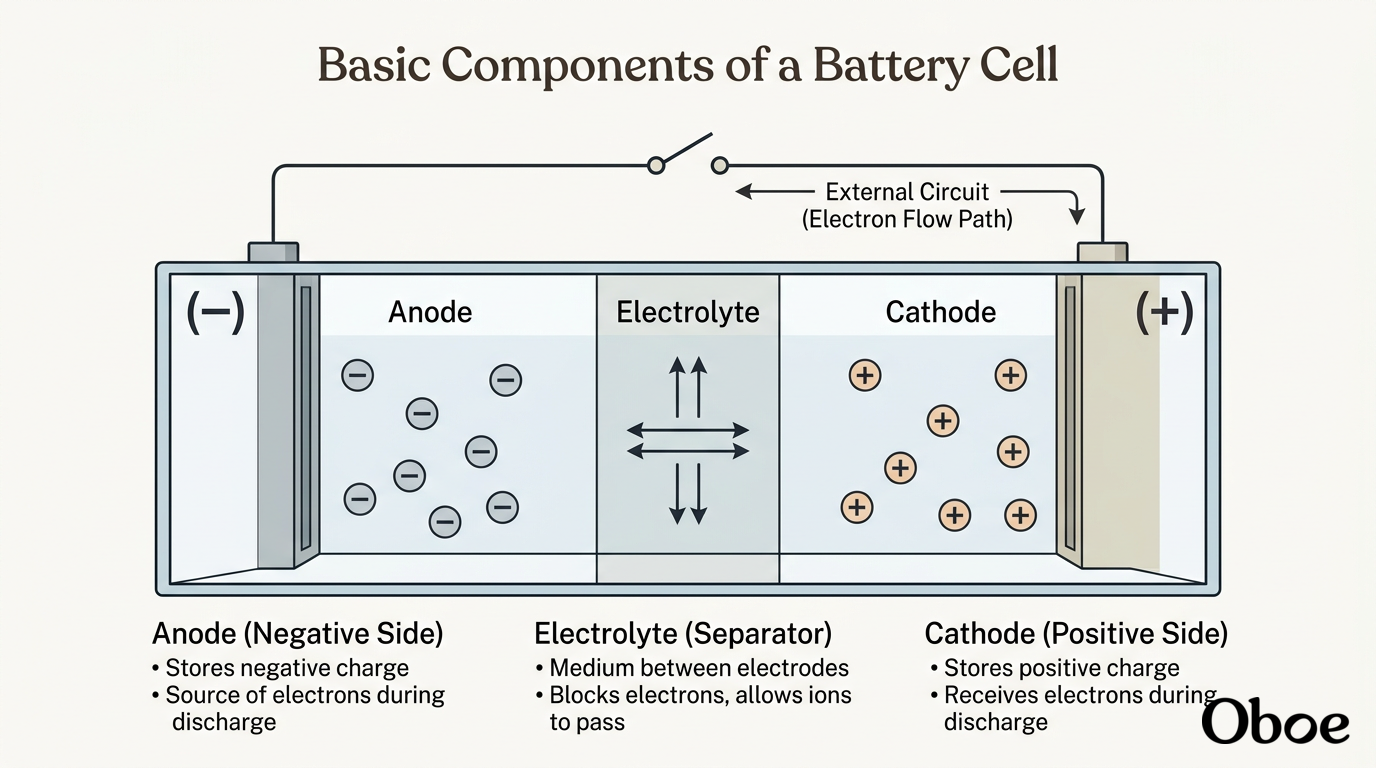
I've started generating that diagram so you can see how this physical layout works.
Before we look at how they talk to each other, which of these three parts feels the most interesting or surprising to you so far?