
How do batteries store energy?
It's great to dive into how batteries store energy with you! To make sure we tailor this session perfectly to your needs, are you exploring this out of general curiosity, studying for a science class, or working on a specific project?
I'm just curious about how things work.
It is wonderful to have you here! Since you are exploring out of curiosity, we can skip the dry textbook jargon and focus on the beautiful, physical reality of what is actually happening inside these little powerhouses.
A schematic section of a battery cell showing the anode, electrolyte, and cathode.
I have created a basic visual of a battery cell above so you can see how these three core parts are arranged. Before we look at how they interact, let's make sure we have a handle on who is who in this setup.
Make me a diagram showing how electrons move
You got it! Let's zoom in on exactly how those electrons travel to make your devices run.
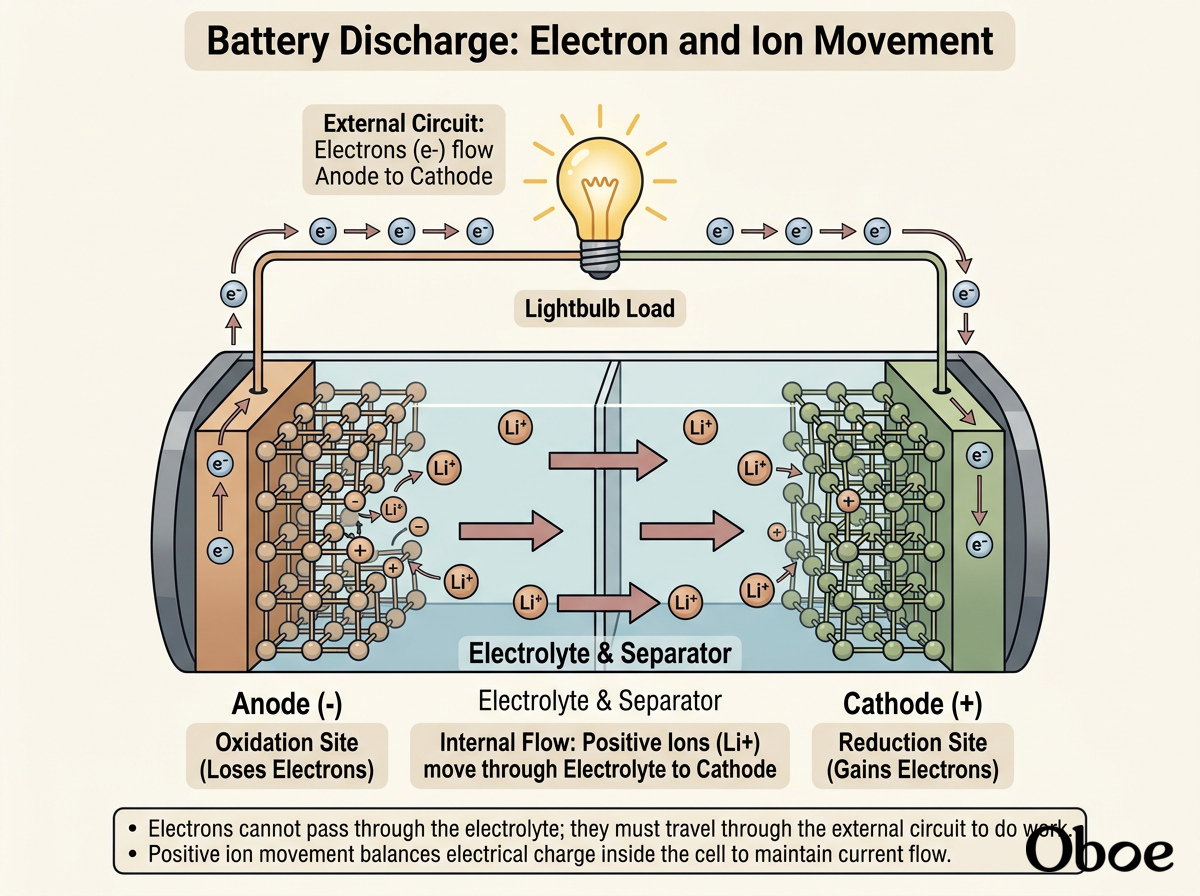
I've started building a diagram to map out this electron highway for you. While it generates, think of the anode as an electron crowded-house. The chemical reactions there are constantly trying to push electrons out, but the internal acts as a strict barrier. It absolutely refuses to let electrons pass directly through it.
Because the electrons are blocked internally, they have to take the external route—flowing through the wires of your phone, laptop, or flashlight to reach the cathode, which eagerly pulls them in. This flow of electrons through the external circuit is what we call an electric current!
But there's a catch: as negative electrons leave the anode, it starts building up a positive charge, while the cathode builds up a negative charge. If this kept happening, the flow would instantly grind to a halt. To keep things balanced, charged atoms called ions must slide through the electrolyte inside the battery at the exact same time.