
Oboe
No history yet

Tell me the history of Private turnpike companies in both 18th Century England and the United States in 2 paragraphs without leaving out important details

Welcome! I'm excited to help you explore how private turnpikes transformed travel and trade. Before we dive into the history, I have one quick question to help me tailor our conversation to what you find most interesting.

Would you like to focus on specific economic impacts, or compare how public interest vs. private profit drove turnpike creation in both countries?

I would like both with a deep analysis and insights

It's great to have you on board! Since you're looking for a deep analysis that covers both the economic outcomes and the clash between public interest and private profit, we'll trace this fascinating evolution step by step.

Your path
Early American Private Turnpike Companies
Comparison of UK and US Models

The Crisis of the Parish Road System

Before the 18th century, England's roads were in a state of absolute decay. Responsibility for road maintenance fell squarely on local , which relied on a system of compulsory, unpaid labor from local peasants known as statute labor. This system was plagued by a fundamental mismatch of incentives: local villagers had very little desire to break their backs repairing roads that were primarily being torn up by heavy, long-distance commercial wagons passing through to other towns. As industrialization began to brew, the demand for reliable inter-urban transit skyrocketed. The old system simply couldn't scale, leaving travelers stuck in deep, muddy ruts for days.

Enter the Turnpike Trusts

To solve this infrastructure crisis, the English government authorized a radical institutional innovation: the . Initiated through individual Acts of Parliament, these trusts bypassed parish authority, handing control of specific stretches of road to local boards of trustees—typically made up of local merchants, landowners, and gentry. Crucially, these trusts were legally structured as non-profit organizations. They were granted the power to erect toll gates and charge travelers directly for using the road. To get the roads upgraded quickly, they issued secured by the future toll revenues. This allowed them to raise immediate capital to buy gravel, pave roads, and hire professional surveyors.
Because they were legally structured as non-profits, any financial surplus the trusts generated could not be pocketed by the trustees. By law, every extra penny had to be reinvested directly back into road upkeep and debt retirement. This created a strong alignment with the public interest: the goal was better transit and debt clearance, not maximizing private payouts.

I would like to explore the 3 aspects you just pointed me out to

It is wonderful to see your enthusiasm! Let's zoom in on how these Parliamentary Acts and the non-profit model transformed the physical roads, how they were funded, and the massive economic payoff that followed.

Funding the Upgrade

To turn a muddy, rutted path into a smooth, paved road, Turnpike Trusts needed serious upfront cash. Because they could not issue stock, they relied entirely on a combination of toll gates and . By securing loans with the promise of future toll revenues, trusts could immediately hire professional surveyors and buy high-quality gravel. This funding model ensured that those who used the roads paid for their upkeep. To enforce this, trusts erected toll houses and gates every few miles, staffed by a resident toll-keeper.

The Economic Impact

The physical improvements funded by these tolls triggered an absolute revolution in English transport. Better, harder road surfaces meant that heavy wagons no longer sank into the mud. Coaches could travel throughout the winter, and travel times between major cities plummeted. For instance, the journey from London to Manchester, which once took several grueling days, was cut down to just under 30 hours by the late 18th century. This speedup did not just make travel more comfortable; it drastically reduced freight charges and enabled the rapid movement of goods, fuel, and raw materials that fueled the early .

To help you visualize exactly how these trusts functioned and reinvested their money, let's look at a diagram of the English Turnpike Trust model.
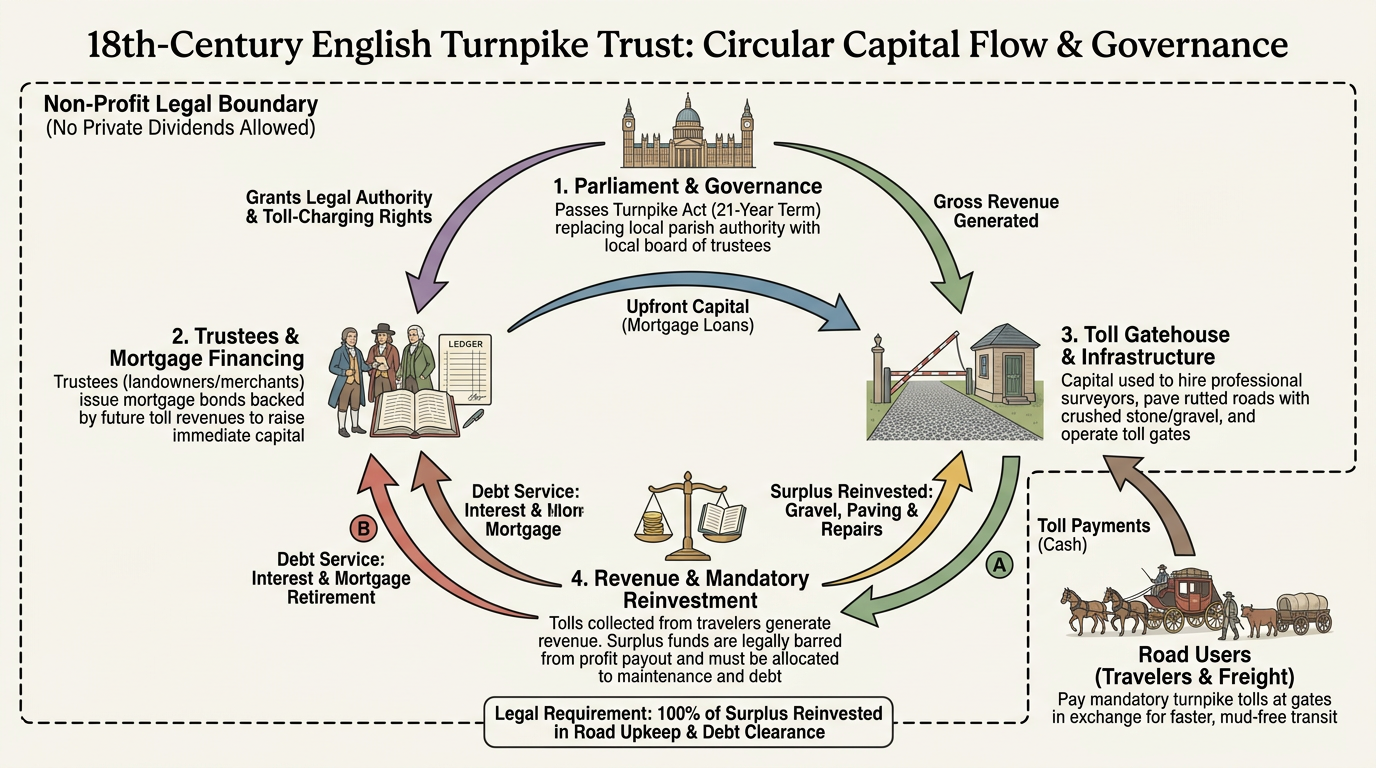
18th-Century English Turnpike Trust: Circular Capital Flow & GovernanceDiagram

This visualization highlights how the non-profit loop kept capital working directly for the road.

Since we are in Student Mode, let's see how well you have grasped this English turnpike system before we cross the Atlantic to see how the Americans did things. Ready for a quick question?

They were non-profit bodies that reinvested toll surpluses back into the roads.

Economic History
LV 1
Infrastructure Development
LV 1
Skills

Spot on. You nailed it. The English trusts were strictly non-profit entities required by law to pump every single penny of surplus back into the roads, aligning their operations closely with local public transit needs.

Now, let's cross the Atlantic to the newly independent United States in the late 18th century, where a completely different turnpike experiment was about to unfold.

The Birth of the American Corporate Turnpike

Following the American Revolution, the young United States faced a massive geographic challenge: its population was rapidly expanding westward, but the existing transportation infrastructure consisted of little more than rugged, former native trails. Local governments lacked the tax revenue and administrative capacity to build high-quality, long-distance highways. To bridge this gap, American states turned to a radical institutional departure from the British non-profit model. Instead of creating volunteer trusts, they chartered private, for-profit .

The Philadelphia and Lancaster Turnpike

The spark that ignited America's toll road boom was the chartering of the , completed in 1795. Spanning 62 miles in Pennsylvania, this state-of-the-art paved highway was a resounding engineering success that slashed travel times and successfully connected rural agricultural hinterlands directly to the busy port of Philadelphia. Unlike their British counterparts, the private investors who bought stock in this corporation expected to receive cash dividends from the toll profits.
This corporate structure meant that profit was the official, explicit goal. However, as we will explore, the real-world motivations of the merchants, farmers, and landowners who bought these shares were often far more complex than just making a direct financial return on their stock. Since we are in Student Mode, let's test your intuition before we dive into the financials. Why do you think local merchants and landowners eagerly bought stock in these corporate turnpikes, even if the toll roads themselves struggled to pay direct cash dividends?

They wanted to boost their local land values and lower the shipping costs for their own goods.

Economic History
LV 1
Economics
LV 1
Skills
You hit the nail on the head! That's exactly right. Local merchants, farmers, and landowners weren't investing in these turnpikes to get rich off direct cash dividends. Instead, they were playing a much savvier long game. Historians call this the motivation. If a new paved road cut travel times to the nearest port in half, local merchants saved a small fortune on shipping their own goods, and landowners watched their property values skyrocket.

The Grim Financial Reality

Because investors prioritized these indirect benefits, they tolerated what would otherwise be considered a financial disaster. In reality, almost all early American turnpike companies were highly unprofitable. Toll revenues barely covered the high costs of hiring gatekeepers, repairing washed-out gravel, and maintaining wooden bridges. High corporate dividends were virtually non-existent, and many turnpikes never paid back their original investors a single cent. Yet, because these roads boosted local economies so dramatically, communities kept voting to charter them. It was a massive transfer of private wealth into public infrastructure.

Now that we have looked at the unique ways both the British and Americans got their roads built, let's put them head-to-head.

Are you ready to compare these two models directly and see how they eventually gave way to new technologies?

Continue to the head-to-head comparison

Let's put these two revolutionary systems side by side to see how their core mechanics functioned in practice. On paper, they look like opposites, but their economic realities tell a much more surprising story.

The Institutional Face-Off

To understand why these systems behaved the way they did, we have to look at how they were built from a legal and financial standpoint. In England, the was a non-profit entity. It could not issue stock or pay dividends to its directors. Instead, it raised capital by issuing mortgage debt—bonds that paid a fixed interest rate to local lenders, secured by future toll revenues. By law, any cash left over after paying this interest and basic upkeep had to be plowed right back into the road. Across the ocean, the American was structured for profit. It raised money by selling ownership shares (equity) to the public. If the road made money, those stockholders expected to receive variable cash dividends. However, because of high maintenance costs and rampant toll evasion, actual cash dividends were almost non-existent. Yet, the roads were still built because they delivered immense value directly to the local businesses owned by those very same stockholders.
FeatureBritish Turnpike TrustsAmerican Turnpike Companies
Legal StructureNon-profit trustFor-profit corporation
Primary FinancingMortgage debt (bonds)Equity (stock shares)
Surplus CapitalReinvested into road upkeepDistributed as dividends (ideally)
Investor RewardFixed interest on bondsIndirect economic boom ('use and esteem')
This comparison reveals a fascinating paradox. While the British system was legally designed as a non-profit, its investors received steady, reliable interest payments on their bonds. Meanwhile, the American system was legally designed to make a profit, but its investors almost never received direct cash payouts—instead receiving their return via a general regional economic boom. To make sure we have this fundamental contrast down, let's look at how these financial mechanisms worked. Since we are in Student Mode, let's see if you can spot the key difference in how an investor made money from these two systems.

Which of the following statements accurately describes the primary financial difference for an investor in these two systems?

British trust investors received fixed interest on debt, while American corporate investors primarily gained indirect business benefits.

Comparative Analysis
LV 1
Economic History
LV 1
Skills
You are absolutely spot on! That is exactly right. British investors bought bonds to collect safe, fixed interest payments from a non-profit trust, whereas American investors accepted the high risk of stock ownership because they cared about the indirect economic payoff—using the road to boost their own local businesses and property values. Now, let's look at the ultimate fate of both networks. Despite their revolutionary beginnings, both the British and American networks eventually faced severe operational, financial, and competitive crises in the 19th century.

The Challenge of Maintenance and Shunpiking

As the years wore on, both systems began to buckle under the weight of high upkeep costs and a highly creative form of toll evasion known as . Building a road was a one-time capital expense, but keeping it smooth in the face of heavy carriage traffic, iron-rimmed wagon wheels, and winter freezes was an ongoing financial nightmare. To make matters worse, locals who resented paying tolls quickly figured out that they could bypass the official toll gates by carving out clever detour paths through nearby forests or fields, popping back onto the turnpike just past the collector's view. These bypasses were cheekily called "shunpikes."

Superseded by Steam and Iron

While shunpiking drained toll revenues, the final, fatal blow to private turnpikes came from technology. In the 19th century, a transportation revolution swept across both nations, first in the form of and, soon after, the steam-powered . No matter how smooth a gravel turnpike was, a single horse walking along a flat canal towpath could pull fifty times more weight in a barge than it could pull in a wagon on a road. When steam locomotives arrived, they offered unprecedented speed and hauling capacity that rendered long-distance road freight completely obsolete almost overnight.
As turnpikes went bankrupt or saw their charters expire, state and local governments stepped in, converting these previously private networks into the free public road systems we use today. It was a massive transfer of private infrastructure into the public domain. To make sure we consolidate this complete history, let's run a quick check of your understanding. Since we are in Student Mode, here is your next multiple-choice question.

When canals and railroads emerged in the 19th century, what was the primary reason they successfully superseded the private turnpike networks?

They offered far lower shipping costs and higher speeds for moving heavy bulk goods.

Economic History
LV 2
Transportation History
LV 1
Skills
Spot on again! You are absolutely right. No matter how smooth or well-maintained a gravel road was, the physics of a steel wheel on an iron rail or a heavy barge floating on water simply outmatched a horse pulling a wagon. Canals and steam-powered railways lowered shipping costs to a fraction of road transport and kept things moving at speeds a horse-drawn carriage could never match. With that, we have reached the end of our exploration into the rise, financial inner workings, and ultimate legacy of both the British non-profit trusts and the American for-profit corporate turnpikes.

To help you consolidate everything we have covered across these three distinct eras, I can assemble a comprehensive, highly structured study guide or a set of review flashcards for you.

Can you recommend a book where I will see this full history

I would love to recommend some excellent reading for your project. For a truly definitive, highly readable, and deeply insightful dive into the financial and social history of American toll roads, you should read , John Majewski, and Christopher Baer's landmark book, : Toll Roads and the Rise of the American Turnpike Corporation.
If you are interested in a broader, epic sweep of how these early turnpikes, canals, and railroads collectively built the modern world, another absolute masterpiece is The , 1815-1860 by George Rogers Taylor. It is an older classic, but it remains the gold standard for understanding how the shift from rough dirt roads to iron rails physically constructed the American economy. To help you organize all the different concepts we have discussed—from statute labor to joint-stock corporations and shunpiking—I can put together a resource to help you study.