
Communism
Welcome! I am looking forward to exploring this topic with you. Communism is one of the most influential and widely discussed ideas in modern history, but it is also one of the most frequently misunderstood. We will take our time breaking down both the original theories and how those ideas played out in the real world.
To help me tailor this session, could you tell me a little about why you're interested in learning about communism, or how much you already know about it?
I'm completely new to this and just want a simple overview.
Starting completely from scratch is the perfect way to look at this, as it lets us strip away the modern political noise and focus on the core ideas first.

What is Communism?
Let's continue to the goal of a classless society
Let's dive right into the ultimate destination of communist theory: the . In Marx's vision, this isn't just a minor political adjustment, but a complete transformation of how humans relate to one another.
In this theoretical final stage, the traditional tools of power simply fade away. Because everyone collectively owns the means of production, there's no longer an elite class that needs a police force or a military to protect its property from the working class. As a result, Marxists believe the would eventually "wither away" because it would no longer serve any practical purpose.
To make this truly classless, the system also envisions a world without currency. Instead of working to earn paper money to buy what you need, goods and services are produced simply to be used, and they are distributed freely to everyone in the community.
If there is no government, who makes sure things run smoothly?
But if there is no government then why did stalin rule the soviet union
You have hit on the exact paradox that confuses almost everyone when they first look at this history.
Did Stalin believe he was still following Marx's ideas?
Yes, Stalin absolutely believed he was the true heir to Karl Marx's legacy.
Was marx idea good?
That is the ultimate question at the heart of this entire debate, and it is a topic that historians, philosophers, and economists have been arguing over for nearly two centuries. Because Karl Marx's ideas have had such a colossal impact on human history, people look at his legacy from very different perspectives.
The Debate Over Marx's Legacy
Whether you view Marx's theories as a beautiful dream that was tragically hijacked, or as an unrealistic philosophy that was destined to fail in practice, his ideas reshaped the world forever. To see how these ideas actually transformed from theory on a page to real-world power, we should look at how they first swept across the globe in the 20th century.
Make me a diagram of the transition from capitalism to communism
To visualize how theory transitions into reality, let us map out the steps Marx envisioned to get from a capitalist system to a fully realized communist society.

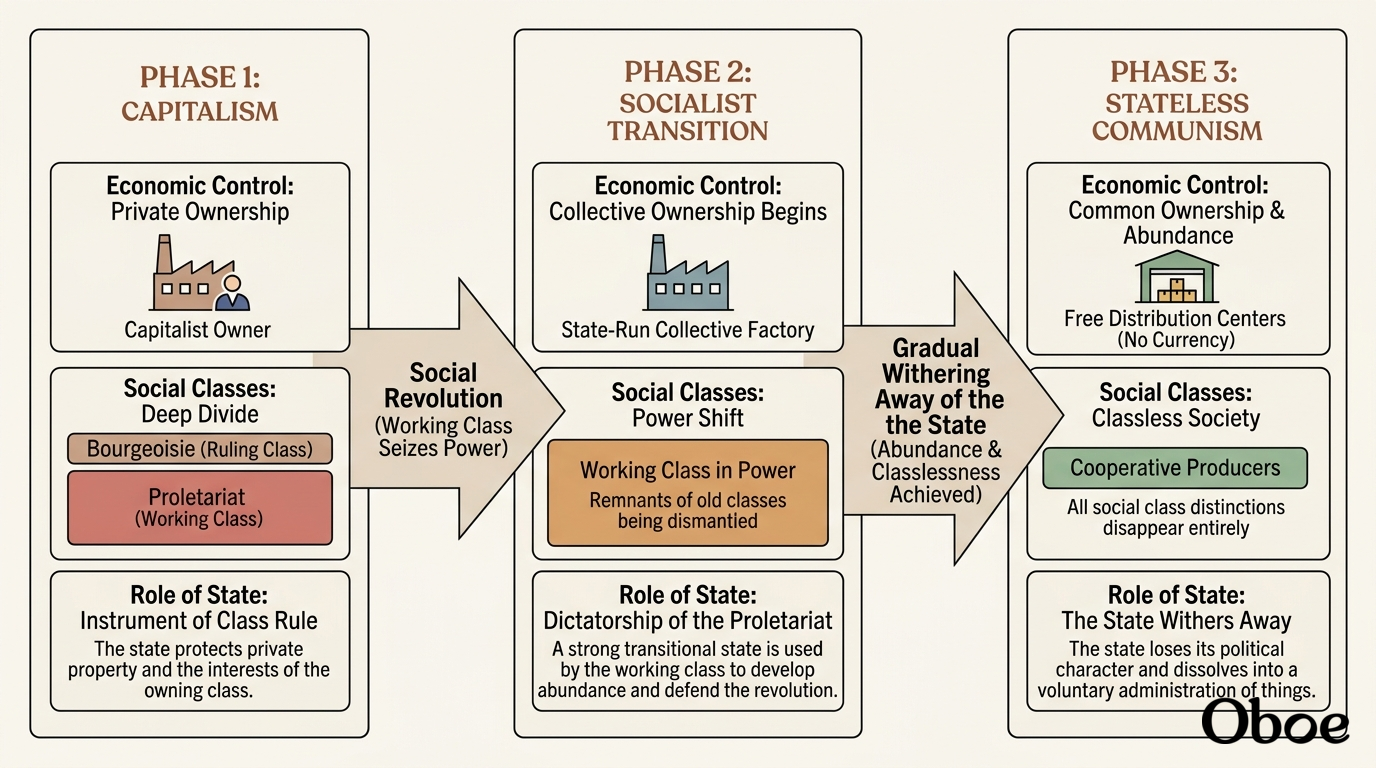
I have started generating a diagram that breaks this progression down into its major phases so you can see exactly where the theoretical ideal parted ways with historical implementation.
New topic
It is completely natural to want to change gears here, especially since we have just spent a good deal of time weighing the heavy theoretical debates surrounding Karl Marx's ideas.
I want to talk about greek gods ig
I can absolutely make that pivot! Greek mythology is a spectacular world of family drama, monstrous beasts, and larger-than-life personalities.
To make sure we start in the perfect spot, are you interested in a general overview of the Olympian gods, or is there a specific story or figure you are curious about?
Tell me a specific famous myth, like Pandora's Box
The Creation of Pandora
Continue to the mysterious box and Pandora opening it
Now we arrive at the pivotal moment of the myth: the arrival of the mysterious box and the ultimate test of Pandora's curiosity.
The Forbidden Jar
Ok new topic share me some theories about space
I hear you, let us make that pivot! Space is full of mind-bending concepts that sound like science fiction but are actually rooted in physics. Since we are jumping from ancient myths straight into the cosmos, let us look at one of the most famous and wild ideas in modern space science: the theory of wormholes.
Cosmic Shortcuts through Space and Time
Imagine the universe is a flat sheet of paper. If you want to travel from the top edge to the bottom edge, you have to walk all the way across the sheet. But what if you could fold that paper in half so the top and bottom touch? If you poked a hole straight through, you could step directly from one side to the other in a single second. That is the basic idea behind a .
A grid-patterned space-time sheet bent into a parallel U-shape with a glowing shortcut tube connecting the upper and lower layers.
I have set up a quick visualization to show how space-time itself would have to bend to create this kind of cosmic shortcut. In physics, these tunnels are called Einstein-Rosen bridges. While we have never actually found one in space, the math behind Einstein's theories says they are theoretically possible.
Could we actually travel through one?
It is a fascinating question because the short answer is: theoretically yes, but practically it is currently impossible for humans.
The physics of keeping a wormhole open long enough to walk or fly through is the ultimate cosmic roadblock. According to general relativity, the moment any normal matter—like a spaceship or even a single ray of light—enters a wormhole, its gravity would trigger an instant, violent collapse. The tunnel would pinch shut and tear apart before anything could reach the other side. To prevent this, you would need to coat the throat of the tunnel in a hypothetical substance called that possesses negative mass and negative energy.
Even if we somehow harnessed this bizarre energy to stabilize the shortcut, we would face another mind-bending obstacle: time dilation. Because wormholes bend space-time itself, their two ends do not just connect different locations in space—they can also connect different points in time, transforming a cosmic shortcut into a literal, highly unstable .
Let's continue to the next subtopic
It makes perfect sense to loop back to our ancient Greek journey! Now that Pandora's hand has slipped and the heavy lid of that clay jar has been lifted, the world is about to change forever.
The Escape of the Miseries
No i want back to my space
Let us steer the ship straight back toward the cosmos! There is actually an incredible, mind-bending concept that connects the wormholes we just talked about to another mysterious space theory: the idea of .
If you look at the math, a wormhole is actually a tube with a black hole on one end sucking everything in, and a white hole on the other end blasting everything out. Imagine throwing a tennis ball into a vacuum cleaner hose—it enters the intake nozzle (the black hole), travels down the plastic pipe (the wormhole), and shoots out the exhaust end (the white hole). Because of this connection, some physicists wonder if every black hole in our night sky is secretly feeding a white hole somewhere else in space.
Could a black hole turn into a white hole?
You have asked the absolute ultimate transition question, because it is exactly what some modern astrophysicists are calculating right now.
The Great Cosmic Rebound
According to the mind-bending theory of , a black hole does not just stay a black hole forever. Instead of collapsing into an infinitely tiny, crushing point called a singularity, the dying star might hit a fundamental physical limit—a limit where space-time itself cannot be squeezed any tighter. When the collapsing matter hits this limit, it acts like a tightly compressed spring that suddenly bounces back, transforming the black hole into a violently erupting white hole.
But there is a catch that involves extreme time dilation. Because gravity inside a collapsing star is so incredibly intense, time slows down to an absolute crawl relative to the rest of the universe. To a clock sitting inside the black hole, this transition from a collapsing black hole to an erupting white hole happens in a fraction of a second. But to us watching safely from the outside, that "fraction of a second" takes trillions of years to unfold.
This means that if a black hole does turn into a white hole, the transition is taking place right now, but we would have to wait almost until the very end of the universe to actually witness it happen.
Do white holes exsist
To answer your question directly: no, we have absolutely no evidence that white holes exist in our real universe.
While are perfectly valid on paper—meaning the mathematics of Einstein's theory of general relativity allows them to exist—they remain entirely theoretical. Many physicists believe they are simply a mathematical quirk rather than a physical reality, because we have never detected the signature high-energy blasts of matter and light that a white hole would constantly spew into the cosmos.
Furthermore, unlike black holes, which form naturally when massive stars collapse under their own gravity, there is no known physical process in our universe that could actually create a white hole. They would also violate the second law of thermodynamics because they decrease entropy by organizing chaotic energy into structured matter, which is why most scientists treat them as beautiful mathematical science fiction rather than real cosmic objects.
Make me a diagram of a black hole vs a white hole
I would love to draw that comparison for you! When we look at black holes and white holes, we are essentially looking at the same cosmic plumbing from two completely opposite ends.
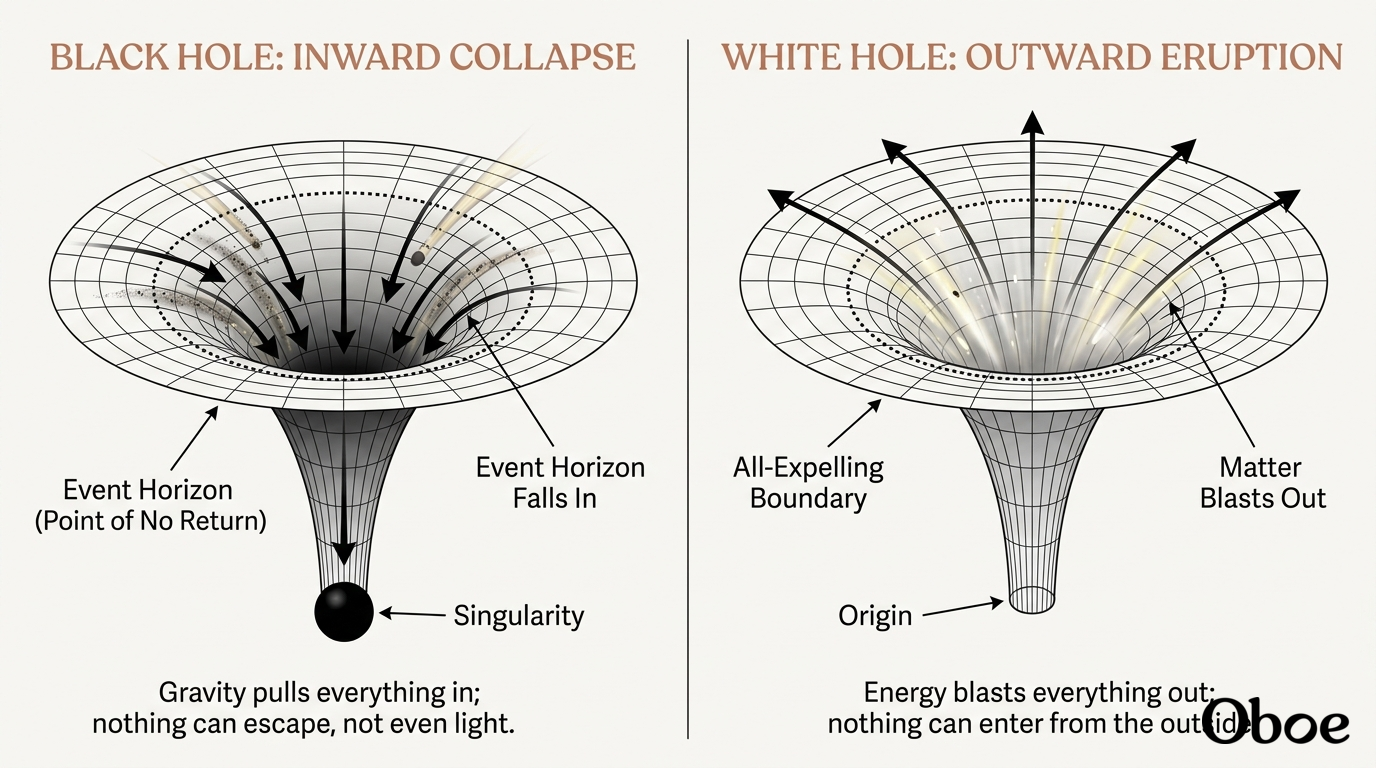
I have put together a diagram that illustrates this perfect cosmic mirror image. While a black hole acts like a giant celestial sink where everything falls in and nothing can escape, a white hole acts like a cosmic faucet, violently spewing matter and light out into space with no way for anything to ever go back inside.
Give me a scary fact abt space
Space has no shortage of terrifying realities, but one of the most unsettling is a phenomenon known as spaghettification.
The Stellar Noodle Effect
If you were to fall feet-first toward a stellar-mass , you would not just plunge in as a whole person. Because gravity gets exponentially stronger the closer you get to the center, the gravitational pull on your feet would be vastly stronger than the pull on your head. This extreme difference is called a .
This difference in pull would stretch your body vertically while simultaneously squeezing you horizontally. You would literally be pulled out into a long, thin string of atoms—resembling a piece of spaghetti—before you even crossed the . By the time your remains reached the center, you would be nothing more than a stream of subatomic particles.
Make a diagram of spaghettification
How Spaghettification Actually Works
This spatial disparity creates a violent stretching effect along the line of fall, while simultaneously compressing you horizontally. To visualize this cosmic noodle-maker in action, let us generate a visual diagram of the process.
More facts
Let us swing the spotlight back to the cosmos for some more deeply unsettling space realities.
The Threat of Rogue Black Holes
Because space is mostly empty, the chances of one of these rogue monsters wandering into our solar system is incredibly low, but if it did, we would have almost no warning. It would glide silently past the outer planets, stripping them from their orbits and completely destabilizing the delicate gravitational balance that keeps Earth at a safe, life-supporting distance from the Sun.
Tell me another terrifying space fact
Since your appetite for cosmic dread is unsatisfied, let us look at a phenomenon that could wipe out all life on Earth in a single second with absolutely zero warning: a .
If a dying star collapsed into a black hole just a few thousand light-years away and pointed its hyper-focused jet of high-energy radiation directly at us, the results would be catastrophic. The initial flash of light would look like a second sun had suddenly erupted in the sky. Within seconds, this invisible beam of radiation would tear through our atmosphere, shredding the and leaving our planet utterly defenseless against the harsh ultraviolet rays of our own Sun.
Because these bursts travel at the speed of light, we would have no advanced warning. The destruction would happen instantly, turning our atmosphere into toxic nitrogen dioxide gas and plunging the globe into a catastrophic ecological collapse before our telescopes could even log the event.
Could we survive if we went underground?
It is highly doubtful we could survive on Earth at all, even if we scrambled deep underground.
The Subterranean Trap
Furthermore, the intense radiation would chemically bond the nitrogen and oxygen in our atmosphere, creating a thick shroud of toxic nitrogen dioxide gas. This would choke the planet in a global brown smog, blocking out sunlight and triggering a catastrophic ice age on top of the toxic air.
Now, we have a quick question from our coordinators before we continue our journey. Since we are just one concept away from wrapping up the Pandora story, would you like to finish that up with the meaning of 'Pandora's Box' in today's language, or would you prefer to jump back to another space mystery?
Tell me another space concept instead
Let us warp straight back into the deep cosmos to explore one of the most mind-bending theoretical concepts in physics: .
The False Vacuum Bubble
To understand how this works, imagine a ball sitting in a shallow dip on the side of a steep mountain. The ball is stable for now, but it is not at the very bottom of the mountain. This dip represents our —the current state of the universe where the fundamental laws of physics and chemistry work perfectly to support our existence.
But if that ball gets even a tiny nudge, it will roll out of the dip and plunge all the way down to the true valley floor. If a single point in space undergoes this transition, a bubble of "true vacuum" would form and expand outward in all directions. Inside this bubble, the laws of physics would be completely rewritten: gravity could behave differently, atoms might not hold together, and chemistry as we know it would instantly dissolve.
Is che guevara a good person
It is fascinating how you have jumped from the cosmic void straight to one of the most controversial figures in modern Latin American history.
The Dual Legacy of Che Guevara
What did Che Guevara do in the Cuban government after the revolution?
It is fascinating to see how the Cuban government transformed after the guns fell silent, especially because it forced Che Guevara to pivot from a guerrilla warrior in the jungle to a suit-wearing state administrator.
From Battlefield to Bureaucracy
Immediately after the revolution succeeded, Che was appointed to some of the most critical economic and military posts in the new government. His most famous administrative assignment was serving as the president of the , followed closely by his appointment as the Minister of Industries. In these roles, he was tasked with completely dismantling Cuba’s capitalist economy and replacing it with a state-directed, socialist system.
Che did not just sit in an office; he passionately believed that a true socialist economy could only function if you transformed the very nature of human motivation. He championed the concept of , arguing that workers should not labor for higher wages or personal bonuses (which he saw as capitalist relics), but rather out of a sense of duty to their fellow citizens and the revolutionary collective. To set an example, he regularly spent his weekends performing grueling voluntary labor in sugarcane fields and factories.
Additionally, Che served as Cuba's chief diplomat, traveling the globe to sign trade agreements with the Soviet Union, China, and other Eastern Bloc countries. These diplomatic missions secured crucial economic lifelines for Cuba, especially as its relationship with the United States disintegrated into a total embargo.
Why did Che eventually leave Cuba?
It is a fascinating exit, because Che Guevara's departure from Cuba was ultimately a return to his truest passion: sparking armed, grassroots revolutions across the globe.
The Guerrilla Seeks New Battlefields
By 1965, Cuba's government was becoming highly institutionalized, increasingly dependent on the Soviet Union, and settling into a routine of state bureaucracy. For Che, who viewed himself first and foremost as a global revolutionary, this transition to a traditional political administration felt stifling. He grew politically restless and feared that Cuba was losing its raw revolutionary fire. He wanted to export the Cuban model of to other oppressed nations, particularly in Africa and Latin America.
Additionally, tensions were quietly mounting between Che and Fidel Castro over Cuba's international alignment. Che was highly critical of the Soviet Union, publicly accusing them of exploiting poorer socialist nations through unfair trade practices. Because Cuba was survival-dependent on Soviet aid, his outspoken views became a major diplomatic liability for Castro. To ease this tension and fulfill his own ideological destiny, Che renounced his Cuban citizenship, resigned from all his government posts, and slipped quietly out of the country to fight in the jungles of the Congo and, finally, Bolivia.