
GenPeach's competitive set: identify 3-5 GenAI creative tools and how they position against them.
I'd love to help you break down the competitive landscape for GenPeach AI, but first, I want to make sure I tailor this analysis perfectly to your goals.
Are you analyzing GenPeach's competitive set for a GTM strategy, product roadmap planning, or investment research?
Go-to-market (GTM) strategy
That makes total sense; a GTM strategy requires a razor-sharp understanding of exactly what makes a product stand out in a crowded market. Let's start by laying out the foundation of who GenPeach AI actually is and what makes their technology unique before we size up the competition.
The New Era of Human-Centric AI
- High-Fidelity Human Generation: No more plastic-looking skin or distorted hands. Their models are trained specifically to nail human anatomy and micro-expressions.
- Emotional Awareness: The ability to inject specific, subtle emotional states into generated subjects.
- Fine-Grained Controllable Diffusion: Giving professional creators precise, surgical control over poses, camera movement, and video temporal stability.

Continue to identifying the 3-5 primary competitors
Let's dive right into the competitive landscape, looking at the first heavy hitter GenPeach will face: Midjourney.
The Aesthetic Standard-Bearer: Midjourney
| Feature / Vector | GenPeach AI | Midjourney |
|---|---|---|
| Primary Focus | Hyper-realistic, anatomically perfect humans | Highly stylized, painterly, & dramatic aesthetics |
| Control Mechanism | Fine-grained structural controls (pose, micro-expressions) | Text prompt-to-image with random aesthetic exploration |
| Platform Access | Native API & studio workflows for developers/studios | Discord-centric community & web-app generation |
| Video Capability | Native, temporally consistent multimodal video | Highly limited / experimental video features |
Our next competitor block introduces the video giants. Would you like to explore how Runway, Luma, and Pika dominate motion, or do you want to test how we position against Midjourney first?
Continue to Runway, Luma, and Pika
Let's zoom in on the powerhouse trio that currently dominates the frontier of generative video: Runway, Luma, and Pika.
The Motion Lords: Runway, Luma, and Pika
While Midjourney conquered static images, these three players carved out their kingdoms in generative video. Historically, generative video was plagued by chaos—characters morphed into different people mid-scene, backgrounds warped dynamically, and realistic physics did not exist. Today, these platforms rely on advanced to make video clips look like cohesive, continuous shots.
For GenPeach's GTM strategy, the battle here isn't about general motion; it's about control over the human subject. Here is how these platforms compare on the battlefield:
| Competitor | Moat / Core Strength | Where They Excel | The Strategic Gap for GenPeach |
|---|---|---|---|
| Runway (Gen-3) | Enterprise presence & multi-tool suite | Broad cinematic camera sweeps & complex physics simulations | Generalist approach; lacks surgical, emotional nuance in human faces |
| Luma (Dream Machine) | High-speed rendering & camera fluidity | Action-heavy sequences, fast camera tracking, & perspective shifts | Rapid movement often compromises facial identity and clothing consistency |
| Pika (Pika 1.0) | Consumer-friendly features & effects | Micro-animations (e.g., sound effects, "inflating" objects) | Fun, social-first tools; lacks the cinematic resolution and deep realism required by studios |
If a creative director uses Runway or Luma to generate a dramatic wide-angle tracking shot of a bustling street, the result will look incredibly cinematic. But if they zoom in closely on a character's face to capture a subtle, flickering moment of heartbreak—the "uncanny valley" of plastic skin, frozen micro-expressions, or creeping distortion immediately breaks the illusion.
GenPeach's focus on hyper-realistic humans and deep emotional control targets this exact weakness. While Runway sweeps the camera across the landscape, GenPeach captures the soul of the actor in the center of the frame. This allows GenPeach to position itself not as a direct replacement for wide-world generators, but as the indispensable specialized tool for human-centric storytelling.
Next up, we have Adobe Firefly, which takes an entirely different strategic angle by focusing on commercial safety and deep workflow integration. Should we see how Adobe tries to lock down the enterprise market, or would you prefer to explore how open-weights competitors like Black Forest Labs change the game for developers?
Make a diagram mapping these video tools on a Control vs Realism axis
I've kicked off a diagram to help us map these video tools on a Control vs. Realism axis, allowing us to visually pinpoint the exact gaps where GenPeach can thrive.
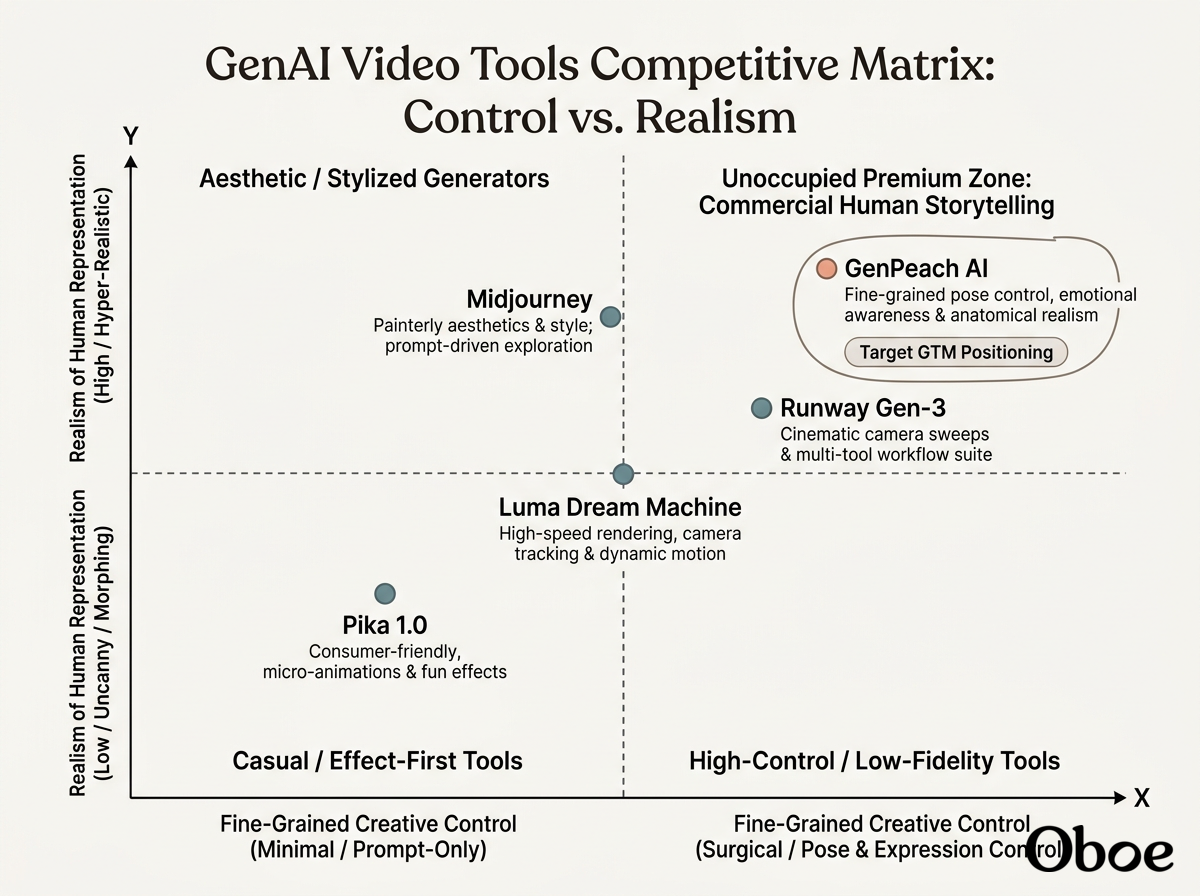
While the diagram is generating, let's keep our strategic momentum going. There are two other massive forces in the market we need to map: Adobe, which dominates the commercial and corporate world, and the open-weights community, which gives ultimate power to software developers.