
help me pre pare for this interviewhttps://www.linkedin.com/jobs/view/4426687667/
I would love to help you prep for this interview and make sure you walk into the room feeling completely ready. Because LinkedIn job links often require a login to view the full details, let's make sure we have all the right context first.
Could you share the job title, company, and key details, or simply copy-paste the text of the job description here?
Executive, Planning (Material Planning Department) About the job Role Overview
The Executive, Planning is responsible for executing Material Requirements Planning (MRP), monitoring inventory levels, forecasting demand, and ensuring the timely availability of materials to support business operations.
The role requires close collaboration with Warehouse, Procurement & Tender, Engineering & Facilities, and suppliers to ensure planning activities are aligned with operational requirements while maintaining optimum inventory levels.
Key Responsibilities
Material Planning & Inventory Management
Execute Material Requirements Planning (MRP) activities to support operational requirements. Maintain and review planning parameters to ensure timely Purchase Requisition (PR) issuance. Monitor inventory levels and identify potential shortages, excess stock, or supply risks. Ensure timely availability of spare parts and materials to support operational continuity. Monitor material consumption trends and recommend planning adjustments where necessary. Forecasting & Demand Analysis
Analyse historical consumption data and demand patterns. Support forecasting activities and identify potential inventory risks. Monitor forecast accuracy and recommend improvements to planning methodologies. Work closely with stakeholders to understand upcoming operational requirements and project demands. Supply Chain Coordination
Coordinate with Procurement & Tender, Warehouse, Engineering & Facilities, and suppliers to ensure smooth material flow. Monitor supplier delivery performance and identify potential supply disruptions. Assist in resolving material shortages and expedite critical items when required. Support cross-functional planning initiatives to improve supply chain efficiency. Reporting & Performance Monitoring
Prepare weekly and monthly planning performance reports. Monitor key planning metrics, including stock availability, forecast accuracy, and plan adherence. Develop reports and dashboards to support decision-making and inventory control. Identify and escalate potential risks affecting material availability. Continuous Improvement
Support process improvement initiatives within Material Planning. Identify opportunities to enhance inventory management, planning accuracy, and operational efficiency. Participate in system enhancement projects and process optimization initiatives. Promote best practices in planning and inventory control.
Requirements
Education
Bachelor's Degree, Post Graduate Diploma, or Professional Qualification in: Supply Chain Management Logistics Business Administration Operations Management Engineering Or any related discipline. Experience
Minimum 3–5 years of experience in: Inventory Management Material Planning Supply Chain Operations Warehouse Planning Procurement Support Functions Technical Skills
Candidates with exposure to the following will have an added advantage:
MRP / ERP Systems Inventory Planning & Control Forecasting & Demand Planning Microsoft Excel (Pivot Tables, Formulas, Dashboards) Data Analysis & Reporting Supply Chain Performance Monitoring Inventory Optimization Techniques
Preferred Attributes
Strong analytical and problem-solving skills. Detail-oriented with excellent planning capability. Good communication and stakeholder management skills. Ability to work independently and manage multiple priorities. Strong coordination and follow-up skills. Comfortable working with data, reports, and inventory systems.
That job description is incredibly helpful, and it gives us a clear map of exactly what the hiring managers are looking for. Before we dive into dissecting those planning responsibilities and tailoring your stories, I want to make sure I understand your background so we can match it perfectly to what they need.
How much prior experience do you have with MRP tools (such as SAP or Oracle) or material forecasting and planning roles?
I have some experience with planning, but I am new to formal MRP systems.
That makes total sense, and it is actually a very common spot to be in. Many excellent planners transition into roles with formal Enterprise Resource Planning systems without having previously used them, so we can absolutely frame your experience to show you are ready.
Before we start structuring your specific stories, let's nail down exactly how you have handled planning in the past so we can translate those methods into the language of .
What tools or methodologies (such as Excel spreadsheets, manual reorder points, or other inventory tracking) have you used in your prior planning experience?
wait i have 2 years experience in master control and basic ERP system in my 1st 2 years of working. an now additional 2 years ++ experience in Rapid Response and expandable system.
That is absolutely fantastic context, and it changes the game completely. You aren't new to these concepts at all; you've actually been working with the core building blocks of modern systems for years.
Having two years of experience with Master Control and basic Enterprise Resource Planning software, paired with over two years using RapidResponse and expandable systems, means you have already executed the exact logic behind formal Material Requirements Planning. Large-scale software like SAP or Oracle simply automates the same fundamental mathematical decisions you've already been managing manually and digitally.
Let's break down exactly how your experience maps directly to what this new employer is looking for. This mapping will serve as your ammunition to confidently answer technical and behavioral questions during the interview.
| Your System Experience | What It Teaches You | How It Maps to Their Job Requirements |
|---|---|---|
| RapidResponse | Concurrent planning, scenario analysis, and immediate demand/supply balancing. | Forecasting & Demand Analysis: Reviewing consumption trends and recommending planning adjustments. |
| Master Control | Strict version control, process compliance, document control, and change management. | Continuous Improvement: Supporting system enhancement projects and process optimization. |
| Basic ERP Systems | Managing bills of materials, inventory transactions, and basic database structures. | Material Planning: Monitoring inventory levels, executing MRP loops, and generating Purchase Requisitions. |
| Expandable Systems | Working with highly custom, scalable databases and adapting to system updates. | Data Analysis & Reporting: Utilizing Excel, dashboards, and reporting metrics to monitor stock availability. |
When the interviewer asks about your familiarity with their specific system (like SAP or Oracle), your strategy isn't to say "I don't know it." Instead, you will showcase how your experience with RapidResponse and basic ERPs makes you a fast learner who already understands the underlying database structures and business rules.
To help you visualize how these systems interact to support a material planning role, I've started generating a diagram illustrating how RapidResponse, ERP databases, and Master Control coordinate to keep inventory levels optimized.
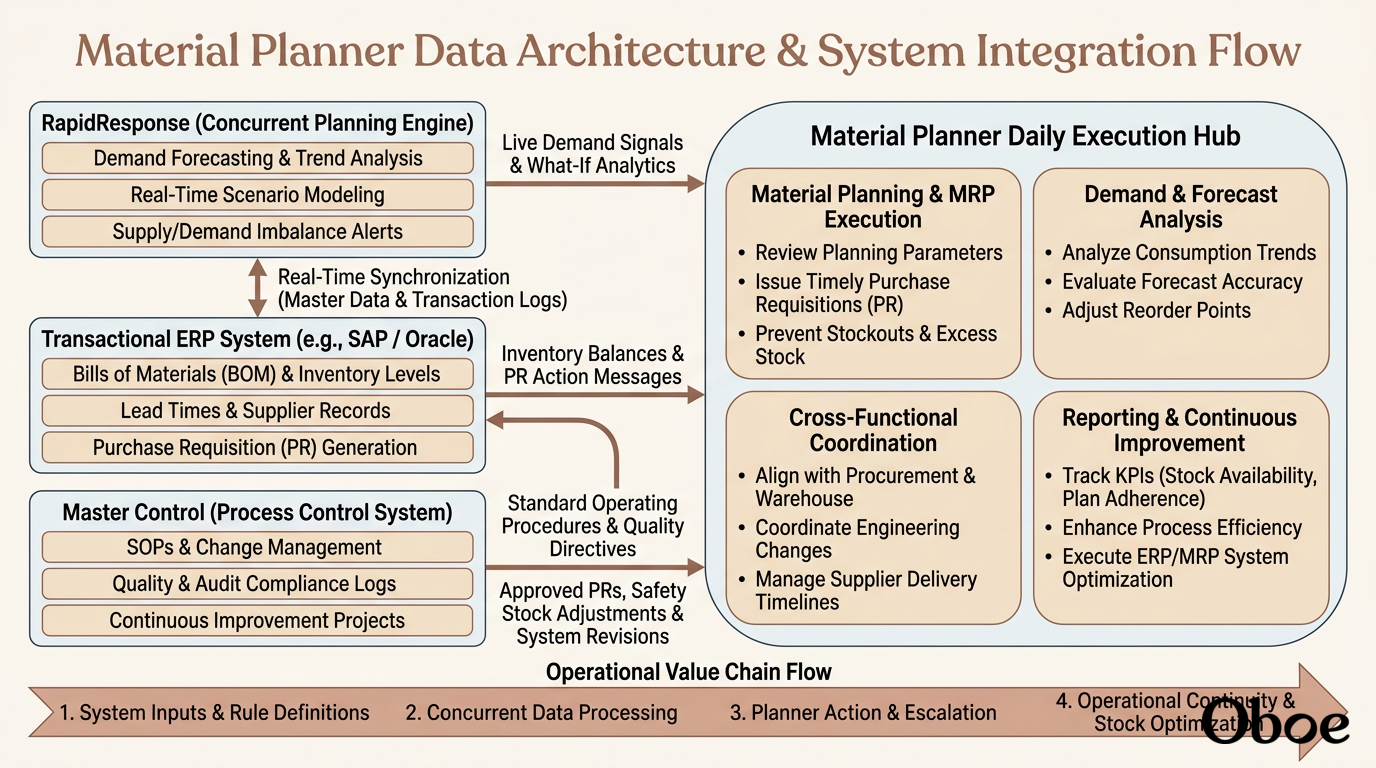
This visualization will help you speak confidently about how data flows from inventory status, through a planning engine, and into purchase requisitions.
Are you ready to see how we can package this technical mapping into a powerful, confident STAR-method story for your behavioral questions, or would you like to dive deeper into the technical mechanics of how RapidResponse compares to SAP/Oracle first?
Continue to framing system experience using the STAR method
Let's dive straight into using the STAR framework to structure your system experience so you can deliver incredibly polished responses.
Let's walk through a concrete example of how we can structure your RapidResponse experience to directly answer a very common planning question: "Tell me about a time you had to adjust a planning forecast due to an unexpected supply or demand change."
Here is how we translate your daily work into a stellar STAR response:
| STAR Step | What to Say (Your Story Template) |
|---|---|
| Situation | In my previous role using RapidResponse, we faced a sudden 30% spike in demand for a core component due to an unexpected client project. |
| Task | I needed to immediately assess our supply health, identify potential inventory shortages, and adjust our planning parameters to prevent a stockout without creating long-term excess. |
| Action | Instead of relying on manual spreadsheets, I ran a concurrent planning simulation in RapidResponse to model different lead-time scenarios. I aligned with our warehouse and procurement teams, then adjusted our reorder points and safety stock levels in the system based on the real-time data. |
| Result | We avoided a critical material shortage, maintained a 98% stock availability rate, and stabilized our inventory levels without holding dead stock. |
Do you see how cleanly that flows? You start by describing the problem, zoom in on your technical usage of RapidResponse as the solution, and finish with a strong, successful outcome.
Before we practice building your own customized story, let's make sure we have the core structure down.
To make sure this structure is locked in, which part of the STAR response should take up the most time and detail when you are speaking to the interviewer?