
Oboe
No history yet

I want to learn Entrepreneurial Psychology & High-Stakes Signaling. I want to learn the core psychological traits of successful founders (resilience, risk tolerance, locus of control, bias for action). I also want to learn how to translate these internal traits into external signals to build trust with pre-seed/seed/Series A VC investors and close early B2B sales.

Let's take a look at the proposed roadmap designed to help you master the psychological toolkit of high-performing founders and translate those internal traits into powerful signals for investors and B2B buyers.

Your path
Translating Internal Mindset into Investor Signals
Founder-Led Sales and B2B Trust Signaling
Integrated Execution across Pitch and Sales

I want to ensure this matches your goals perfectly before we dive into the core traits. How does this outline look to you, and what specific venture or industry context (e.g., enterprise software, deeptech, fintech) will you be applying these signaling strategies to?

This looks good. I will be going broad.

Since you are looking to apply these principles broadly, we will focus on the universal psychology of venture creation. Let's start with the first pillar of our journey: the role of in building resilience and managing adversity as a founder. When navigating the volatile startup lifecycle, your internal mental state is not just a personal matter—it acts as your venture's ultimate strategic asset.

Understanding Resilience Under Adversity

As a founder, adversity is not an occasional hurdle; it is your baseline operating environment. In positive psychology, resilience is defined not simply as the capacity to survive stressful periods, but as the active ability to 'bounce back' and even experience following significant setbacks. Research shows that founders who consciously cultivate high psychological capital are far better equipped to convert operational failures into developmental milestones. Rather than viewing setbacks as permanent personal indictments, resilient founders view them as temporary, localized, and surmountable challenges.
When you face intense pressure—such as losing a key hire or getting rejected by a dozen VCs—your resilience is what keeps your decision-making clear. By maintaining high psychological capital, you prevent cognitive biases from clouding your strategic judgment, ensuring that you do not succumb to premature panic or rigid thinking.

How does a founder's resilience impact their team during a crisis?

During a crisis, a founder's resilience acts as the psychological anchor for the entire organization. Startups operate under extreme conditions of and structural vulnerability, meaning your team is constantly looking to you for cues on how to interpret threat levels. If a founder panics, the anxiety rapidly cascades down, triggering cognitive overload, decision-making paralysis, and a loss of collective across the team.

The Mechanics of Internal Team Signaling

When you maintain high psychological capital in front of your team, you are engaged in active internal signaling. This provides three structural benefits to your team during a storm:
  • Establishes Psychological Safety: By demonstrating that setbacks are surmountable and localized, you create an environment where team members feel safe to report failures early, propose creative solutions, and collaborate openly without fear of finger-pointing.
  • Stabilizes Team Decision-Making: Under high stress, human cognitive capacity narrows, often leading to "Go Fever" or panic-driven choices. Resilient leadership keeps the team's mental processing clear and orderly.
  • Prevents Talent Flight: Startups are inherently risky. Your consistent, level-headed persistence signals to your key hires that the venture is stable and that you possess the strategic capacity to navigate the crisis, protecting your most valuable resource.
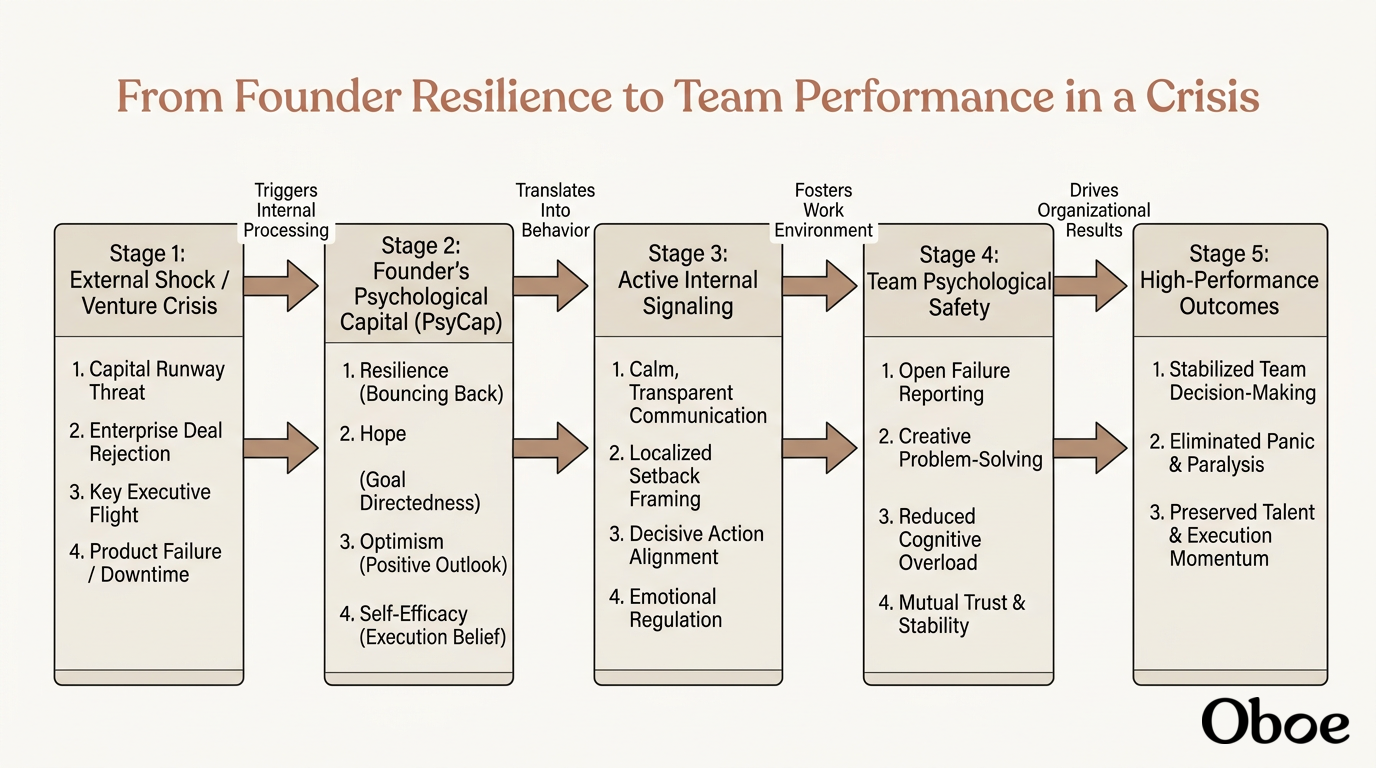
From Founder Resilience to Team Performance in a CrisisDiagram

I have initiated a diagram to visually map out exactly how your internal resilience flows downward to stabilize your team's decision-making and operational execution.

Now that we have covered how resilience works internally and within your team, are you ready to explore our next core trait: how a founder's internal vs. external locus of control dictates their strategic choices?

What is an example of a founder signaling resilience poorly to their team?

While a founder's resilience is a critical strategic asset, signaling it poorly to a team can cause massive structural damage. When pressure mounts, leaders often fall into traps that actively erode organizational stability. The most common pitfall is —a state where a founder aggressively downplays severe realities, insisting that "everything is fine" while the boat is visibly taking on water. This creates a deep disconnect for the team, who begin to doubt the founder's situational awareness or truthfulness, breaking down the very foundation of organizational trust.
Another destructive behavior is . When founders lack the internal psychological capital to handle high-stakes friction, they alternate rapidly between panic and forced calm. This unpredictability signals to the team that the founder is reacting to external storms on impulse rather than executing a stable, deliberate strategy.
Lastly, poor signaling often shows up as micromanaging out of pure anxiety or flat-out masking critical bad news from team members. By withholding truths, a founder creates a massive gap in information, forcing employees to operate under intense uncertainty, which ultimately sparks rumors, drops collective morale, and leads to talent flight. Now that we have contrasted healthy resilience with these destructive signaling behaviors, are you ready to explore how a founder's internal vs. external locus of control shapes their strategic decision-making?

How can a founder share bad news transparently without causing panic?

Sharing bad news without causing panic is one of the ultimate tests of a founder's . To execute this successfully, you must master a dual-framing technique: balancing extreme transparency about the current operational reality with relentless, clear-cut confidence in your team's collective to solve the problem. This approach ensures you do not trigger panic, but instead channel your team's focus toward execution.

The Tactical Delivery Framework

To deliver difficult updates without losing your team's trust or drive, structure your communication using a three-step protocol:
  • Acknowledge the Reality Directly: State the facts clearly without sugarcoating. If cash runway has decreased or a major pilot was canceled, say so immediately. This prevents the damaging effects of and stops rumors before they start.
  • Define the Actionable Horizon: Do not present a problem without a clear, immediate step forward. Break down the crisis into a localized, surmountable challenge with concrete tasks assigned for the next 48 hours to preserve .
  • Anchor in Long-Term Control: Reframe the setback not as a permanent failure of the venture, but as a temporary, navigable data point that your team is fully capable of addressing. This reinforces an internal locus of control across the entire organization.
Crisis Communication GuideStudy Guide

I have queued up a study guide that contains a practical, word-for-word delivery template so you can see exactly how to structure these hard conversations in real life.

Now that we have fully explored resilience and internal communication under adversity, we are ready to advance to the next core trait: how a founder's internal vs. external locus of control dictates their strategic decision-making and response to market feedback. Shall we continue?

Give me a quiz on founder resilience and team signaling first

Let's put your understanding of founder resilience, psychological capital, and team communication protocols to the test before we advance.

During an operational crisis, a founder decides to shield the team from anxiety by withholding news of a shortened runway. Simultaneously, they maintain an incredibly upbeat, highly positive posture in all meetings. According to entrepreneurial psychology, why is this signaling method counterproductive?

It forces the team to operate under severe uncertainty, fostering rumors, while the mismatched positivity (toxic optimism) destroys trust.

Entrepreneurial Psychology
LV 1
Skills
Spot on! Your answer highlights the exact danger of this mismatch. By hiding the shortened runway, you deprive your team of the situational awareness they need to adjust, while projecting forced positivity makes your communication feel completely detached from reality. In positive organizational behavior, this combination of and information withholding triggers severe cognitive load. Team members quickly detect the logical inconsistency between your verbal messages and the actual stress indicators in the environment, destroying their psychological safety and driving talent to look for the exit.

Locus of Control in Founder Decision-Making

Now that we have fully addressed resilience, let's look at another core psychological driver: your , or LOC. Originating from Julian Rotter's social learning theory, LOC represents the degree to which you believe you have power over the outcomes in your life compared to external forces. Founders with a strong internal locus of control believe that their own choices, effort, and strategic execution directly dictate the venture's success or failure. Conversely, those with an external locus of control attribute outcomes to luck, market timing, or macroeconomic shifts.
This psychological orientation heavily dictates your strategic choices and adaptability in the face of customer feedback. A founder with an extreme internal LOC is highly proactive, viewing every obstacle as a surmountable challenge that can be solved with smarter execution. However, when taken to an extreme, a heavy internal LOC can lead to like overconfidence or escalation of commitment. The founder might reject objective market signals, assuming they can simply force their original product-market fit through sheer willpower, ignoring critical pivot opportunities.
Conversely, founders with an external LOC are highly sensitive to market feedback, but they risk falling into passivity during a crisis. They may blame a failed fundraise entirely on "the macro environment" or investor shortsightedness, failing to adjust their pitch or operational metrics because they believe the outcome is out of their hands. The key to high-performance startup leadership is a balanced internal LOC: believing you steer the ship, while remaining highly objective about the ocean's actual currents.

How does a founder's locus of control show up during investor pitch meetings?

During investor pitch meetings, your locus of control (LOC) is not just a background personality trait; it is a live variable that is continuously evaluated by venture capitalists (VCs) under high-stakes conditions.

The Pitch Room Dynamics of Locus of Control

When VCs probe your business model during Q&A, they are actively looking for that distinguish high-potential leaders from those who will buckle under market pressure. How you attribute your startup's milestones, failures, and future growth dictates their assessment of your agency.
Investor QuestionExternal LOC Response (Weak Signal)Optimal Internal LOC Response (Strong Signal)
"Why did your last pilot program fail to convert?""The client had internal budget cuts and their team was disorganized." (Blaming external factors)"We didn't pre-qualify their integration readiness. We've revised our qualification criteria to prevent this." (Owning the outcome)
"How will you handle a competitor launching a clone?""The market is huge, so hopefully we won't cross paths much." (Passive reliance on luck)"We will accelerate our product velocity. Here is how our execution cycle outpaces theirs." (Proactive control)
"What happens if the macroeconomic environment worsens?""Our funding round and target market depend heavily on interest rates." (Macro dependency)"We have structured a capital-efficient roadmap to maintain 24 months of runway regardless of macro shifts." (Calculated mitigation)
While demonstrating high agency is crucial, founders must avoid the trap of . Extreme internal LOC can manifest as arrogance or a refusal to accept market realities. VCs look for optimal internal LOC: high agency paired with intellectual honesty, showing you respect the ocean's currents even as you steer your ship.

To cement this concept, let's look at how optimal internal LOC is tested under fire. Ready for a quick scenario challenge on how to project this balance to a pre-seed investor?

An investor asks: 'Your go-to-market plan relies heavily on a single partnership channel. If that partner pulls out, what happens to your business?' Which response signals optimal internal LOC?

"We are actively mitigating that risk by initiating parallel pilots with two alternative channels this quarter to ensure we maintain control over our distribution pipeline."

Entrepreneurial Psychology
LV 1
Pitching
LV 1
Skills
Brilliant choice! By choosing that response, you demonstrated an optimal internal under pressure. You acknowledged the potential risk of a single-partner GTM path without deflecting blame onto market conditions, and you presented concrete, proactive mitigation steps that keep your venture firmly in the driver's seat.

Risk Tolerance and Comfort with Ambiguity

Building on this proactive agency, high-performance founders must also develop an exceptional . In the early stages of a venture, you will almost never have 100% of the data required to make a perfect decision. Whether you are pricing an enterprise contract or deciding which product feature to build next, you operate under conditions of severe information asymmetry and market volatility.
To manage uncertainty without succumbing to anxiety, successful entrepreneurs rely on calculated risk-taking. Rather than gambling blindly, they run low-cost micro-experiments to gather real-world data and rapidly de-risk assumptions. This active posture prevents and transforms ambiguous market threats into structured, solvable challenges.

How do VCs test a founder's comfort with ambiguity during a pitch?

During pitch meetings, venture capitalists are acutely aware that early-stage investing is less about audited financials and more about evaluating how a founder manages extreme uncertainty. Because of this, VCs do not just listen to your business plan; they actively deploy diagnostic pressure tests during Q&A to probe your and risk tolerance.

How VCs Probe the Unknown

To expose your psychological limits, experienced investors look past standard slides and evaluate how you construct arguments when there is no clear right answer. They probe this by introducing hypothetical roadblocks or highlighting gaps in your data, watching closely for two specific cognitive responses:
  • Response to the Data Void: An investor might ask you to project sales metrics for a totally unproven, non-existent GTM channel. VCs are not looking for a guessed number. They want to see your —specifically, whether you can comfortably formulate a logical, structured hypothesis under pressure or if you freeze up and search for excuses.
  • Reaction to Hypothetical Ruin: When a VC asks, "What happens to your business model if this foundational API is permanently restricted?", they are testing your immediate psychological recovery. A lower-tolerance founder shows defensive , while a high-tolerance leader treats the hypothetical crisis as an engineering optimization problem, instantly mapping out alternative workarounds.
Now that we understand how VCs dissect these traits, it is crucial to recognize how founders accidentally sabotage themselves. Even with high risk tolerance, founders can easily fall victim to underlying cognitive biases—like the sunk cost fallacy—when processing market feedback. Shall we dive into how to mitigate these biases next, or would you like to put your investor signaling skills to the test right now?

Give me an example of a VC question that tests comfort with ambiguity.

When you are in the hot seat during a pitch, venture capitalists do not just want to see your calculated projections; they want to see how you perform in a data void. Early-stage VCs are highly sophisticated at constructing diagnostic questions designed to probe your and expose your risk tolerance limits under pressure. Knowing how to recognize these prompts allows you to pivot from defensive panic to structured, high-agency reasoning.

Two Classic VC Pressure-Test Questions

During Q&A, you are highly likely to encounter these two distinct archetypes of ambiguity testing:
  • The Fermi Estimate Challenge: "If you were to launch your enterprise platform in Brazil next quarter, and you have zero historical performance data there, how would you determine your pricing model and target account list within 30 days?"
    • What they are testing: VCs do not expect an accurate financial projection. They are testing whether you have the to structure a chaotic, data-scarce scenario, or if you succumb to decision freeze.
  • The Black-Swan Extinction Scenario: "Imagine your primary software partner suddenly changes their API access terms overnight, rendering your core automation feature non-functional. Walk me through your first 72 hours."
    • What they are testing: This is a diagnostic test for emotional resilience. VCs are analyzing whether you experience immediate and attempt to deflect blame to external factors, or if you instantly treat the systemic collapse as a tactical optimization puzzle with a clear bias for action.
Now that we have analyzed how VCs expose your comfort with the unknown, we must tackle the hidden traps of processing actual feedback. Even founders with high ambiguity tolerance often fall victim to deep-seated —such as the sunk cost fallacy—when market signals contradict their original vision. Shall we dive into how to systematically mitigate these mental traps to preserve your capital and runtime?

Give me an example of how to answer the Brazil Fermi challenge successfully.

To ace the Brazil Fermi challenge in front of an investor, you must show that you do not need perfect clarity to construct a logical, rigorous strategic path. Instead of guessing a number, you should walk the VC through a structured that breaks the unknown market down into highly manageable, calculated variables. The goal is to demonstrate that even with zero historical data, your decision-making is driven by systemic, high-agency planning rather than blind speculation.

The Anatomy of a Winning Brazil Fermi Response

When hit with this specific question, structure your answer into three distinct layers to signal optimal internal locus of control and supreme comfort with ambiguity:
  • Anchor on Proxy Benchmarks: Acknowledge the data void immediately, then establish a baseline using your most comparable existing market. For example: "While we lack direct historical data in Brazil, we can anchor our initial assumptions on our early cohort data from Southern Europe, adjusting for regional purchasing power parity."
  • Establish a Bottom-Up ICP Filter: Clearly define how you will identify your first target accounts within 30 days without spending heavily. Explain that you will filter for companies exhibiting specific, highly visible digital signatures—such as utilizing particular developer tools or experiencing rapid head-count growth in target departments.
  • Design a Low-Cost Discovery Pilot: Propose a micro-experiment to validate your pricing model. For instance, outline a plan to run a 2-week, targeted outbound campaign offering a highly localized "Design Partner" tier to 50 qualifying accounts, gathering raw willingness-to-pay data in real time to de-risk your pricing assumptions.
By laying out this exact sequence, you transform a potentially paralyzing hypothetical scenario into a structured, executable research sprint, sending a powerful to the VC that you are a high-execution founder who thrives in chaotic environments.

To help you master this, I have started generating a specialized worksheet containing three real-world Fermi scenarios that frequently pop up in institutional fundraising rounds.

VC Ambiguity Pressure Test WorkbookWorksheet

The worksheet above is a fantastic tool to train your brain to think in frameworks whenever you are put on the spot during a pitch.

Now that we have mapped out how to respond to these ambiguity tests, are you ready to transition to our next core topic: how to identify and systematically mitigate cognitive biases—like the sunk cost fallacy—when processing actual market feedback?

How do I recognize when my internal locus of control is turning into a cognitive bias like overconfidence?

An internal locus of control is your greatest asset, but without continuous calibration, it can easily mutate into dangerous cognitive biases like or escalation of commitment. The transition occurs when you stop treating your agency as a tool to navigate objective reality, and start treating it as a license to ignore reality.

Three Warning Signals of Toxic Agency

To prevent your psychological capital from turning into a strategic liability, watch closely for these three warning signs that your internal locus of control has crossed into a :
  • Rejecting Objective Friction as 'Noise': When user engagement drops or customer acquisition costs spike, you immediately blame your team's execution rather than questioning your core product assumptions.
  • Equating Pivot with Defeat: You view changing your original product-market thesis as a personal failure of willpower, rather than treating a pivot as a rational, data-driven optimization.
  • Sunk Cost Rationalization: You double down on a failing GTM channel by investing more capital and team focus, believing that your sheer persistence will eventually force the market to bend to your vision.

To maintain absolute strategic alignment, you need a highly objective feedback loop that separates your psychological drive from hard business realities.

I have started generating a specialized diagram to help you visualize how to build a robust mental firewall that keeps your internal locus of control balanced with real-world customer validation.
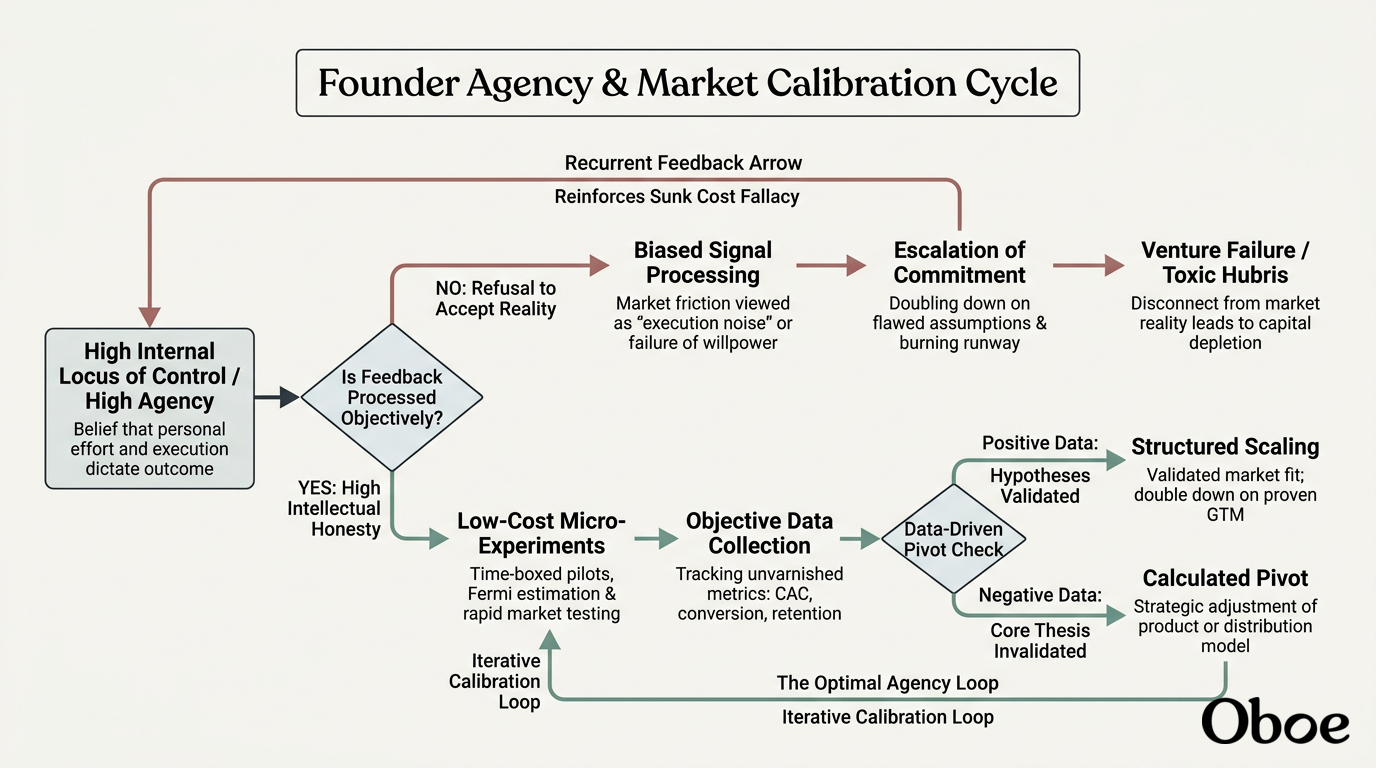
Founder Agency & Market Calibration CycleDiagram

This visualization will show you exactly where the cognitive drift occurs so you can catch it before it burns through your cash.

Would you like to explore concrete tactical frameworks to balance this internal conviction with cold market data, or would you prefer to test your ability to diagnose overconfidence in a rapid-fire scenario?

How do I set up micro-experiments to act as reality checks?

To prevent your internal locus of control from mutating into cognitive biases, you must establish an objective feedback loop that separates your psychological drive from hard business realities. Designing is the most powerful tactical method to force these essential reality checks.

The Anatomy of a Reality-Check Micro-Experiment

An effective micro-experiment operates like a scientific trial, stripping away personal bias and replacing assumptions with unvarnished . To design a robust, low-cost experiment that acts as an unyielding reality check, you must structure your testing around three strict operational parameters:
  • Define a Falsifiable Hypothesis: Your hypothesis must be specific and binary. Instead of stating "customers will like this feature," declare "at least 15% of invited users will click the checkout button within 72 hours."
  • Establish Pre-Commitment Gates: Before collecting any data, write down the exact threshold that defines success and failure. Pre-committing to these metrics prevents you from retroactively rationalizing poor results as "promising interest" or "market noise."
  • Time-Box the Discovery Sprint: Force rapid cycles by limiting your experiment to a tight window, such as 5 to 10 business days. This constraints-driven environment prevents decision freeze, stops cash burn, and keeps your execution velocity exceptionally high.

To help you build these feedback loops directly into your workflow, I have started generating an interactive study guide that maps out how to structure these validation sprints step-by-step.

Founder Reality ChecksStudy Guide
This framework will enable you to continuously stress-test your assumptions without slowing down your day-to-day operations. With these micro-experiments protecting you from overconfidence, we are ready to cover our final psychological driver: how maintaining high execution velocity and a relentless bias for action fuels organizational momentum. Shall we move forward?

How do I ensure my team doesn't burn out during rapid weekly micro-experiments?

Preventing burnout while running rapid weekly validation sprints is one of the most critical operational challenges in early-stage ventures. When you enforce a high-velocity culture, it is easy to accidentally burn out your team by treating every micro-experiment as a high-stakes emergency. To build a sustainable testing cadence, you must balance intense operational speed with absolute and clear boundaries.

The Three Pillars of Sustainable Sprinting

To keep your team highly energized without sacrificing execution momentum, structure your operational cadence around three core principles:
  • Set Strict Boundaries on Scope: Constrain each micro-experiment so that it requires no more than 10% to 15% of your team's weekly engineering or operational capacity. Sprints should be lightweight diagnostic checks, not heavy engineering overhauls.
  • Establish Peer Support Systems: Combat the psychological isolation of high-stakes testing by encouraging collaborative feedback. Research in entrepreneurial psychology indicates that and peer networks act as vital buffers that significantly lower founder and employee burnout.
  • Decouple Test Results from Performance: Frame the failure of a micro-experiment as a major scientific win. If your team fears that a negative data signal reflects poorly on their personal capabilities, they will hide bad results or suffer from extreme stress.
By implementing these guardrails, you shift your company culture from a exhausting grind to a highly structured, data-driven science lab, ensuring your team has the long-term runway to discover true product-market fit.

How do I communicate an experimental failure to my team without killing momentum?

Communicating an experimental failure to your team is a critical test of your internal locus of control and emotional intelligence. In high-performance startups, a failed micro-experiment is not a failure of execution; it is an that successfully saves the company precious capital and runway.

The Tactical Script for Framing Failure

To keep team momentum high, you must consciously avoid sending that project disappointment or panic. Instead, use a structured communication framework that reinforces psychological safety and treats invalidation as strategic progress:
  • Celebrate the Speed of Discovery: Begin by highlighting how quickly the team arrived at the answer. For example: "Because we restricted this test to 5 days, we discovered that enterprise buyers do not value this reporting feature without wasting months of development time."
  • Separate Hypothesis Failure from Competency: Clearly decoupling the outcome of the experiment from your team's individual capabilities prevents defensive posturing and . Frame the result as a win for the process, proving that your pipeline is working precisely as designed.
  • Redirect Team Agency Immediately: Leverage your internal locus of control by immediately steering the team's focus toward the next strategic iteration. Use the raw customer data collected to refine your assumptions, transforming a negative signal into the exact fuel needed for your next validation sprint.

Now that you can run rapid micro-experiments and communicate results without losing momentum, we are ready to transition to our final core trait: how maintaining a relentless bias for action and driving high execution velocity serves as your ultimate psychological driver. Shall we move forward to the final trait, or would you like to practice framing a real-world experimental failure to your team first?

Give me a quick scenario to practice framing an experimental failure to my team.

To master the art of framing invalidation to your team, let's step directly into the shoes of a founder steering through a high-stakes, real-world scenario.

Scenario: The Enterprise Discovery Sprint

Imagine you just ran a highly intensive 5-day to test a proposed premium analytics tier. Your falsifiable hypothesis was: At least 15% of our pilot partners will request pricing for the advanced reporting dashboard within 72 hours of access. Instead, the metric came back at a flat 0%. Your team is highly technical, deeply committed, and visibly deflated. They feel like they just wasted an entire week building a dashboard no one wanted, and you can sense evaporating into quiet disappointment. How do you structure your messaging in your weekly review meeting to frame this outcome as a massive strategic progress while maintaining supreme psychological safety?

Which of the following opening statements to your team signals optimal internal locus of control and keeps execution velocity high?

"We hit 0% engagement, which is an outstanding, clean scientific invalidation. By failing fast in 5 days, we saved ourselves 3 months of dead-end engineering. Let's redirect our momentum to test our alternative API integration next."

Entrepreneurial Psychology
LV 1
Psychological Safety
LV 1
Team Management
LV 1
Skills
An absolutely flawless execution. By choosing this response, you demonstrated an exceptional while maintaining deep emotional intelligence. You framed the 0% engagement rate not as a demoralizing project failure, but as a clean, rapid scientific invalidation that saved your company months of engineering runway. This proactive framing preserves your team's mental energy and reinforces a high-agency, culture where it is safe to test bold ideas.

Bias for Action and Execution Velocity

With your team's psychological safety firmly secured, we can now master the final, most dynamic psychological trait of elite entrepreneurs: a relentless and high execution velocity. In the chaotic early days of a venture, momentum is your most potent psychological shield. It acts as an internal antidote to anxiety and serves as a highly visible to external investors.

To show you how this operational speed directly impacts both your internal team dynamics and your external fundraising success, I have initiated a conceptual diagram of the momentum cycle.
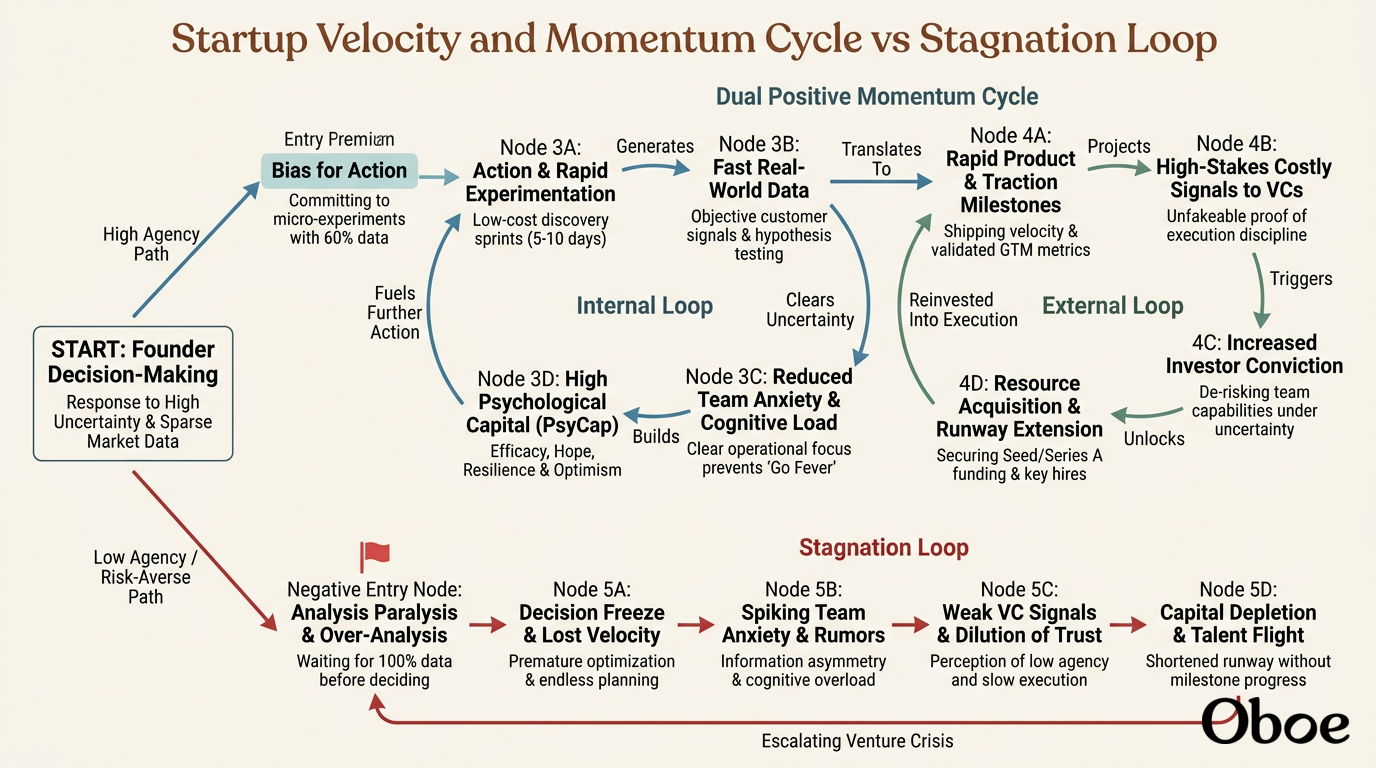
Startup Velocity and Momentum Cycle vs Stagnation LoopDiagram

The upcoming visualization will map out how speed acts as an absolute buffer against founder burnout and investor skepticism.

Now that we have completed our deep dive into the foundational psychological traits of entrepreneurs, are you ready to transition to our next major area: how to translate this internal psychological strength into powerful high-stakes signals that win over venture capitalists?

Continue to the next area: Translating Internal Mindset into Investor Signals

Your path
Founder-Led Sales and B2B Trust Signaling
Integrated Execution across Pitch and Sales
Now that we are transitioning into how to translate your internal psychological traits into powerful, high-stakes external signals, we must examine through the lens of early-stage venture capital. In data-scarce environments like pre-seed and seed stages, investors have virtually no historical financials to analyze. Consequently, they treat you, the founder, as the primary source of risk and opportunity, making your psychological makeup the ultimate they are trying to decode. To build deep investor conviction, you need to understand how to turn your inner agency, resilience, and velocity into visible, unfakeable proof of execution.

Why VCs Evaluate Psychology as a Core Asset

In the early rounds of fundraising, the traditional valuation models used for established enterprises completely break down. When a company is pre-revenue, investors are essentially pricing a hypothesis under extreme uncertainty. In these high-stakes, data-scarce environments, VCs look for specific psychological markers as leading indicators of venture success:
  • The Premium on Psychological Capital: Experienced VCs treat a founding team's collective —their combined hope, self-efficacy, resilience, and optimism—as a highly valuable strategic asset. This psychological reservoir acts as the operational cushion that prevents team collapse during unavoidable market storms.
  • Detecting Costly Signals: Investors actively discount "cheap talk" or polished slides. Instead, they look for —such as your deep domain expertise, personal sacrifices, and highly disciplined operational cadence. These actions are incredibly difficult for low-execution founders to mimic, instantly separating high-potential leaders from the noise.
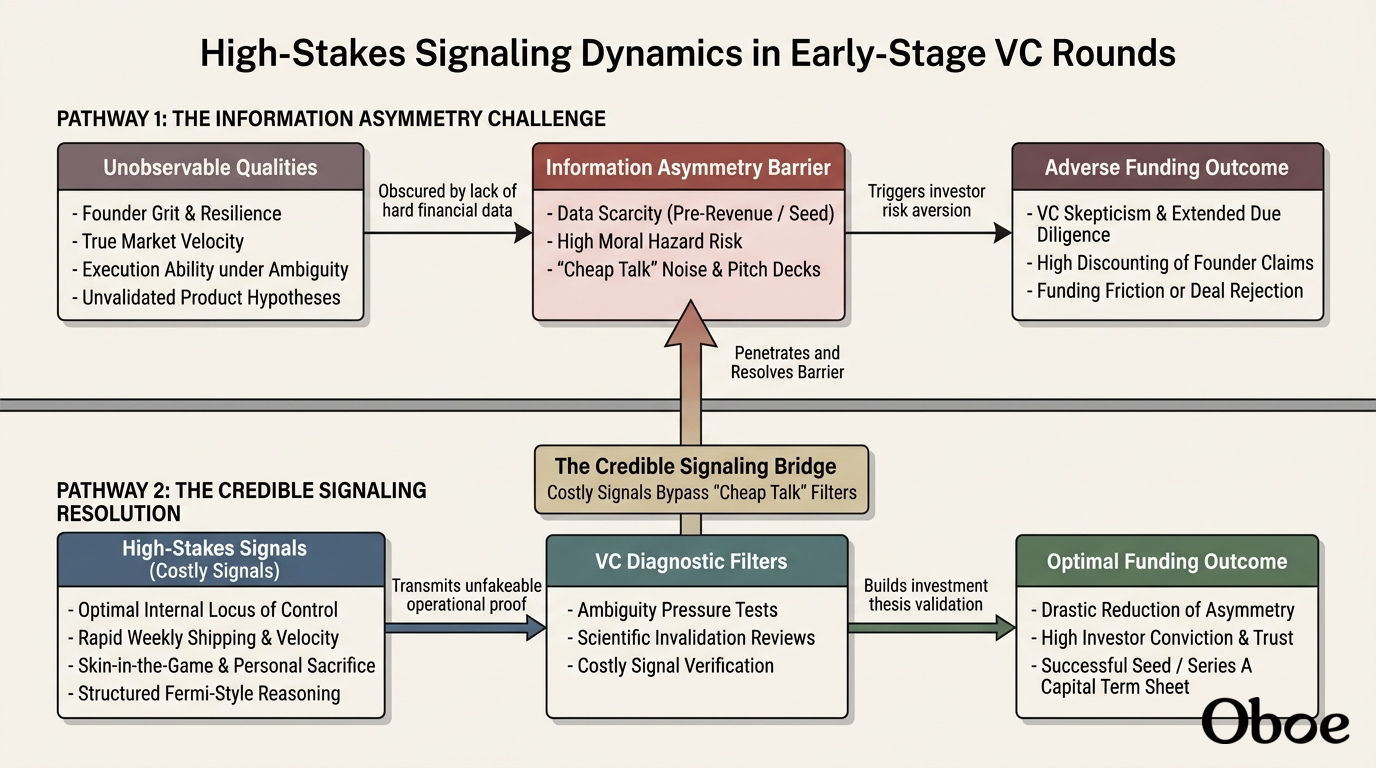
Understanding these signaling dynamics is the secret to reframing how you approach your pitch. Instead of viewing Q&A as an interrogation, you can start treating it as a platform to project optimal internal locus of control and execution velocity. To help you visualize how these signaling dynamics operate in real-time negotiations, I have started generating a conceptual diagram of the investor signaling framework.
High-Stakes Signaling Dynamics in Early-Stage VC RoundsDiagram
The diagram above maps out how structuring your communication around costly, credible indicators helps bypass standard investor defenses and build trust rapidly. Are you ready to dive into how to signal this locus of control and resilience during the actual pitch meeting Q&A, or would you like to explore how to demonstrate your operational velocity through your ongoing investor updates first?

How do I signal locus of control when a VC criticizes my business model?

When an investor criticizes your business model, they are rarely trying to sink your pitch; instead, they are running a diagnostic test to observe your under pressure. Founders with a weak locus of control react defensively or immediately capitulate to the feedback. To project an optimal internal locus of control, you must treat their criticism as a collaborative discovery process, validating their underlying concern while remaining firmly in the driver's seat of your strategic execution.

The Tactical Script for Handling Pitch Criticism

To maintain absolute agency and signal resilience when a VC points out a perceived flaw in your unit economics or market entry, use this three-step communication formula:
  • Acknowledge and Reframe the Risk: Validate their perspective immediately without agreeing that it is an existential block. For example: "That is a fair critique of our early GTM channel, and rising customer acquisition cost is indeed the critical variable we are monitoring."
  • Introduce Your Mitigating Micro-Experiments: Shift from defensive speculation to cold, empirical data. Pivot the conversation to your active validation loops: "To de-risk this exact concern, we ran a last week targeting a highly specific developer cohort, which yielded an initial 18% engagement rate."
  • Reassert Strategic Locus of Control: Wrap up your response by demonstrating that you are actively steering the ship based on objective validation gates rather than blind hope: "If our next sprint fails to maintain that baseline, our pre-committed milestone check triggers an immediate GTM shift to our alternative API partner network."

By applying this framework, you prove to the investor that you do not require a perfect, friction-free environment to make progress.

To help you master this high-agency pivoting technique, I have initiated the generation of an interactive worksheet that walks you through practical Q&A scenarios and teaches you how to handle intense VC objections on the spot.

VC Pitch Q&A Objections: Mastering the Internal Locus of ControlWorksheet

The worksheet above is highly effective for practicing these verbal reframing techniques before you step into your next investor meeting.

Are you ready to test your skills in a quick, interactive Q&A challenge here, or would you prefer to continue to how you can demonstrate this operational velocity to prospective investors over time through a disciplined update cadence?

Give me a pitch objection scenario to practice right now.

Let's put your high-agency reframing skills to the test with a direct VC pitch challenge.

The Challenge: The CAC Critic

During a partner meeting for your seed round, a skeptical investor leans forward, looks at your slides, and says: "Your customer acquisition cost is incredibly high, and honestly, this unit economic model looks completely unsustainable. I don't see how you ever reach profitability with this GTM strategy." To signal an and demonstrate your team's extreme , you need to process this feedback without capitulating or getting defensive. Your goal is to show the investor that you are actively managing this risk through rapid, empirical validation loops.

Which of the following responses best projects an internal locus of control and uses micro-experiments to reframe the VC's unit economics critique?

"You are highlighting the exact critical variable we are tracking. To de-risk this, we just finished a 72-hour outbound campaign targeting a tighter engineering cohort, which cut CAC by 35% on early sign-ups. We have set a hard 14-day validation gate to prove this cohort can sustain our target margins before scaling."

Entrepreneurial Psychology
LV 2
Objection Handling
LV 1
Pitching
LV 1
Skills
You analyzed the high-stakes investor scenario perfectly. By selecting this answer, you demonstrated a superb . Rather than capitulating, you reframed their critique around a highly disciplined, time-boxed micro-experiment that proved a 35% CAC reduction. This shows VCs that you do not panic under pressure; instead, you use structured validation to systematically navigate market friction.

Operational Velocity as a Costly Signal

Now that you have mastered the art of verbal signaling in face-to-face pitch Q&A, we must look at how to sustain this impression over time. The single most powerful way to de-risk investor skepticism during your fundraising process is by demonstrating consistent . In early-stage venture capital, where hard financial data is virtually non-existent, investors use your shipping cadence as a to separate high-execution founders from the noise.
To establish this credibility, you should build a disciplined during your raise. Sending structured updates every two to three weeks—highlighting your pre-committed milestones, active micro-experiments, and rapid customer loops—forces the investor to watch your progress in real-time. By the time they are ready to make an investment decision, they will have objective proof that your team moves at an elite pace.
We have completed our exploration of how to translate your internal psychological traits into high-stakes investor signals. We are now ready to progress to our next major subtopic, where we will examine how founders can leverage these same psychological signaling tools to close early enterprise deals and build deep B2B customer trust.
Your path
Founder-Led Sales and B2B Trust Signaling
Integrated Execution across Pitch and Sales

Continue to Founder-Led Sales and B2B Trust Signaling

Your path
Integrated Execution across Pitch and Sales
Now that we have explored how to project your psychological capital to venture capitalists, we must transition to the ultimate domain of execution: translating this internal resilience into revenue. In early-stage B2B ventures, you cannot rely on slick sales reps or standard scripts to close high-ticket deals. Enterprise buyers are inherently risk-averse, terrified of backing a young company that might go under. To pierce this defense, you must leverage founder-led sales as your primary strategic weapon, converting your personal credibility, passion, and deep domain expertise into an unfakeable signal of long-term commitment.

Why B2B Buyers Trust Founders Over Hired Reps

When an enterprise executive speaks with a hired sales representative, their guard is naturally up; they expect a polished pitch and a push to close. However, when the founder enters the room, the psychological dynamic shifts completely. Your presence acts as a powerful that reduces the buyer's risk perception, making them far more willing to take a chance on an early-stage product for several key reasons:
  • The Authority to Solve Problems: Hired sales reps are bound by rigid playbooks and must constantly defer to "the product team." When you sell as a founder, the buyer knows they are talking directly to the decision-maker who can pivot the roadmap, customize integrations, or personally step in to resolve operational crises.
  • Unmatched Domain Expertise: Your deep problem-centric knowledge allows you to speak to the customer's operational pain points with extreme authority. Instead of pitching features, you can educate the buyer on industry-wide shifts, instantly positioning yourself as a trusted advisor rather than a transaction-oriented vendor.
  • Signaling Long-Term Skin-in-the-Game: By showing up in the trenches yourself, you communicate that you are fully committed to their success. Your reputation and the survival of your venture are on the line, giving the enterprise buyer confidence that you will not abandon them post-implementation.
To help you structure this transition from a product-focused builder to a high-influence executive salesperson, I have initiated an action-oriented document outlining the ultimate Founder-Led Sales Playbook.
B2B Founder-Led Sales Playbook: Closing Your First 10 Enterprise CustomersDocument
This operational blueprint is designed to help you de-risk early customer adoption without wasting time on premature product demos. Now that we have established the unique psychology of founder-led sales, are you ready to learn how to run an 'Anti-Pitch' discovery meeting that uncovers deep pain, or would you prefer to explore how to design low-stakes pilot programs that give buyers skin-in-the-game first?

How do I run an 'Anti-Pitch' discovery session?

Running an requires a complete shift in your psychological approach. Traditional sales reps enter meetings with a deep desire to showcase features, which enterprise buyers immediately read as a transactional hazard. As a founder-advisor, your objective is not to pitch, but to run a highly structured, diagnostic consultation that uncovers the buyer's deep operational pain while establishing absolute .

The Anatomy of a Diagnostic Discovery Session

To execute this successfully, divide your discovery conversation into three distinct, highly intentional operational phases:
  • Ask Deep Diagnostic Pain Questions: Ban all slides and product demos. Instead, ask high-yield questions that explore the direct financial and operational impact of their current bottlenecks. For example: "What is the manual workaround your team uses when your reporting pipeline lags, and how does that delay affect your executive decision-making speed?"
  • Establish Co-Orientation: Mirror their terminology and validate their internal hurdles. Once they outline their challenges, reframe their problems back to them with absolute clarity to prove that you possess unmatched .
  • Formulate a Mutual Commitment Plan: Never end a meeting with "let me know what you think." Instead, propose a low-risk, time-boxed pilot with clear from both sides, shifting the conversation from a sales pitch to a shared operational project.

To make it incredibly easy for you to deploy this communication framework, I have initiated a highly interactive sales simulation game.

B2B Anti-Pitch DiscoveryQuiz

The simulation above is a fantastic way to train your conversational muscles so you can maintain a collaborative, advisor-led dynamic when you are in the room with decision-makers.

Are you ready to test your diagnostic skills in a real-world scenario right now, or would you prefer to explore our strategic playbook for securing corporate commitment plans first?

Give me a scenario to practice running an Anti-Pitch discovery session.

Let's put your diagnostic sales skills to the test with a high-stakes enterprise scenario. To successfully close your first 10 customers, you must completely resist the temptation to run a slide-based product pitch. Instead, treat this meeting as a high-agency, collaborative consulting opportunity to systematically uncover administrative bottlenecks.

Scenario: The Enterprise Security Bottleneck

You are sitting across from the VP of Infrastructure at a Fortune 500 financial services firm. They have agreed to a brief 20-minute meeting because they are struggling with developer onboarding delays. They are highly risk-averse, protective of their data, and instantly skeptical of unproven startup software. They open the call with a classic, protective defensive screen: "Thanks for jumping on. We are quite busy, so why don't you share your screen, show us a quick 10-minute demo of what your software does, and we can go from there?" If you immediately capitulate and show the demo, you fall into the trap, losing all consultative authority. If you stubbornly refuse, you break rapport. How do you respond to reassert an optimal internal locus of control and guide them through a true without losing their interest?

Which response best redirects the VP's demo request into a diagnostic discovery session while establishing your authority as a founder-advisor?

"I would love to show you the platform, but since we have limited time, let's spend 15 minutes discussing your specific onboarding bottlenecks first so I can customize the demo exactly to your infrastructure setup."

Consultative Selling
LV 1
Sales Discovery
LV 1
Skills
An outstanding selection. By choosing Option A, you demonstrated supreme cognitive agility and maintained an under pressure. You did not get defensive, nor did you capitulate to the request for an immediate demo. Instead, you successfully validated their time constraint while firmly maintaining control of the meeting agenda. By framing the discovery questions as a necessary step to customize the eventual software showcase to their unique infrastructure, you transformed a transactional hazard into a collaborative, peer-level consultation.

The Three-Step Anti-Pitch Framework in Practice

To systematically move enterprise buyers from initial skepticism to deep trust, you must guide them through the core phases of the . Now that you have successfully bypassed their initial defensive screen, you can execute the three-step framework in real-time:
  • Step 1: Ask Diagnostic Pain Questions: Focus entirely on uncovering the financial and operational reality of their current workarounds. You want to ask questions that force the VP to quantify the pain of developer onboarding delays.
  • Step 2: Establish Co-Orientation: Mirror their terminology exactly. Reframe their security and access bottlenecks to show you have unmatched , proving you understand their day-to-day friction better than any generic competitor.
  • Step 3: Propose a Mutual Commitment Plan: Never let the meeting end with passive next steps. Instead, propose a low-risk, highly structured pilot program that requires from both sides.

Now that you have mastered these B2B trust signaling techniques, we are ready to progress to our final subtopic, Integrated Execution across Pitch and Sales. Here, we will pull together everything you have learned about managing founder psychology under pressure, combining investor signaling and customer discovery into a unified strategy for venture growth.

Your path
Integrated Execution across Pitch and Sales

Let's step into this final phase of integrated execution.

Continue to Integrated Execution across Pitch and Sales

To tie everything we have explored together, we must recognize that managing high-stakes situations is not just about what you say in a pitch deck or a discovery call; it is about how you protect your own mind. When you are running parallel investor and sales sprints, your founding team's collective is the single most precious asset you own. If you allow your cognitive batteries to drain to zero, your ability to project confidence, process sharp criticism, and make high-agency strategic decisions will degrade instantly.

The Triple-Loop Integration: Alignment in the Trenches

True operational mastery happens when you realize that pitching VCs and running B2B sales are actually the exact same discipline. In both arenas, you are attempting to bridge a severe gap in trust and information. When you master with a skeptical enterprise buyer, you are practicing the precise cognitive agility required to handle a VC's aggressive business model critiques. By treating every customer objection as a diagnostic data point and every investor challenge as a micro-experiment, you reduce your personal and build a highly structured, repeatable execution playbook.

To help you master this high-pressure coordination, I have initiated a comprehensive study guide summarizing our integrated psychological frameworks.

Psychological Signaling GuideStudy Guide

This synthesis serves as an excellent reference to keep on your desk as you prepare for upcoming fundraising rounds and sales pipelines.

Now that we have reached this final milestone, let's put your integrated communication skills to the test. I have designed a highly interactive, double-sided scenario challenge that requires you to manage both an investor conflict and a customer pilot negotiation in immediate succession. Are you ready to dive into this final evaluation?

How do I balance fundraising velocity with sales momentum daily?

Balancing active fundraising sprints with enterprise sales momentum is the ultimate test of a founder's . When you are forced to jump from a high-stakes VC pitch directly into a strategic customer discovery call, your mental bandwidth is pushed to its absolute limit. To prevent systemic burnout and protect your team's collective , you cannot rely on sheer hustle. You must implement a highly disciplined, structured operational rhythm that treats your time as a finite strategic resource.

The Dual-Track Calendar Framework

To manage both tracks simultaneously without letting either stall, top-performing founders abandon chaotic daily multitasking in favor of a structured Dual-Track Calendar:
  • Batching Operational Contexts: Divide your week into dedicated, non-overlapping blocks. For example, reserve Mondays, Wednesdays, and Fridays exclusively for B2B outbound prospecting and . Confine investor follow-ups, deck iterations, and pitch meetings strictly to Tuesdays and Thursdays. This segmentation eliminates the costly setup time of mental context-switching.
  • The 15-Minute Buffer Zone: Never schedule an investor meeting immediately after a customer call. Build a non-negotiable 15-minute buffer between blocks to reset your conversational posture. Use this brief window to actively shift your mindset from an aggressive market-validation posture back into a collaborative, peer-level advisor state.

To help you master this high-pressure coordination in real-world scenarios, I have initiated the generation of an interactive worksheet that walks you through practical, day-to-day scheduling trade-offs and operational boundary-setting.

The Dual-Track Founder Calendar & Context-Switching PlannerWorksheet

The worksheet above is a highly effective tool for auditing your current weekly schedule and protecting your executive focus from being pulled in too many directions.

Are you ready to test your integrated communication and scheduling agility in a real-time, double-sided scenario challenge right here, or would you prefer to explore our strategic playbook for managing high-stress parallel sprints first?

Explain context-switching with an analogy

To master the daily transition between these high-pressure tracks, you must understand that fundraising and selling are structurally opposite conversational modes. Think of your cognitive focus as a that must be deliberately tuned. When you speak to early-stage venture capitalists, you are broadcasting on a high-frequency channel: you are telling a macro-narrative, projecting explosive market opportunity, and selling future milestones. Conversely, when you step into a B2B enterprise discovery room, you must completely mute that broadcast. You must switch to a low-frequency, deep-receiver channel: your job is not to project the future, but to run a quiet, diagnostic consultation, actively listening to uncover granular, administrative friction points.

The Risk of Signal Contamination

When you fail to actively adjust your cognitive receiver, you suffer from , which instantly degrades your trust in the room. If you bring your VC-facing pitch language into an enterprise discovery session, the buyer immediately hears a transactional threat and puts up defensive walls. Conversely, if you bring hyper-detailed, low-level product troubleshooting into a venture partner meeting, the investor assumes you lack the strategic vision to scale the company. Protecting your through rigid, batched scheduling is the only way to keep these signals pure.

How do I protect my calendar from reactive VC schedule changes?

Protecting your calendar from reactive investor rescheduling is not merely an administrative challenge; it is a critical defensive strategy to preserve your team's finite . When you allow venture capitalists to dictate your daily timeline with last-minute adjustments, you inadvertently signal that your operational momentum is subservient to their calendar. To maintain absolute control, you must establish clear, high-agency boundaries that protect your enterprise sales focus while keeping investor pipelines active.

Operational Playbook for Calendar Defense

To prevent reactive scheduling from causing a devastating in your B2B pipelines, you must implement three tactical boundary-setting protocols:
  • Dedicated Investor Emergency Slots: Restrict all investor interactions to pre-defined blocks (e.g., 4:00 PM to 6:00 PM on Tuesdays and Thursdays). If a VC requests an urgent reschedule outside these windows, offer these slots exclusively. This communicates that your primary daylight hours are dedicated to serving active customers.
  • Establish Clear Meeting SLAs: When initiating a fundraising sprint, explicitly outline your communication availability. Let prospective investors know that you operate on a highly structured cadence and require a minimum of 24 to 48 hours' notice for scheduling adjustments.
  • Protect Customer Blocks with Extreme Ownership: Never postpone a scheduled enterprise discovery call to accommodate an investor. Doing so introduces a dangerous where your prospect senses they are secondary to your funding pursuits. If an investor conflict arises, hold the line on the customer meeting and push the VC to your designated buffer window.

To help you navigate these scheduling crises without burning bridges, let's look at how to handle a real-world conflict.

An influential lead investor candidate reschedules a Tuesday partner meeting to 10:00 AM Thursday—the exact time you have a crucial, multi-stakeholder pilot discovery session with a Fortune 500 prospect. How do you respond to protect your sales momentum while keeping the VC warm?