
Oboe
No history yet

Crusoe AI

I have created a learning path to guide our exploration of Crusoe AI, focusing on how they align high-performance computing with clean energy.

Your path
Energy-First Infrastructure & Sustainability
Crusoe Cloud & AI Stack
Large Scale AI Factories

You can easily adjust this learning path at any point if you want to focus on specific areas. To help tailor this session to your background, what brings you to learning about Crusoe AI today, and how familiar are you already with AI cloud infrastructure or clean energy computing?

I'm interviewing for a customer success role.

An interview for a customer success role is an exciting step, and understanding Crusoe's core identity as an is key to standing out. Since they serve highly technical engineering teams who need massive GPU clusters, your role would focus on translating their pioneering infrastructure into seamless client success. Let's look at how Crusoe started and how they evolved to meet this massive demand.

The Pivot: From Flare Gas to AI Infrastructure

Crusoe was founded in 2018 with a mission to solve an environmental problem: natural gas flaring. In remote oil fields, excess natural gas is often burned off (flared) because there are no pipelines to transport it, wasting energy and releasing greenhouse gases. Crusoe developed (DFM) technology, placing mobile data centers directly at the wellheads to capture this stranded gas and convert it into electricity on-site to power high-performance computers. Originally, this cheap, stranded power was used for cryptocurrency mining.
As the generative AI boom erupted, the demand for high-performance computing skyrocketed, creating a massive global shortage of both GPUs and the power to run them. Crusoe pivoted their business model, taking their "energy-first" philosophy and scaling it up to build vertically integrated AI data centers. Today, they are recognized as a leading provider, expanding beyond mobile flare-gas units to massive, gigawatt-scale grid-connected facilities that utilize solar, wind, and geothermal energy to power the next generation of artificial intelligence.
For a customer success manager, this evolution is a powerful talking point. Crusoe isn't just renting out computer chips; they are solving the primary physical bottleneck of the AI era—energy availability. This brings us to their core value proposition for customers. Let's look at why high-profile clients choose Crusoe over traditional cloud hyperscalers like AWS, Azure, or Google Cloud.

Why do major clients like Meta and Oracle choose Crusoe over AWS?

Major clients like Meta and Oracle choose Crusoe over legacy hyperscalers because Crusoe resolves the absolute bottleneck of the modern AI era: raw energy availability. Traditional hyperscalers like AWS were originally architected for general-purpose CPU workloads, such as hosting websites or databases, meaning their data centers and power grids are often poorly suited for the massive, continuous power draw required by high-performance GPU clusters. Crusoe, by contrast, operates with an "energy-first" philosophy, locating and developing massive power resources—including stranded natural gas, wind, solar, and geothermal—specifically to power AI workloads.

The Neocloud Advantage: Speed, Scale, and TCO

While legacy clouds struggle with power grid backlogs and long queue times, Crusoe builds power and computing infrastructure in parallel. This unique capability allows them to bypass traditional grid delays, offering clients rapid speed-to-market. By utilizing low-cost, stranded, or remote energy assets, they also dramatically lower the (TCO) for large-scale training, passing those structural savings directly to clients who would otherwise pay premium commercial grid utility rates at traditional hyperscalers.

To give you a better sense of how massive this infrastructure is, let's look at a diagram showing the scale of their physical footprint.
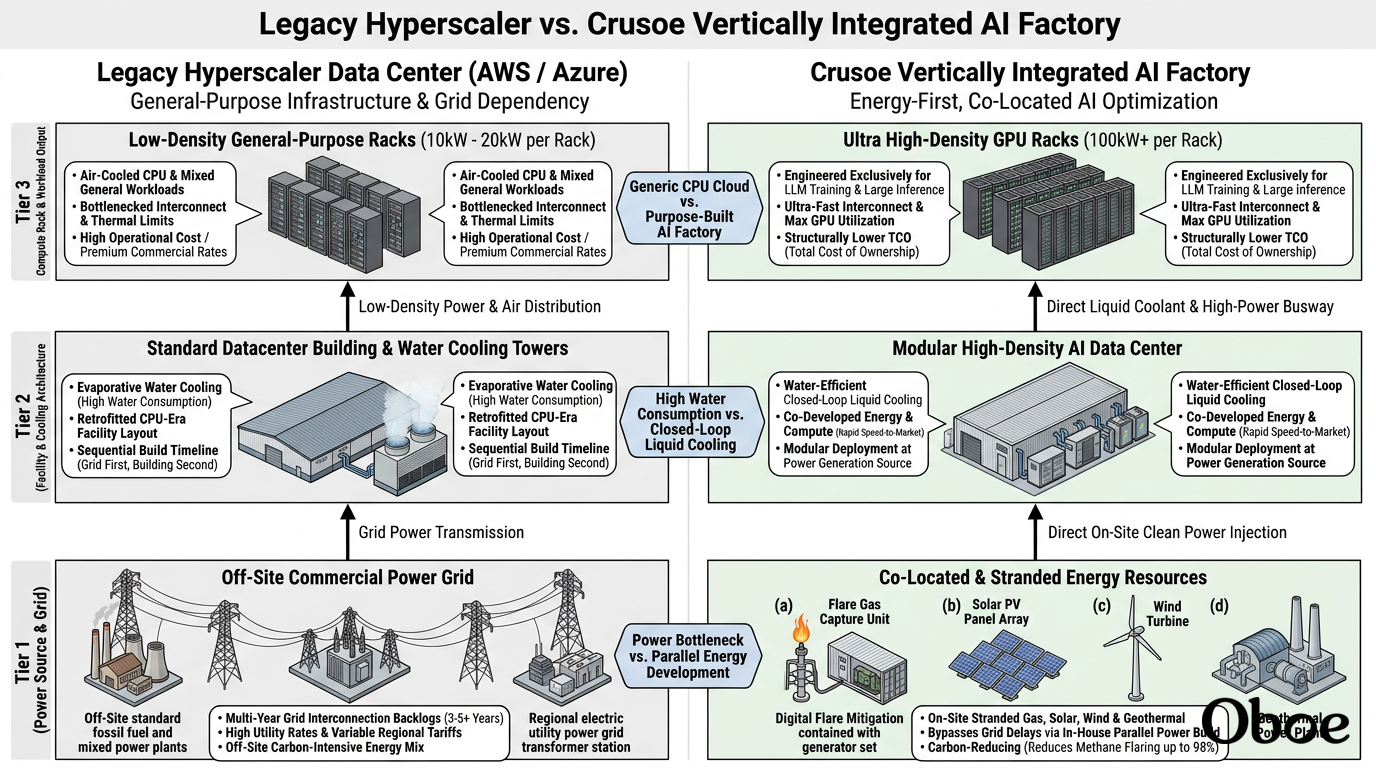
Legacy Hyperscaler vs. Crusoe Vertically Integrated AI FactoryDiagram
As you prepare for your customer success interview, framing this energy-first approach is vital. When talking to engineering teams at startups or enterprises, you aren't just selling virtual machines; you are selling guaranteed power access and rapid deployment at a massive scale that traditional clouds simply cannot match. Let's look at how Crusoe designs its actual data centers to support these massive clusters.

Can you teach me the customer-specific motions? Like, what would it look like in seat?

As a Customer Success Manager (CSM) at Crusoe, you are the strategic champion for highly technical engineering teams who are renting millions of dollars in GPU compute. Your day-to-day "in-seat" motions revolve around three core pillars: seamless technical onboarding of massive GPU clusters, proactive infrastructure health monitoring to maintain strict service level agreements, and driving value-realization during Quarterly Business Reviews.

1. Technical Onboarding & Developer Workflows

Unlike legacy clouds where customers self-serve with simple virtual machines, Crusoe clients are deploying complex workloads. Your first motion is partnering with their ML platform engineers to map their architecture to the right orchestration environment. Depending on their workflow, you will guide them to use (CMK) for containerized microservices and inference, or for massive, multi-node training runs.
For developers who want to avoid managing infrastructure altogether, you will introduce them to the . Here, they can utilize Serverless Inference and Serverless Fine-Tuning. This allows them to quickly run low-overhead, LoRA-based supervised training runs without having to manually provision and scale dedicated GPU nodes.

2. High-Touch Support & Crisis Management

At this scale, hardware failures are not a matter of if, but when. A single failing InfiniBand cable or a degraded GPU memory module can interrupt a multi-node training job, costing the customer thousands of dollars in idle time. Crusoe's commitment to reliability is legendary—promising a 99.5% cluster uptime and backed by a 24/7 enterprise support team that averages a sub-6-minute first response time.
In seat, your motion during a node failure is highly proactive. Rather than waiting for the client to open a ticket, your system monitoring alerts you immediately. You coordinate with the data center operations and engineering teams to isolate the faulty node, migrate the customer's active checkpoint to healthy hardware, and initiate automatic node replacement via Crusoe AutoClusters—all while keeping the client updated in real-time to preserve our 100% CSAT rating.

3. The QBR: Quantifying Economic & Environmental Value

The ultimate retention motion for a Crusoe CSM is the Quarterly Business Review (QBR). Traditional cloud CSMs focus primarily on credits and virtual machine uptime. At Crusoe, you build a narrative around physical efficiency, economic savings, and climate alignment. You will pull metrics demonstrating how our parallel power development and stranded energy assets reduced their total cost of ownership compared to legacy clouds, while showing the exact metric tons of carbon emissions avoided by running their workloads on our green, energy-first infrastructure.

To prepare for your interview, would you like to run a mock scenario of how to handle a major GPU cluster outage, or should we look at how to structure a winning QBR presentation?

Show me how to structure a Crusoe QBR.

To ace your interview, structuring a Crusoe Quarterly Business Review (QBR) requires moving away from the generic "cloud consumption" slides of legacy hyperscalers. Instead, you must deliver a highly tailored presentation that highlights Crusoe's unique physical and structural strengths.

Crusoe Customer Success: Quarterly Business Review (QBR) Presentation Guide and TemplateDocument

I have drafted a comprehensive QBR presentation framework for you. This document acts as a strategic blueprint that you can use during your interview to show the hiring team exactly how you would drive retention and expansion.

Driving Technical & Economic Alignment

As a CSM, you will use the economic section of the QBR to prove that the customer's engineering team is getting maximum value out of their allocated hardware. By showcasing high GPU utilization rates facilitated by , you help them squeeze every ounce of performance out of their contract, which directly lowers their overall .

The Sustainability Advantage

The green ledger in our QBR is one of Crusoe's strongest differentiators. While legacy clouds rely on carbon offsets or green energy certificates to claim sustainability, Crusoe CSMs present actual physical mitigation metrics. You will quantify the direct reduction in greenhouse gases achieved by running their compute on or dedicated that physically run on diverted flare gas, solar, and wind.