Look back time and cosmic light cone diagram
Welcome! I am excited to explore how space and time intertwine with you, especially through the mind-bending lens of light cones.
Before we dive into how looking out into the night sky is literally a form of time travel, I'd love to know a bit about what brings you here today.
It's a personal hobby and I love learning about space
I am thrilled to have you here! Exploring the universe as a hobby is incredibly rewarding, especially because the night sky is literally a giant, sparkling history book. Every time we look up at the stars, we are not seeing them as they are right now—we are looking back in time.
The Cosmic Speed Limit
Continue to how distance relates to lookback time
To see exactly how distance and lookback time lock steps together, let's look at the simple math that connects them.
Can you show me diagrams and charts to explain this concept
I would love to! Visualizing these concepts is where the magic really happens, because our brains aren't naturally built to process four-dimensional spacetime without a good picture.
Mapping Spacetime

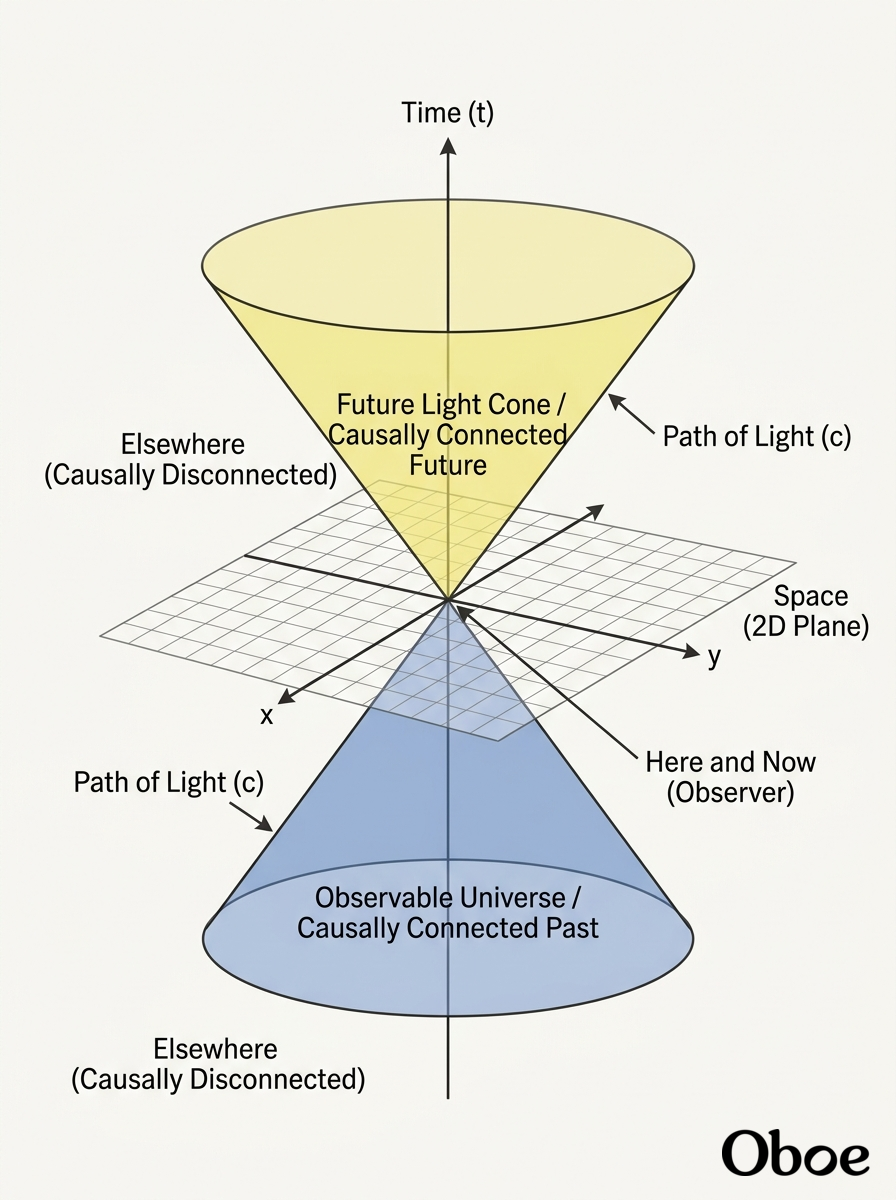
Lookback time and cosmic light cone diagram
It is fascinating to think about, isn't it? By looking at how these two ideas connect, we can see exactly why there is a hard limit to what we can ever observe in our universe, no matter how powerful our telescopes become.
The Edge of the Observable Universe
This means everything we see in the cosmos is a snapshot captured at a unique intersection of distance and history along the edge of our past light cone.
Now that we have established how lookback time defines the boundaries of our observable bubble, we are ready to explore the geometry of light cones in more detail, starting with how they map out the difference between our past, our future, and the regions of spacetime we can never reach.
Cosmic light travel
Let's take a closer look at the other half of that hourglass shape we saw in the diagram: your future light cone. Just as the past light cone maps everything that has already happened to send light to your present moment, the future light cone represents everywhere you could potentially go, and every point in spacetime you could ever hope to influence.
Your Reach in Spacetime
If you turn a flashlight on right now, the photons you release will begin to spread outward from Earth, traveling at the speed of light (). In our diagram, this expanding sphere of outbound light traces the surface of your future light cone.
Because nothing with mass can travel faster than light, your own physical path through the future—your —is strictly trapped. You can never travel fast enough to escape the boundaries of this upper cone. If you want to travel to a distant star system to build a colony, or send a radio message to a future generation, those targeted events must lie entirely inside your future light cone.
This geometry divides the universe into three distinct regions:
-
The Past Light Cone: Everything that can possibly affect you right now.
-
The Future Light Cone: Everything you can possibly affect in the future.
-
Elsewhere: The vast regions of spacetime outside both cones. Because physical signals cannot travel faster than light, these regions are from you. An event happening in 'Elsewhere' right now cannot affect you, and you cannot affect it. You are completely isolated from each other.
Ultimately, this means we each live inside our own personal, moving 'light cone bubble' that constantly determines what we can see, what we can reach, and what is forever locked away from us in the deep silence of space.
Please show me diagrams and charts
Here is an interactive visualization of how these regions divide up spacetime around you.
A Minkowski spacetime diagram showing the past and future light cones meeting at a central point.
I have created an interactive coordinate chart to help map these boundary zones.
If you look at the flat space on the left and right—the areas labeled Elsewhere—these represent events that are too far away for light to bridge the gap. For instance, if a star in a galaxy 15 billion light-years away goes right now, that explosion is completely isolated from our "Here and Now." It cannot affect us, and we cannot see it, because its signal is still rushing toward our future bubble.
Now that you can see how light cones divide up our reality, how do you feel about these concepts? We can wrap up our journey by looking at how cosmic expansion stretches these boundaries, or we can test your knowledge with a fun, custom quiz!