
Help me prep for this interview https://www.linkedin.com/jobs/view/4443970967/?trackingId=lvvHwvqSTUy4zm95oiC7Nw%3D%3D
I'd love to help you prep for this role! Bayer's Viluco plant in Chile is a key site, and we'll make sure you're completely ready to stand out in this interview.
I am new to agriculture but have experience in general production/equipment maintenance
That general production and equipment maintenance background is actually a massive asset for this role! Even though you are new to agriculture, your hands-on experience with equipment, troubleshooting, and keeping systems running smoothly translates perfectly to operating a line.
Before we dive into the core responsibilities at the Viluco plant, let's nail down your logistics. When is your interview scheduled?
It's in a couple of days
A couple of days is the perfect amount of time to get locked in and confident. Since you already have experience keeping production equipment running smoothly, you have a huge head start on the mechanical side—we just need to frame it for agricultural processing.

The Journey from Raw Crop to Premium Seed
What kind of cleaning and sorting machines do they actually use?
That is exactly the right question to ask. Since you already have experience with equipment maintenance, you will find that these machines rely on the same fundamental physical principles you are used to, just applied to sorting biological material.
The Four Pillars of Seed Conditioning
- : This is usually the first stop. It uses a combination of airflow and vibrating screens. The air blows away light dust, chaff, and empty seeds, while the screens have specific perforations to let the right-sized seeds fall through while keeping large sticks or tiny weed seeds out.
- Gravity Tables: These are highly sensitive vibrating decks tilted at an angle, with air blowing upward through them. Because of the air and vibration, the seeds behave almost like a fluid. The heavier, high-quality seeds settle to the bottom of the deck and move to the high side, while lighter, insect-damaged seeds or weed seeds float to the top and slide down to the reject discharge.
- : Also known as indent cylinders, these are large, rotating horizontal drums with thousands of tiny pocket-like indents on the inside surface. Shorter, broken seeds fit snugly into the indents and get lifted to the top of the rotation where they drop into a capture trough, while the prime, longer seeds stay in the bottom of the cylinder to slide out the end.
- Color/Optical Sorters: The most high-tech of the bunch. These machines drop seeds in a rapid, single-file stream past high-speed cameras. If a seed doesn't match the exact color profile of a healthy seed, a ultra-fast blast of compressed air physically shoots the bad seed out of the stream in mid-air.
To help you visualize how these machines work in sequence to isolate the perfect seeds, I can generate a quick structural flow diagram.
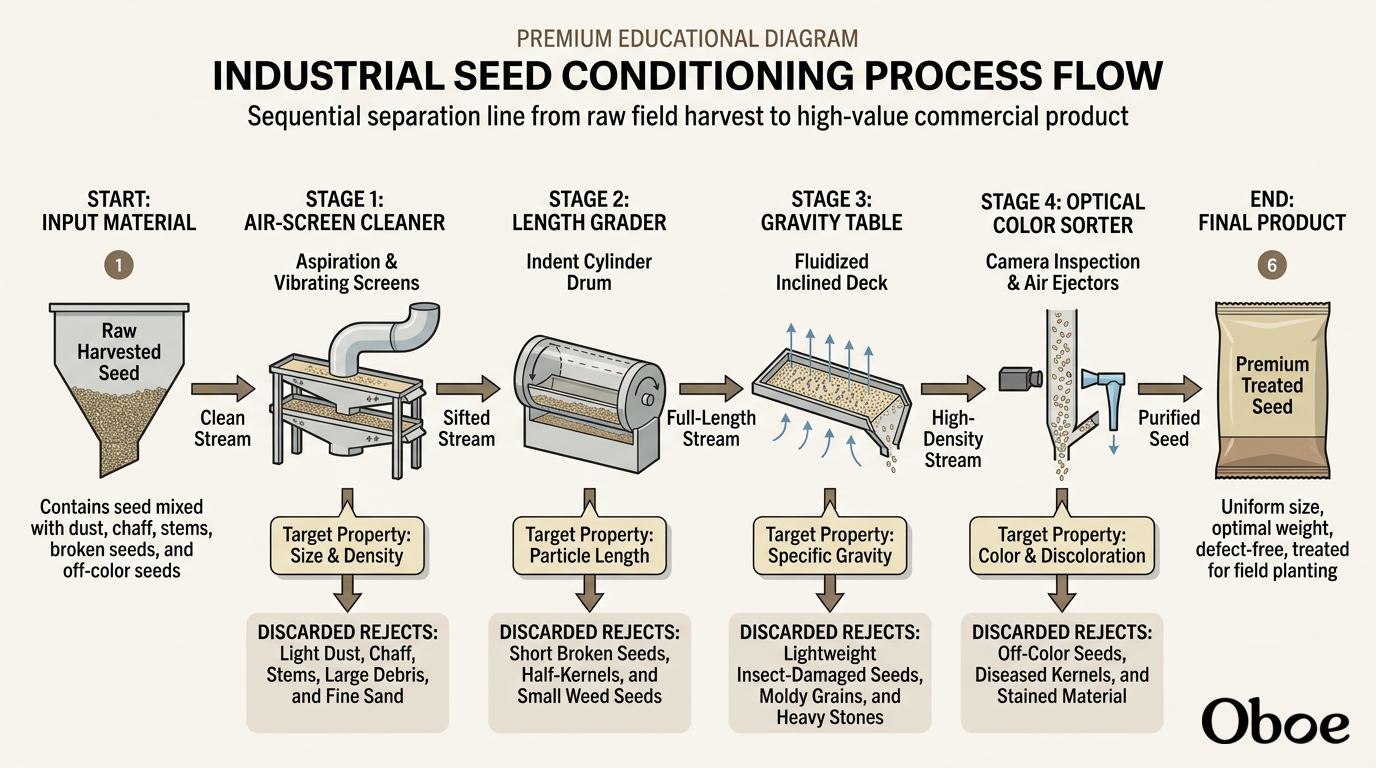
With your background in maintenance, an interviewer will love to hear how you would prevent downtime on these machines—like checking for screen wear, calibrating air damper actuators, or cleaning optical camera lenses.
Which of these four machine types makes the most sense to you based on your previous industrial experience?
Let's continue to connecting equipment maintenance concepts to these machines.
Connecting your previous maintenance experience directly to these seed conditioning machines is the absolute best way to show the interviewer that you can hit the ground running. Since you already know how to keep industrial systems online, you don't need to learn a whole new trade; you just need to apply your existing troubleshooting skills to a biological product.
Translating Maintenance to Seed Conditioning
An interviewer at Bayer Viluco will likely ask how you handle preventive maintenance or minimize . The key is showing that you understand where these specific machines are vulnerable to wear and how a failure impacts seed quality.
| Machine Type | Key Maintenance Checkpoint | Why It Matters for Quality / Safety |
|---|---|---|
| Air-Screen Cleaner | Screen integrity & eccentric bearing lubrication | Torn screens let large debris pass; failed bearings cause uneven shaking. |
| Gravity Table | Air deck fabric wear & deck fan filter cleaning | Friction changes disrupt the fluid-like bed; clogged filters cause bad density separation. |
| Length Grader | Indent wear & internal trough alignment | Worn indents fail to lift broken seeds; poor alignment rejects high-value seed. |
| Optical Sorter | Air ejector solenoid response & camera lens dust | Sticky valves miss off-color seeds; dusty lenses cause false rejects. |
Let's look at a concrete example. On a gravity table, the deck is tilted and vibrates while air blows up from underneath. If the fabric on the deck starts to fray or get smooth, the seeds won't grip the surface correctly. This tiny mechanical wear completely ruins the density separation, meaning bad seeds will end up in the premium stream.
When an interviewer asks you about a time you solved a mechanical problem, you can use this table to show how you would monitor these critical wear areas proactively.
To show the interviewer you can adapt quickly, it's highly effective to walk them through your personal diagnostic checklist. For instance, if you noticed a sudden drop in output quality on an air-screen cleaner, what mechanical components would you check first?